
Reviews · Sheet 43-H2G2 · Odeon Leicester Square · Wednesday 20 April 2005
Don't Panic.
In April 2005 I queued from before dawn for the world premiere of The Hitchhiker's Guide to the Galaxy at the Odeon Leicester Square. This is the whole day, from the early-morning barrier to the after-party and the quiet Tube home, and then the premiere programme they handed every one of us, recovered and reproduced in full.
- Filed under
- Reviews · Events
- Reference
- REF 43-H2G2
- The night
- 20 April 2005 · Odeon Leicester Square
- By
- Seamus Waldron
The queue
Pre-dawn into Leicester Square, and the wait that followed
The day started absurdly early. To get a decent spot for the premiere, you had to arrive at Leicester Square before the barriers went up. This meant a pre-dawn journey into central London.
The Tube was nearly empty at that hour. A few other early risers with that particular look of determined fandom shared the carriage. We all knew where we were going.
Leicester Square was already showing signs of preparation when I arrived. Barriers were being erected, red carpet being rolled out, and security teams were doing their morning briefings. The queue formed quickly. By 8am there were already several dozen people waiting. The atmosphere was relaxed and friendly, this was a Douglas Adams crowd, after all. Someone had brought a towel, naturally. Conversations ranged from favourite quotes to anxious speculation about whether the film would do the books justice.
The wait
By mid-morning the queue had grown considerably. What had been a handful of dedicated fans was now a proper crowd stretching along the north side of Leicester Square and curling around towards the Hippodrome. The atmosphere was extraordinary: part music festival, part convention, part national celebration of something deeply, wonderfully nerdy.
A group near the front had come in full costume. One lad had fashioned a remarkably convincing Marvin the Paranoid Android head from papier-mache and spray paint. He stood there looking suitably despondent, which was either excellent method acting or the natural consequence of wearing a heavy papier-mache head in the April drizzle. A woman further back wore a dressing gown and carried a towel draped over one arm with studied nonchalance, as if she might need to hitchhike across the galaxy at any moment.
Entertainment in the queue
Someone had brought a portable radio tuned to the original BBC radio series, and small clusters of people kept gravitating towards it, nodding along to familiar passages. There is something peculiar about standing in a London square listening to the demolition of Earth for the purposes of a hyperspace bypass while simultaneously queuing to watch that same event rendered in Hollywood-grade visual effects.
Conversations with strangers came easily. Everyone had their own Hitchhiker's story: the dog-eared paperback discovered at thirteen, the radio series taped off the BBC, the text adventure game that consumed an entire summer holiday. A man behind me had driven down from Edinburgh overnight. A couple next to him had flown in from Amsterdam. Douglas Adams, it seemed, had built something that transcended borders and common sense in equal measure.
The waiting was punctuated by periodic surges of excitement as vehicles arrived and barriers were adjusted. Each time, the crowd would crane forward, phones and cameras at the ready, before settling back when it turned out to be another catering van or a lost taxi driver looking bewildered at finding themselves in the middle of a film premiere.
The red carpet
Late afternoon, the cars arrive, and the stars come out
Late afternoon brought the transformation. Leicester Square shifted from a place of patient waiting into something electric. The red carpet, that peculiar strip of fabric that separates the famous from everyone else, was now flanked by photographers, television crews, and an increasingly vocal crowd. Spotlights were being tested, swinging across the square in wide arcs that caught the faces of people pressing against the barriers.
The first cars began arriving around five o'clock. The crowd surged forward with each new vehicle, a wave of anticipation that rippled from the front all the way back to where I was standing. You could tell who was arriving by the volume of the reaction: a polite murmur for producers and executives, a louder cheer for recognisable faces, and then something approaching a roar when the principal cast began to appear.
The crowd comes alive
There was a wonderful moment when the Vogon costumes from the film were brought out for display near the entrance. They were extraordinary up close: massive, rubbery, deeply unpleasant to look at, which was of course entirely the point. Children pressed their faces to the barriers to get a better view while their parents tried to explain that the alien bureaucrats were meant to be ugly. One small boy declared loudly that they looked like his headmaster, which earned a round of appreciative laughter from nearby adults.
The press photographers were a show in themselves. A wall of them lined the carpet, their cameras producing a constant percussive rattle whenever anyone of note paused to pose. They shouted names, directions, requests, "Over here!", "This way!", "Give us a smile!", with the practised urgency of people who do this every night and have grown immune to glamour. Between arrivals they chatted amongst themselves, checked their equipment, and looked profoundly bored, which seemed entirely appropriate for a Hitchhiker's event.
Meeting the cast
Martin Freeman arrived looking exactly as you would hope Arthur Dent would look: slightly bewildered, pleasantly ordinary, and as though he might prefer to be somewhere quieter having a cup of tea. He worked the crowd with genuine warmth, signing autographs and posing for photographs with the patient good humour of someone who understood that these fans were the reason the film existed at all. When he reached our section of the barrier, he chatted briefly about the pressure of playing such a beloved character, shrugged in that distinctive Freeman way, and said something about just trying not to mess it up.
Sam Rockwell was a different energy entirely. He bounded along the red carpet with the manic enthusiasm that would serve his portrayal of Zaphod Beeblebrox so well. He high-fived fans, mugged for cameras, and generally behaved as though attending your own film premiere was the most fun a person could legally have. His enthusiasm was infectious, even the photographers, those hardened professionals, seemed to perk up when he appeared.
Zooey Deschanel drew enormous cheers as Trillian. She moved along the barriers with a quiet grace that contrasted nicely with Rockwell's exuberance, stopping frequently to speak to fans. Mos Def, cast as Ford Prefect, arrived to genuine excitement from the crowd and seemed pleasantly surprised by the warmth of the British reception. He later admitted in an interview that he had underestimated just how much the books meant to people in the UK.
Bill Nighy generated perhaps the loudest cheer of all, a proper, full-throated British roar of approval. He was playing Slartibartfast, the planetary designer, and the crowd seemed to collectively recognise that this was casting of rare perfection. Nighy responded to the adulation with characteristic self-deprecation, waving as though slightly embarrassed by the whole thing and making jokes that only the people nearest to him could hear.
There was also Garth Jennings, the director, who looked both thrilled and terrified in equal measure, which seemed about right for someone who had been handed the responsibility of bringing Douglas Adams's most famous work to the screen. He paused to talk to fans about the production, and you could see in his eyes the genuine love he had for the source material.
The screening
Inside the Odeon, the lights go down, and the Guide speaks
Entering the Odeon Leicester Square for a premiere is a peculiar experience. The building itself is enormous, one of the great old picture palaces, and on a night like this it seemed to hum with a particular energy. The foyer was crowded with people finding their seats, clutching programmes, and exchanging the kind of excited, slightly nervous chatter that accompanies any event where years of anticipation are about to collide with reality.
We found our seats in the upper circle. The auditorium was vast and ornate, all red velvet and gilt, and it was filling rapidly. Below us the stalls were a sea of heads, and I could pick out several of the cast settling into reserved seats near the front. There is something wonderfully surreal about watching the actors who are about to appear on screen sitting in the same room as you, eating popcorn like ordinary mortals.
The screening begins
The lights dimmed. A hush fell, not gradually but all at once, as though someone had pressed a mute button on a thousand conversations. Then the familiar voice of Stephen Fry began to speak, narrating the Guide's entry on Earth, and the audience collectively held its breath. This was it. After decades of false starts, abandoned scripts, and Hollywood development hell, the Hitchhiker's Guide to the Galaxy was finally a film.
The opening sequence, the dolphins departing Earth to the tune of "So Long, and Thanks for All the Fish", drew an enormous, delighted laugh. It was a statement of intent: this film was going to be fun, it was going to be irreverent, and it was going to take the source material and do something joyfully cinematic with it. The tension in the room noticeably eased. People settled into their seats. Whatever this film was going to be, it was at least going to try.
Around me, I could sense the audience calibrating. Every line of dialogue was being weighed against memory, every visual choice assessed against decades of personal imagination. It was, I realised, an almost impossible task the filmmakers had set themselves: not just to make a good film, but to make a film that could somehow satisfy a million private versions of the same story.
First impressions
The laughter came in waves. Some of it was the spontaneous, surprised kind, the film throwing in visual gags and new material that caught even the most devoted fans off guard. The Infinite Improbability Drive sequence, which turned the entire crew into knitted yarn versions of themselves, produced a reaction somewhere between delight and bewilderment. It was exactly the sort of absurdist invention that Adams himself would have loved.
Other laughs were the warm, recognitional sort, the audience responding to beloved lines delivered in new voices. "Time is an illusion. Lunchtime doubly so." drew an appreciative rumble. The destruction of Earth, narrated by Stephen Fry with perfect deadpan authority, produced that peculiar combination of laughter and sadness that Adams specialised in.
Watching a film at its premiere is a completely different experience from watching it in an ordinary cinema. The audience was not passive, they were participants, reacting collectively to every scene with an intensity that amplified the experience enormously. A joke that might raise a smile at home produced genuine belly laughs here, carried on the momentum of shared anticipation.
There were quieter moments too. When Marvin, voiced by Alan Rickman with devastating melancholy, delivered his lines about being a manically depressed robot, the laughter had a bittersweet edge. Rickman found something genuinely poignant in the character, something that went beyond comedy into the realm of existential sadness that was always lurking beneath Adams's humour. I noticed people around me leaning forward during the Magrathea sequences, drinking in the visual realisation of a world they had built in their imaginations years ago. For the first time, we were seeing the Hitchhiker's universe with our eyes rather than just our minds, and the effect was genuinely moving.
The after-party
Pan Galactic Gargle Blasters and a doleful Marvin by the bar
The credits rolled to sustained applause, not the polite, obligatory kind, but genuine, enthusiastic clapping that went on long enough to become slightly self-conscious. People stood. Not everyone, but enough that it felt like a real ovation. Then the house lights came up and a thousand people began the slow, chattering exodus into the London night, blinking and buzzing with the particular energy of people who have just shared something significant.
The after-party was held at a venue near the square, one of those improbably large London spaces that seem to exist solely for events like this. The room had been dressed with Hitchhiker's themed decorations: towels folded into napkin shapes on every table, cocktails with names like "Pan Galactic Gargle Blaster" served in improbable glassware, and somewhere in the corner, a full-sized replica of Marvin looking doleful next to the bar.
Mingling with the galaxy
The atmosphere was celebratory but tinged with that particular post-screening uncertainty where nobody quite wants to be the first to offer a definitive opinion. Conversations circled carefully around phrases like "visually stunning" and "really captured the spirit" and "what did you think of the ending?", each person testing the waters before committing to a verdict.
I found myself in a loose group that included several people from the queue earlier in the day. The man from Edinburgh was there, now several Pan Galactic Gargle Blasters into the evening and becoming increasingly philosophical about the nature of adaptation. The Dutch couple had somehow acquired matching "Don't Panic" badges and were photographing everything with the systematic thoroughness of people documenting a historic occasion.
Across the room, members of the cast moved through the crowd. There was something pleasantly informal about the whole affair, this was not a velvet-rope, VIP-section kind of party. It felt more like a gathering of people who all belonged to the same slightly eccentric club, brought together by a shared affection for a man who wrote about the absurdity of existence and somehow made it hilarious.
The verdict
So was it any good? The honest answer, and the book it came from
So was it any good? That was the question everyone was asking, and the answer, as with most things connected to Douglas Adams, was complicated. The film was not the book. It was not the radio series. It was not the television series. It was something else entirely, and whether you considered that a triumph or a tragedy depended largely on what you had come expecting.
What the film did well was capture the scale and visual absurdity of the Hitchhiker's universe. The Heart of Gold was magnificent. Magrathea was rendered with real grandeur. The Vogons were repulsive in exactly the right way. And the Guide entries themselves, animated sequences that popped up to explain concepts like the Babel fish or the Infinite Improbability Drive, were genuinely inventive, bringing a graphic design sensibility to Adams's ideas that felt fresh and appropriate.
Where it soared and stumbled
The casting was largely superb. Freeman's Arthur was perfect, the quintessential bewildered Englishman, out of his depth and desperate for tea. Rockwell's Zaphod was divisive but undeniably energetic. And Alan Rickman's voice work as Marvin was a masterclass in comic depression, finding new depths of despair in every line that somehow made the robot more human than the humans around him.
Where the film faltered was in its pacing. Adams's humour is discursive, it wanders, it digresses, it takes the scenic route to its punchlines. Cinema demands momentum and narrative drive, and the film sometimes struggled to reconcile these competing demands. The romantic subplot between Arthur and Trillian, expanded from the books to give the film a conventional emotional arc, felt forced in places. Adams's characters were never really about romance; they were about the comedy of existence.
But these were quibbles, honestly. Sitting in the Odeon that night, watching the film with an audience that loved the source material as much as I did, the overwhelming feeling was gratitude. Someone had finally made the film, and they had made it with love and intelligence and a genuine understanding of what made Adams's work special. It was not perfect. But it was real, and it was here, and that was enough.
The book versus the film
Every adaptation of a beloved book faces the same fundamental problem: the reader's imagination is the greatest special effects department ever created, and no film can compete with it. When you read about Magrathea, you build it in your mind from Adams's words, and what you build is perfect because it is yours. A film has to pick one version of Magrathea and commit to it, and for every person who thinks "yes, that's exactly right", there will be another who feels a quiet pang of disappointment.
The 2005 film made deliberate choices about what to keep, what to change, and what to invent entirely. The Vogon planet Vogsphere was new, a bureaucratic hellscape where paddling hands rose from the ground to slap anyone who had an idea. It was funny, it was visual, and it was entirely in the spirit of Adams, even if it was not in the books. This was perhaps the film's greatest strength: it understood that fidelity to the letter of the text was less important than fidelity to its spirit.
Adams the adapter
It is worth remembering that Adams himself was the most prolific adapter of his own work. The radio series became a novel, which became a television series, which became a stage show, a computer game, and a towel. Each version was different. Characters changed, plots diverged, entire sequences were invented or discarded. Adams openly said that he saw each new version as an opportunity to get things right that he had got wrong before, or simply to try something new because the original approach bored him.
The film continued this tradition. Adams had worked on the screenplay before his death in 2001, and many of the changes, including the Humma Kavula subplot and the expanded romance, originated with him. This did not stop fans from objecting to them, of course. There is a particular kind of literary purist who will forgive an author anything but will condemn an adaptation for the smallest deviation, as though the printed word were sacred text rather than one iteration of an endlessly evolving story.
The truth was that the film got more right than it got wrong. It preserved the fundamental qualities that made the Hitchhiker's Guide special: the wit, the absurdity, the underlying philosophical melancholy, and above all the sense that the universe is vast, incomprehensible, and frequently very funny. That it did so while also being a coherent, entertaining film was an achievement that deserved more credit than it initially received.
Douglas Adams
The absence in the room, four years too early
The elephant in the room, or rather the absence in the room, was Douglas Adams himself. He had died on 11 May 2001, four years before the premiere, of a heart attack at the age of forty-nine. He had spent nearly two decades trying to get a Hitchhiker's film made, and he never saw it happen. The cruelty of this timing hung over the evening like a shadow that nobody quite wanted to acknowledge directly but everyone felt.
The film was dedicated to him, naturally. His name appeared in the credits as a screenwriter, because substantial portions of the script were his work, written during those long years of development. But dedication and credit are poor substitutes for presence. He should have been there, tall and slightly awkward and probably making self-deprecating jokes about how long it had taken. He should have been the one walking the red carpet, looking bewildered and delighted in equal measure.
The man who saw the universe clearly
Adams was that rarest of things: a genuinely original thinker who also happened to be very, very funny. He saw connections between things that other people missed, between technology and philosophy, between science and comedy, between the very large and the very small. He wrote about the destruction of Earth with the same cheerful precision that he brought to describing a cup of tea, and both felt equally important and equally absurd.
He was also, by all accounts, a man of enormous warmth and generosity. The stories told about him at events like this always came back to his kindness, his willingness to spend time with fans, his enthusiasm for other people's ideas, his habit of buying enormous rounds of drinks and then forgetting his wallet. He was six foot five and seemed to fill whatever room he was in, not just physically but with the force of his personality and his relentless, delighted curiosity about the world.
Standing in Leicester Square that evening, surrounded by people who had come to celebrate something he created, it was impossible not to feel the weight of his absence. The film existed because of him. The crowd existed because of him. The towels, the quotes, the shared language of an entire generation of readers and listeners, all of it traced back to a man sitting in a field in Innsbruck in 1971, looking up at the stars and wondering what would happen if someone wrote a hitchhiker's guide to the whole thing.
The legacy
A radio series in 1978, and everything it has become since
The Hitchhiker's Guide to the Galaxy began as a radio series on BBC Radio 4 in 1978. From that modest beginning it grew into something that defies easy categorisation: part science fiction, part philosophy, part comedy, part cultural phenomenon. It became a series of novels, a television series, a stage show, a computer game, a comic book, a set of towels, and eventually a Hollywood film. No other work of British humour has been so thoroughly adapted across so many media.
What makes this legacy remarkable is not just its breadth but its consistency of quality. Adams brought something genuinely new to each version. The radio series had an intimacy and inventiveness that the novels could not quite replicate. The novels had a depth and precision of language that the radio could only hint at. The television series had visual gags that existed nowhere else. And the film, for all its compromises, brought a scale and ambition that the other versions could not have attempted.
Across every medium
The computer game, released by Infocom in 1984, deserves particular mention. Designed by Adams and Steve Meretzky, it was a text adventure of fiendish difficulty and sardonic wit. It required the player to do things that no reasonable person would think of, feeding a cheese sandwich to a small dog, for instance, or removing their own common sense. It was, in many ways, the purest expression of Adams's sensibility: a universe that operated on its own mad logic and punished conventional thinking at every turn.
The stage show toured various productions over the years, each one different, each one finding new ways to realise the impossible on a theatre stage. How do you depict the destruction of Earth in a live performance? How do you show the Heart of Gold? The answer, invariably, was with imagination, cardboard, and a willingness to embrace the absurd, which was, when you thought about it, exactly how Adams would have wanted it.
Standing at the premiere, I was struck by the thought that this film was just the latest iteration of a story that had been told and retold for nearly thirty years, and that would almost certainly continue to be told for decades to come. The Hitchhiker's Guide was not just a book or a radio series or a film. It was an idea, a way of looking at the universe, and ideas, unlike their creators, have the potential to be immortal.
Epilogue
The last Tube home, and what stayed with me
The journey home was quiet. The Tube had that late-night feeling: sparse passengers, the faint hum of the rails, the occasional lurch as the train navigated a curve. I sat with my programme on my lap and my thoughts circling back over the day. It had been nearly eighteen hours since I had left home that morning, and I was exhausted in the particular way that comes from sustained excitement rather than physical effort.
Outside the carriage windows, London slid past in fragments: lit windows, empty streets, the occasional night bus. It occurred to me that somewhere out there, in other Tube carriages and on other buses, hundreds of other people were making the same journey home from the same event, each carrying their own version of the evening. We had all seen the same film, stood in the same crowd, shared the same experience, and yet each of us would remember it differently.
Final reflections
In the years since that April evening, I have thought about the premiere more often than I expected. Not because the film was a masterpiece, it was good, not great, and time has been kinder to it than the initial reviews were, but because the day itself was something special. It was one of those rare occasions when a large number of people came together to celebrate something they loved, and the celebration itself became the thing worth remembering.
The Hitchhiker's Guide to the Galaxy teaches us, among many other things, that the universe is big, that it does not care about us, and that the appropriate response to this is not despair but a kind of cheerful bewilderment. Don't Panic. Bring a towel. Be kind to the people you meet along the way, because they are just as confused as you are. These are not bad rules for living, and they are certainly not bad rules for attending a film premiere.
I still have the programme from that night. It sits on a shelf next to my battered copy of the novel, the one I first read at fourteen and have re-read more times than I can count. Both are slightly worn, slightly foxed, and entirely irreplaceable. They are reminders of a day when I stood in a London square with a thousand strangers and felt, for a few hours, that we all belonged to the same improbable, wonderful species, one clever enough to build spaceships and write jokes, and foolish enough to demolish its own planet for a hyperspace bypass. Douglas Adams would have appreciated the irony. He usually did. It begins on the next page.
The programme
Twelve pages, a free towel apiece. Keep scrolling; the programme turns sideways.
Page 1 of 12 · Front cover
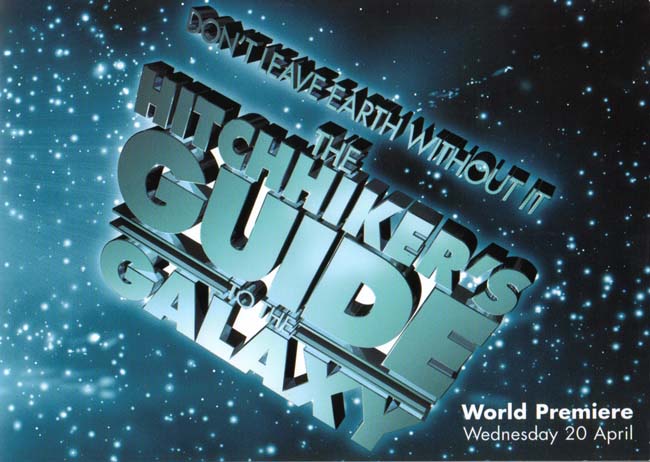
The Guide's logo over deep space. World Premiere, Wednesday 20 April. Look closely and the stars are missing from behind the words Guide and Galaxy, a printing quirk I have stared at for twenty years.
Page 2 of 12 · The story so far
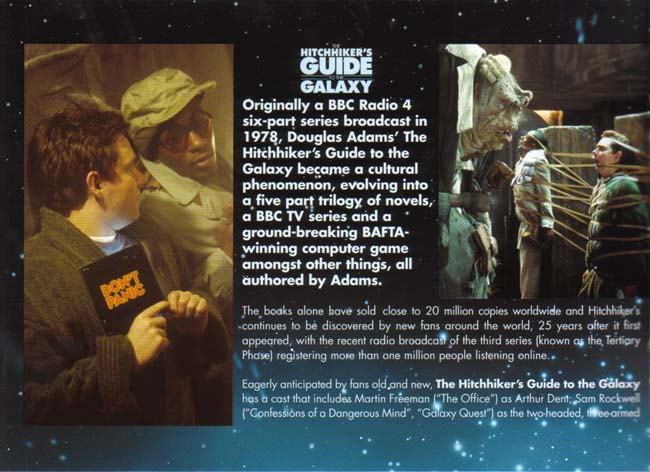
A six-part radio series on BBC Radio 4 in 1978, then six books, a television series and a BAFTA-winning computer game. The potted history, for anyone who arrived without one.
Page 3 of 12 · Production and synopsis
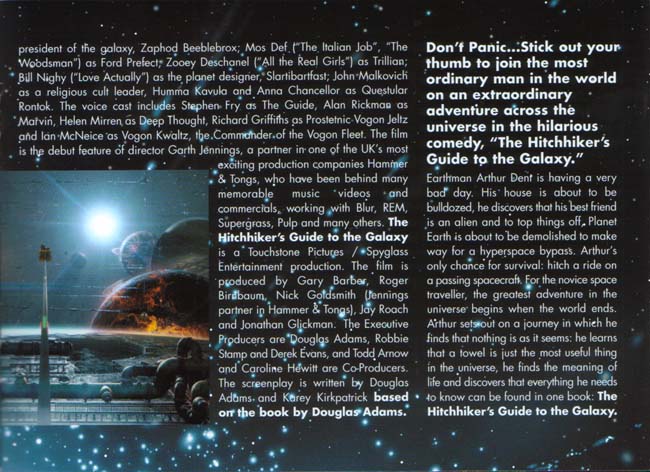
Don't Panic. Arthur Dent is having a very bad day: his house is about to be bulldozed, and so is the Earth. A Touchstone and Spyglass production, screenplay by Douglas Adams and Karey Kirkpatrick.
Page 4 of 12 · The characters
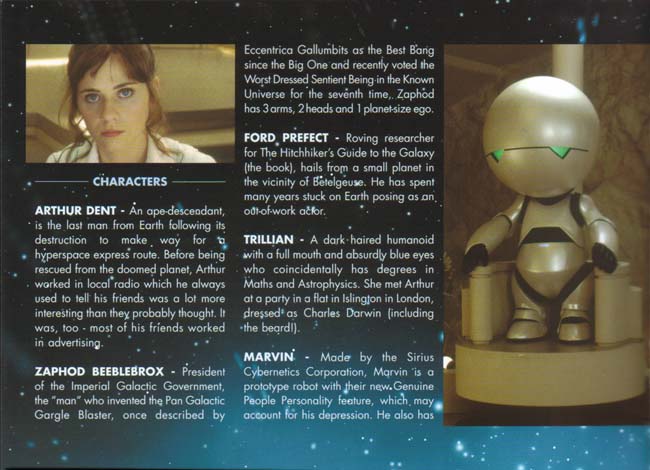
Arthur Dent, Zaphod Beeblebrox, Ford Prefect, Trillian and Marvin, each with a thumbnail and a line. Zaphod: three arms, two heads and one planet-sized ego.
Page 5 of 12 · The cast
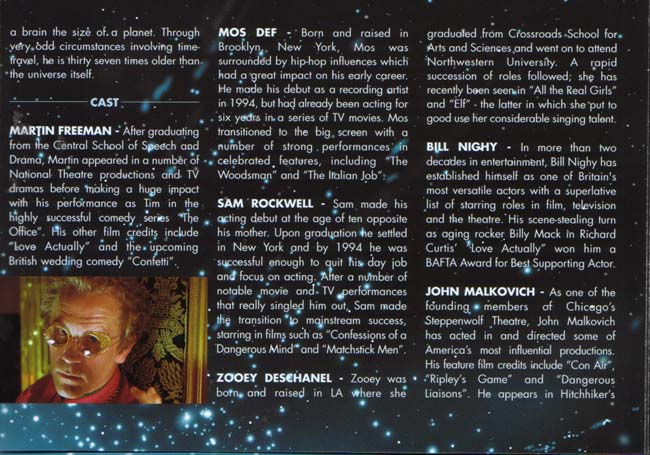
Martin Freeman, Sam Rockwell, Zooey Deschanel, Mos Def, Bill Nighy and John Malkovich, with the potted CVs the night's cheers were built on.
Page 6 of 12 · The cast continued
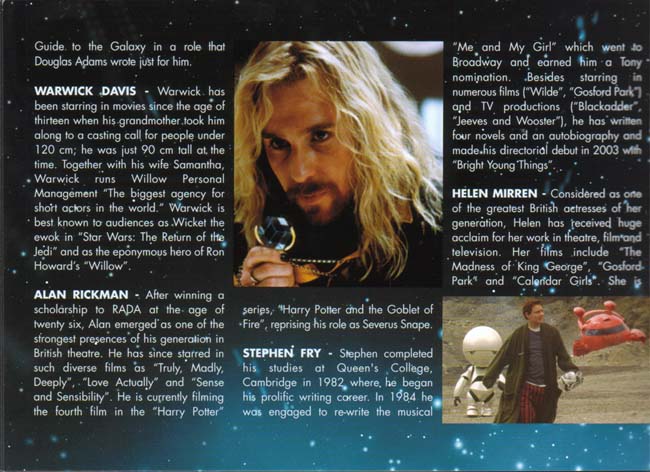
Warwick Davis inside Marvin, Alan Rickman voicing him, Stephen Fry as the Guide and Helen Mirren as Deep Thought.
Page 7 of 12 · Anna Chancellor and the filmmakers
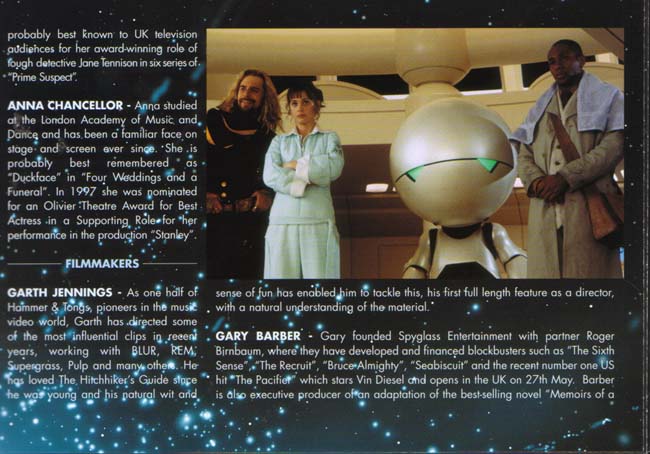
Anna Chancellor as Questular Rontok, then the Hammer and Tongs pair: director Garth Jennings, who has loved the Guide since he was young, and producer Gary Barber.
Page 8 of 12 · The producers
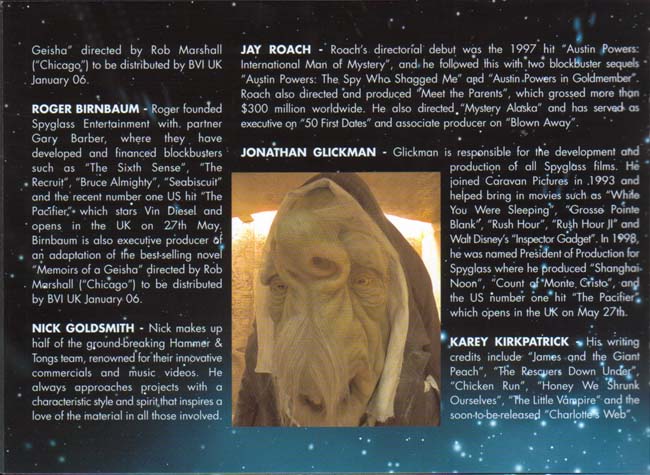
Roger Birnbaum, Nick Goldsmith, Jay Roach, Jonathan Glickman and writer Karey Kirkpatrick. Humma Kavula, the Malkovich role, watches from the corner.
Page 9 of 12 · The author
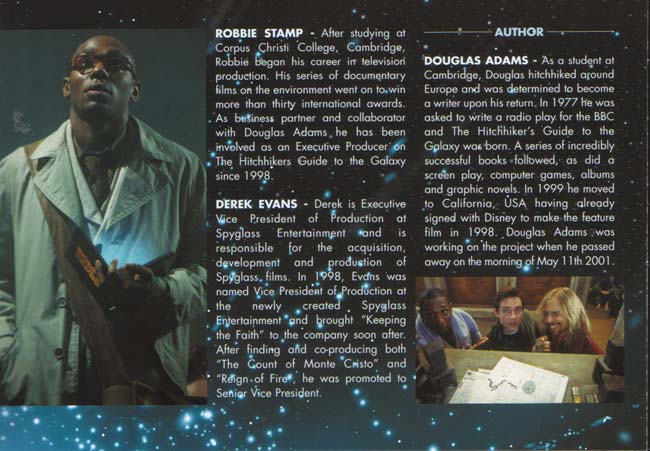
Robbie Stamp and Derek Evans, and then Douglas Adams himself. He signed with Disney in 1999 and was working on the project when he passed away on the morning of 11 May 2001.
Page 10 of 12 · Full credits
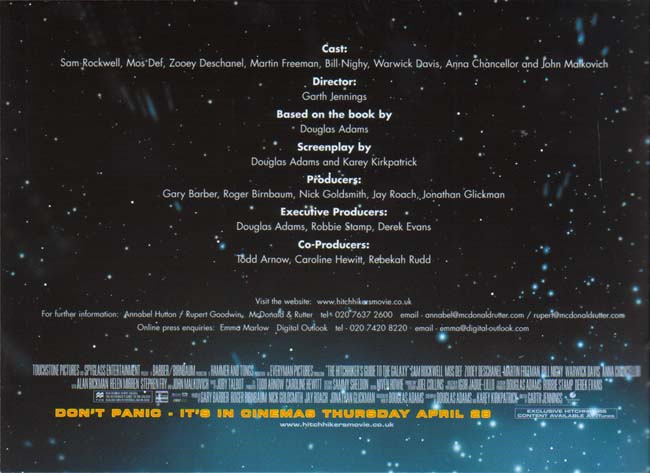
The complete cast and crew block, and the line that dates the whole thing: Don't Panic, it's in cinemas Thursday April 28.
Page 11 of 12 · The emblem
The Guide's own emblem: a thumb cocked for a lift, drawn as a chrome spaceship against the stars.
Page 12 of 12 · Back cover
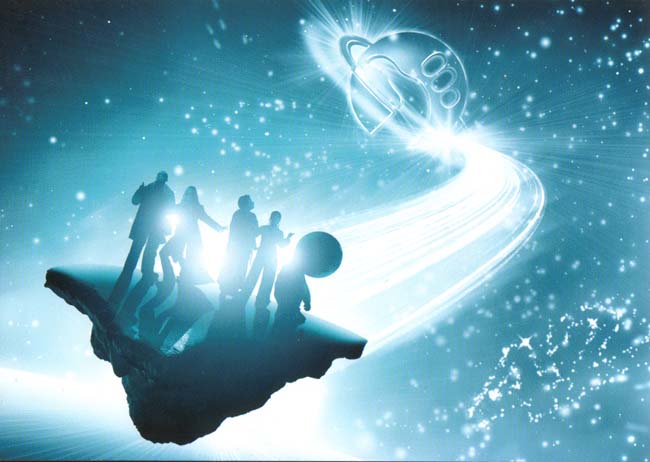
The crew adrift on a fragment of rock, a ringed planet trailing behind them. Where the programme, and the day, ends.