
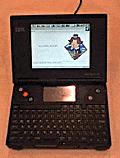
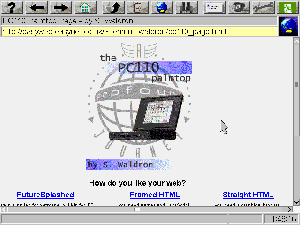
IBM (bless their cotton socks) have been working on a DOS based Web Browser codenamed WebBoy. In essence, this browser will supply HTML3.2 compatibility (what that means to you is that it can handle tables, animated Gifs, frames and font tags) and e-mail. To make things better, it uses the same GUI that was used to write PersonaWare, meaning that when integrated into your PersonaWare menu, you will be able to access the net from one user interface.
Before you ask me “Where can I get WebBoy” let me tell you that finding any information about WebBoy has been really difficult. Everything is in Japanese and nobody in the English speaking world seem to know a thing. WebBoy has been written to be portable, so expect ports to other (non DOS) operating systems in the future.
It runs beautifully on the IBM PC110 palmtop, which is where I first put it through its paces.
Specification
The bullet point specification of the WebBoy is as follows.
- IBM DOS version J5.02/V or greater
- IBM-compatible personal computer
- Intel 386 SX processor or better
- 4MB or more of memory
- 5MB or more free hard disk space
- TCP/IP connections
- PPP
- EUC/JIS/S-JIS japanese encodings
- HTML 3.2
- GIF/JPEG images
- SMTP/POP3 email standards
- SVGA displays with 256 colors at 640x480, 800x600, 1024x768
- VGA displays with 16 colors at 640x480
- Also runs under OS/2, Win 3.1, 95, NT under DOS boxes
Price: 9800 Yen (under US$100)
The underlying technology of WebBoy: MicroPM
By Seamus Waldron
What else do we know about WebBoy? Well, WebBoy will be the second product written using the Micro PM Gui Library from the IBM Embedded Middleware Technical Office. The Micro PM is a very small GUI, for use in low memory (thin client type) software. What they have done is taken 200 or so important API’s from OS/2 Presentation Manager (PM, hence Micro PM), Graphic Programming Interface (GPI), and Control Programming Interface (CPI), to make cross-porting between Micro PM and OS/2 much easier. This means that you can develop applications for the Micro PM on OS/2 and port it directly. Development is not difficult at all on a DOS only or Windows based machine.
The Micro PM is designed as a portable GUI platform, so expect to see it on other platforms soon(ish).
The Micro PM for DOS has been used as a part of the supporting software (PIM) for the IBM Palm Top PC110 (PersonaWare), being sold in Japan.
Press coverage
Below you will find press releases and articles about the WebBoy. The first is a press release that IBM very quietly rolled out.
Press Release (IBM), March 25th, 1997
IBM Japan Develops DOS/V Compatible Version of Internet Browser, IBM WebBoy For DOS Version 3.0, which it will launch on April 29. This is the first ever DOS compatible Web browser. It can be used with Intel 386 and 486 processors. It has features similar to standard Windows and Macintosh browsers including multiple screen partition, multi image layering and graphical user interface. IBM Japan says a total of 2.5 million DOS/V 386 or better machines have been shipped. Its browser can be used with DOS Version 5.02 or better, requiring 4MB RAM and 5MB empty hard drive space. The product will retail at 9,800 yen.
Ref: Japan Industrial Journal, 03/18/97, p5
From Information Week: “IBM Has New Browser Under Wraps” by Jeff Sweat
IBM is working on a flyweight Web browser for network computers and Internet appliances, sources say, making motions in a market where most of the attention is being captured by the duel between Microsoft and Netscape.
The IBM Micro Web Browser, code-named WebBoy, is aimed at machines without hard disks and with tight memory constraints, particularly network computers, set-top boxes, and Internet video game machines. WebBoy requires only four Mbytes of memory to run, while Netscape Navigator 3.0 requires 3.2 Mbytes of hard disk space and nine Mbytes of memory, about half as much as Windows 95.
Update: what I have since learned
Back in 1997 almost everything about WebBoy was in Japanese and impossible to pin down from the English-speaking world. Years later the Japanese-language record has filled in, so here is what it says.
Was it really the first web browser for DOS? Not quite. The Czech browser Arachne reached its first public beta in December 1996, a few months ahead of WebBoy. What WebBoy can fairly claim is to be the first commercial, boxed, graphical DOS browser from a major vendor. It was a product you bought, not a hobbyist project.
Where it came from. WebBoy was built by IBM Japan’s Embedded Middleware Technical Office, the same group behind PersonaWare on the PC110, on the same Micro PM GUI library (a roughly 200-call subset of OS/2’s Presentation Manager). PersonaWare was the first Micro PM product; WebBoy was the second. IBM Japan marketed it under a banner they coined as “recycleware” (リサイクルウェア): software to turn the millions of ageing 386 and 486 DOS/V machines still in Japanese offices and schools into internet terminals, rather than throwing them away.
Versions. There never seem to have been public versions 1 or 2; the first retail release was 3.0, on 29 April 1997. Version 4.0 followed on 21 October 1998, adding JavaScript 1.1, SSL 3.0, MIME email attachments, page and email printing, and a small Java runtime sized specifically to run IBM’s Desktop On-Call remote-control software. By March 2000 it was being sold inside a “Green Software for Recycling” bundle alongside PC DOS 2000. WebBoy was finally discontinued in November 2002.
The sibling that never shipped. Alongside WebBoy, IBM Japan was building NetDiver, an all-Java embedded browser aimed at phones, set-top boxes and internet appliances. It got press in mid-1997 and then quietly vanished. WebBoy was the legacy-DOS half of a two-pronged embedded-browser strategy.
A book, even. SoftBank published a whole guide in 1997: WebBoy活用術 (“WebBoy Usage Techniques: turning DOS machines into dedicated internet terminals”), by Hiroyuki Kida.
It survives. WebBoy is preserved today. The version 3.0 and 4.0 disk images are on the Internet Archive and on abandonware sites, and people have it running again under the 86Box emulator. There is even a Japanese retro-computing scene that pairs WebBoy 4.0 with a PCMCIA network card to put a PC110 back on the modern web.
Sources for this update are Japanese-language: IBM Japan’s launch coverage in Internet Watch and PC Watch (17 March 1997), the v4.0 announcement (September 1998), the Japanese Wikipedia WebBoy entry, and the 我楽多苑 (Garakuta-en) PC110 site; plus English coverage in Tech Monitor and InfoWorld and the Vintage Computer Federation forums.
This is an archive piece, first written in 1997 and updated since. The external links and ordering points of the day are long gone; the page is preserved as a record of the first commercial web browser for DOS.