
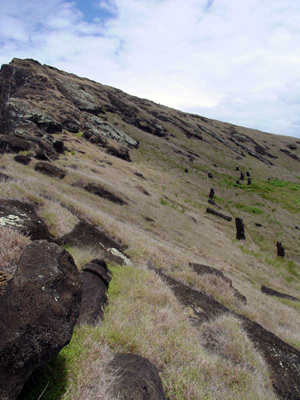
Easter Island is famous for the moai, but the island that made them is just as interesting: three dead volcanoes in the middle of the Pacific, thousands of miles from anywhere.
Easter Island, Rapa Nui to the people who live there, is known for the moai, the stone figures carved between the twelfth and seventeenth centuries. But the island that produced them is worth understanding in its own right. It is about as remote as land gets, a small triangle in the South Pacific, and it is made entirely of volcanoes.
Built by volcanoes
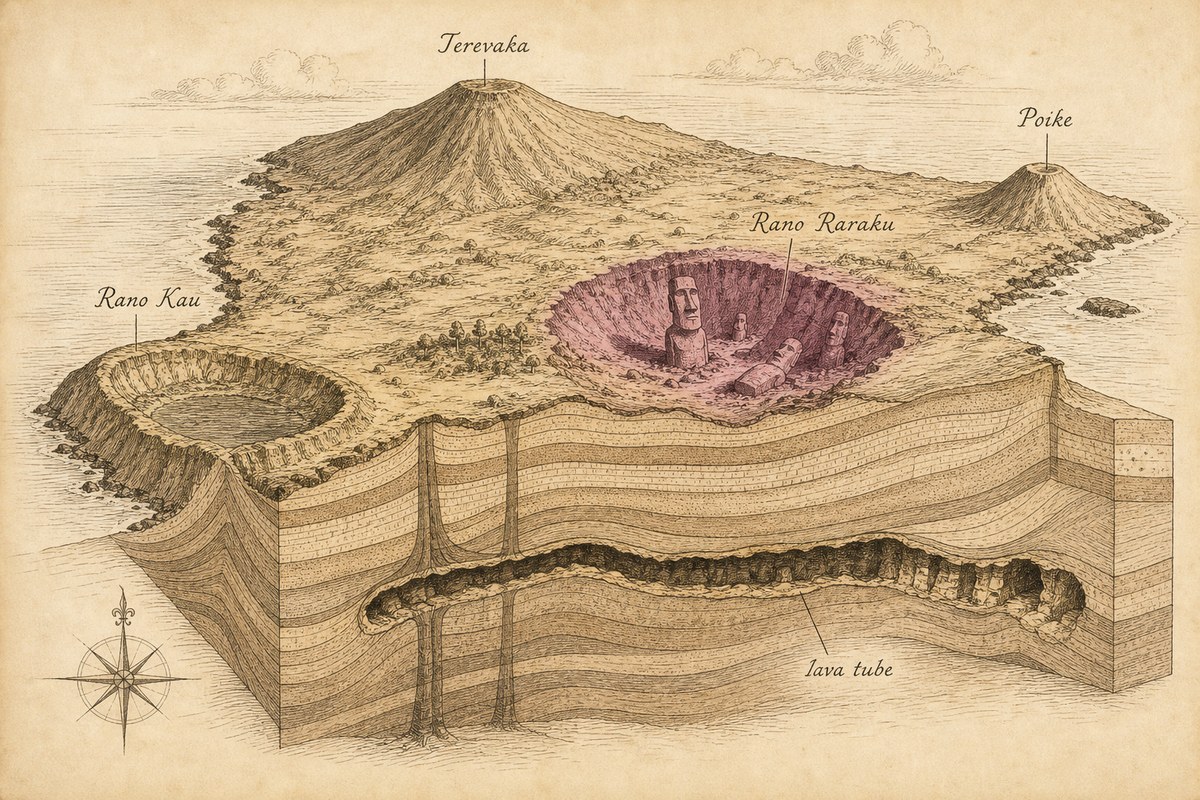
The island is three extinct volcanoes (Terevaka, Poike and Rano Kau) that grew together, which is why it is triangular. It sits over the hotspot that built the Nazca Ridge, the far end of which is now sliding under Peru. In effect the whole island is the top of a mountain that rose from the sea floor.
For anyone interested in geology it is a feast. The crater at Rano Raraku and the cinder cone of Puna Pau are the two to see. Rano Raraku was the quarry for almost every moai, worked for the best part of 500 years, and unfinished statues still lie around its slopes above a quiet crater lake. Puna Pau supplied the red scoria for the pukao, the topknots the statues wore, so it matters to archaeologists as much as to geologists.
The caves
The lava tubes are one of the island’s quieter attractions: long tunnels left where lava ran underground, some tall enough to walk through. The rock is mostly iron-rich basalt and hawaiite, and the minerals show in the walls. A fair number of the caves are unstable, so this is one to do with a local guide rather than a torch and optimism.
Visiting today
Getting there has always been the hard part, and the expense. Flights run from Santiago in Chile, with the occasional one from Tahiti, and the fares reward some patience and planning.
Two things have changed since this was written. The island closed completely to visitors for over two years during the pandemic and only reopened in August 2022. And it is now run much more tightly as Rapa Nui National Park: you buy a park ticket (around 80 US dollars for foreign visitors, valid for ten days), you have to be with a registered guide at most of the sites, and you can only stay in accredited accommodation. In October 2022, soon after reopening, a fire swept part of the Rano Raraku quarry and scorched some of the moai, a reminder of how fragile the place is. None of this makes it less worth the trip. It just means you go on the island’s terms now, which is fair enough.


First written in 2005, updated 2026.