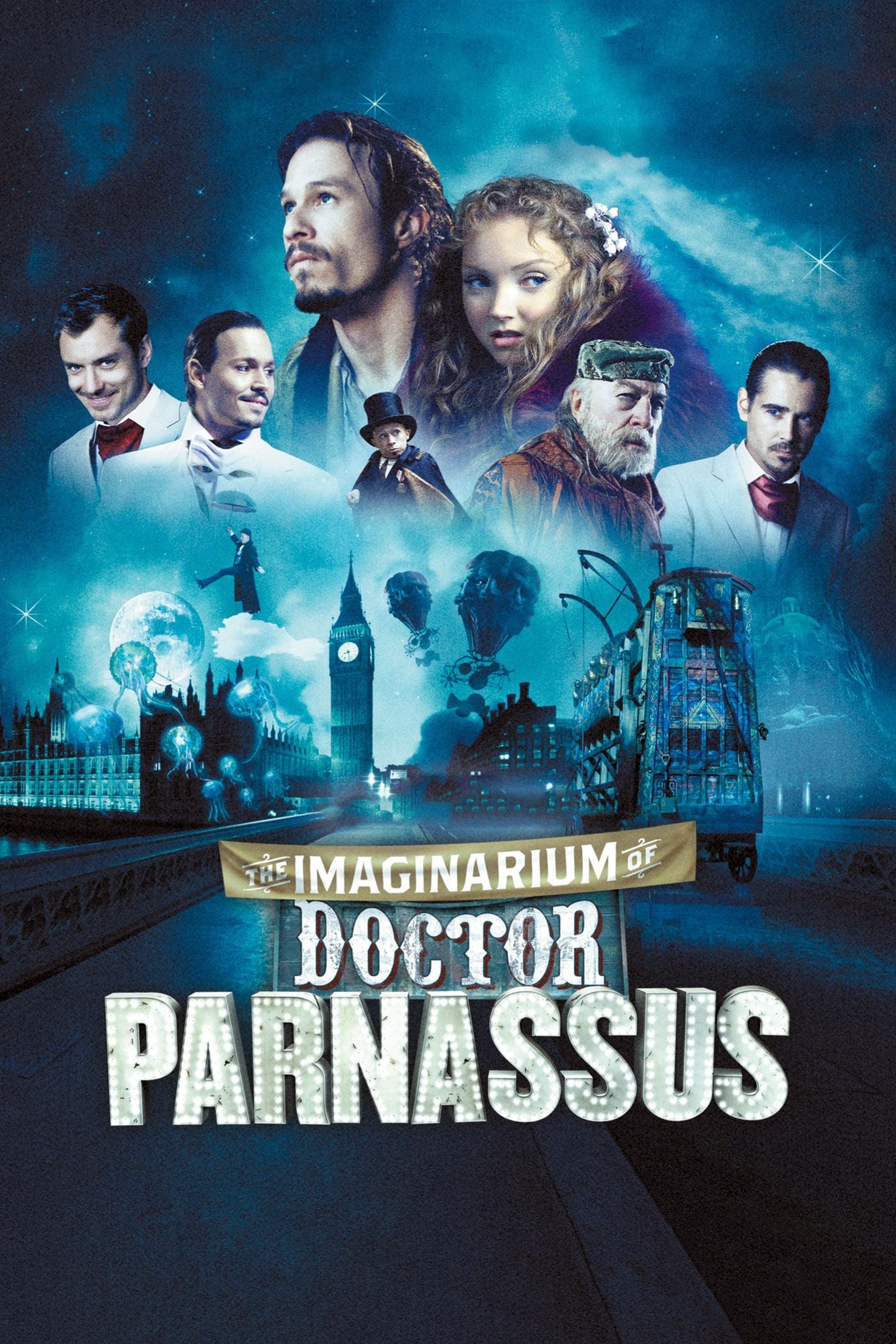

- UK release: October 2009
- Director: Terry Gilliam · Writers: Terry Gilliam, Charles McKeown
- Studio / distributor: Davis Films; Infinity Features; Lionsgate UK
- Genre: Fantasy adventure / surreal drama · Runtime: 123 minutes (BBFC 12A)
- Main cast: Christopher Plummer (The Sound of Music) as Doctor Parnassus; Heath Ledger (Brokeback Mountain) as Tony; Johnny Depp (Edward Scissorhands, Pirates of the Caribbean) as one Tony; Jude Law (The Talented Mr Ripley) as one Tony; Colin Farrell (Minority Report, In Bruges) as one Tony; Lily Cole (St Trinian’s) as Valentina
- IMDb: 6.7 / 10 · Rotten Tomatoes: 64% critics / 60% audience · My rating: 8 / 10
Terry Gilliam has spent his whole career picking fights he cannot win, and the wreckage of those fights is half the legend: the runaway budget of The Adventures of Baron Munchausen, the insurance-claim collapse of his Don Quixote film, the constant sense that the universe has it in for him personally. The Imaginarium of Doctor Parnassus is the one where the catastrophe arrived mid-shoot and could not be rescheduled around. Heath Ledger died with the film half made. What a sensible production would have done is shut down. What Gilliam did, with the help of three friends who flew in for nothing, was fold the loss into the fabric of the thing, and the result is the closest he has come in years to a film that feels both broken and whole at once.
The setup
Doctor Parnassus (Christopher Plummer) is an ageing showman dragging a ramshackle theatre wagon through modern London, offering passers-by a mirror they can step through into a landscape built out of their own imaginations. The catch is that Parnassus made a wager with the Devil, here a soft-spoken Mr Nick (Tom Waits), centuries ago, and the bill is coming due: on her sixteenth birthday his daughter Valentina (Lily Cole) is forfeit. Into this rolls Tony (Heath Ledger), a charming stranger the troupe cut down from a noose under a bridge, who has reasons of his own for keeping his past vague and who starts reshaping the whole enterprise the moment he arrives. Each trip through the mirror changes the man who takes it, which is the conceit that lets the film carry on after its leading actor cannot.
The cast
Plummer is the anchor, and he plays Parnassus as a man worn down to the grain, mournful and a little ridiculous, a magician who has outlived his own magic. Tom Waits gives the Devil a wonderfully relaxed menace, less interested in winning than in keeping the game going, because the game is the only company he has. The much-discussed solution to Ledger’s death turns out to be the film’s strangest grace note: when Tony passes through the mirror he is played in turn by Johnny Depp, Jude Law and Colin Farrell, each of them taking a different facet of the same slippery man. Depp brings the seductive ease, Law the manic energy, Farrell the cornered desperation as the truth closes in. It should feel like a patch job. Instead the changing face becomes a comment on Tony himself, a man with no fixed self to lose. Cole is the weakest link, more a stake to be fought over than a character, but Andrew Garfield’s lovesick Anton gives the troupe a beating heart.
The craft
Nobody alive composes a frame quite like Gilliam, and the dream-world sequences are him off the leash: collapsing perspectives, vast paper landscapes, ladders climbing into nothing, the cheerful ugliness of a fairground that might eat you. Nicola Pecorini’s camera keeps the grubby London exteriors low and damp so the imaginarium can blaze by contrast. The Danna brothers’ score moves between music-hall jollity and something colder underneath. It is not seamless work, the digital seams show and the wager plot keeps tripping over its own rules, but the sheer rate of invention papers over a great deal. You forgive a film a lot when every few minutes it hands you an image you have never seen before.
How it stacks up
This belongs unmistakably with the run of Gilliam pictures about imagination as both salvation and trap. Time Bandits and Baron Munchausen are the obvious cousins, fellow fables of storytellers staving off the dark by spinning tales, and Brazil lurks behind all of it in the way the drab real world is the true nightmare and the fantasy is the escape hatch. Set against the slicker fantasy of its moment, this is the scruffier, more handmade thing, closer in spirit to a stage illusion than a render farm. It shares some DNA with MirrorMask too, another film about a girl and a looking-glass world, but Gilliam’s is the rowdier, more dangerous version.
Critics versus the rest of us
The notices are mixed, and the split is the familiar Gilliam one. Critics are sitting around 64%, audiences a shade lower at 60%, and the recurring complaint is that the story is a shambles, that the rules of the wager never quite cohere, that imagination has once again run ahead of discipline. That is all true. The film is a mess. What the complaint undervalues is how much pleasure the mess contains, and how neatly the casting accident has been turned from a wound into a device. There is also a layer the reviews cannot help reading into it, the sight of Ledger walking and talking, which lends the whole thing a melancholy no script could have written in.
Verdict
I came out of this charmed rather than satisfied, which with Gilliam is usually the right outcome to hope for. The plotting is loose, the emotional stakes never fully land, and a tidier director would have wrestled the third act into shape. None of that is what I will remember. I value world-building, atmosphere and the kind of film that rewards a second look, and this one is stuffed with corners I want to go back and stare at again. It is a generous, defiant, beautiful shambles, and the way it absorbs its own tragedy without exploiting it is the most graceful thing about it. 8⁄10.
Availability: On release in UK cinemas now, with a DVD and Blu-ray to follow.
Update
Added since this review first appeared: The Imaginarium of Doctor Parnassus has settled in as the film that turned a production catastrophe into a curio, the title most people reach for when they want to talk about Heath Ledger’s last work alongside The Dark Knight. Gilliam went on to finally complete his long-cursed The Man Who Killed Don Quixote in 2018, closing the loop on the disaster-prone reputation this film extended. It is widely available on disc and through the usual digital rental and purchase services, and turns up periodically on streaming platforms depending on region.
BBFC content advice
Rated 12A by the BBFC for infrequent strong language, scenes of threat, hanging and smoking. The notes below may contain spoilers.
Threat and horror: Much of the film concerns characters being chased or scared, and there are also scenes in which people see bizarre creatures in the Imaginarium. There are also scenes in which people are punched or slapped, and one in which a teenage girl delivers heavy blows to an man who is trying to molest her. However, there is limited detail.
Language: There is infrequent strong language (‘f***k’), as well as some milder bad language (for example, ‘bitch’, ‘bastard’, ‘bollocks’, ‘tits’).
Suicide and self-harm: In one prolonged scene, a character swings by the neck from a rope under a bridge, seemingly having tried to commit suicide. However, the person is eventually rescued. There is also a scene in which a man is chased by an angry mob, who intend to hang him.
Additional issues: There are also some scenes in which a teenager smokes cigarettes; however, these scenes are brief and there is no discussion of the habit. Sex references in the film include a fifteen year-old girl posing nude on stage during a show; however, all nudity is covered by her hair and limbs. There is also a scene in which a man and woman sleep together; however, there is no strong detail.
Source: British Board of Film Classification (bbfc.co.uk).