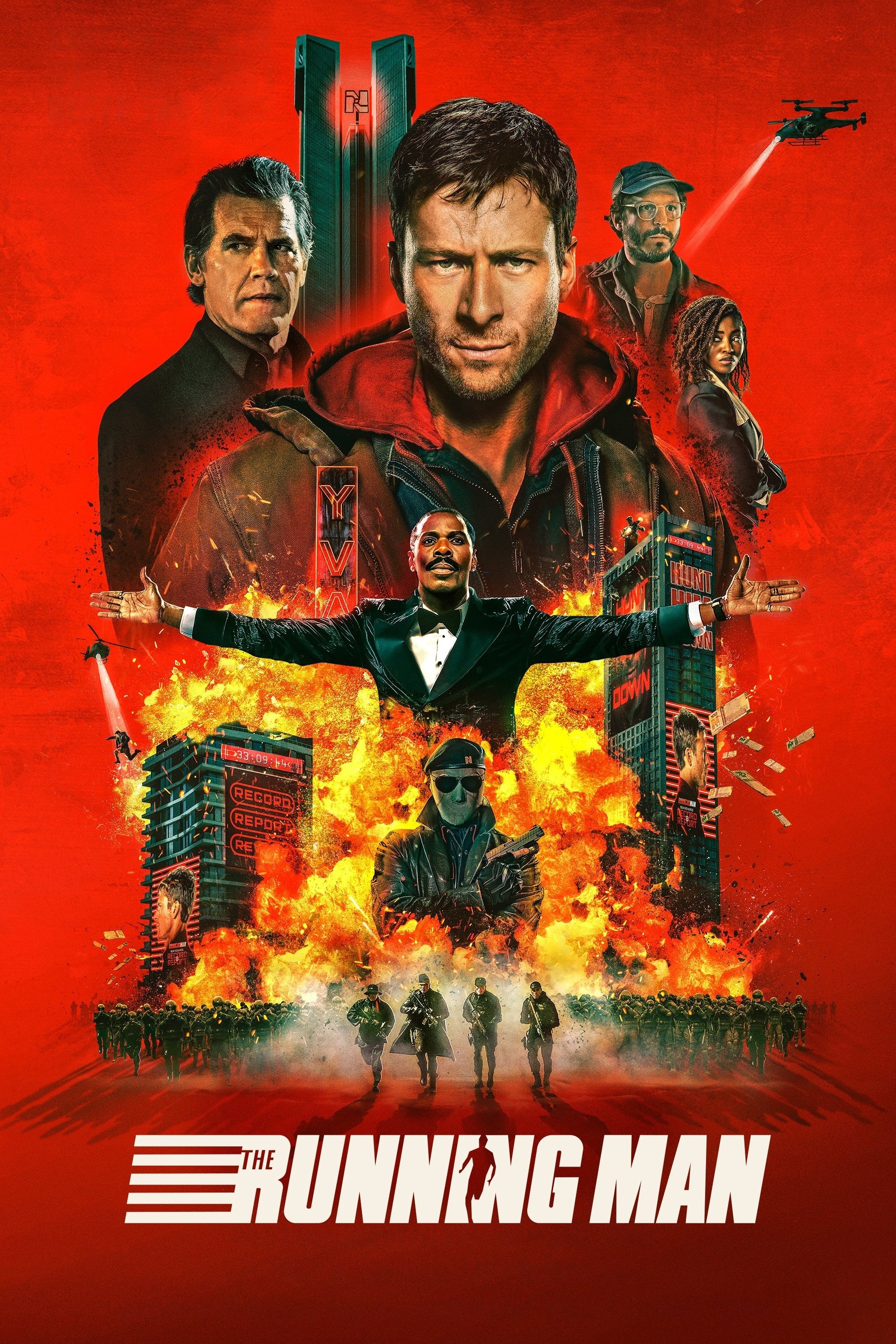

- UK release: November 2025
- Director: Edgar Wright · Writers: Michael Bacall, Edgar Wright
- Studio / distributor: Paramount Pictures; Kinberg Genre; Complete Fiction
- Genre: Dystopian science fiction action thriller · Runtime: 133 minutes (BBFC 15)
- Main cast: Glen Powell (Top Gun: Maverick, Twisters) as Ben Richards; Josh Brolin (No Country for Old Men, Dune) as Dan Killian; Colman Domingo (Rustin) as Bobby Thompson; Katy O’Brian (Love Lies Bleeding) as a fellow contestant; Michael Cera (Scott Pilgrim vs. the World, Superbad) as Elton Parrakis
- IMDb: 6.4 / 10 · Rotten Tomatoes: 61% critics / 77% audience · My rating: 8 / 10
There is already a film of The Running Man, and most people who grew up renting it have a soft spot for it: Arnold Schwarzenegger in spandex, a neon gladiator arena, one-liners landing as often as the kills. What that 1987 version never had much time for was the book it came from, a lean and bleak Stephen King novel published under the Richard Bachman name, set in a poisoned America where a desperate man signs up for a televised manhunt because the prize money is the only thing that might save his sick daughter. Handing that book to Edgar Wright, a director who cuts to music and treats a chase as choreography, sounds at first like an odd marriage of the savage and the slick. It works because Wright has read the same novel the rest of us did and decided to take its anger seriously.
The setup
Ben Richards (Glen Powell) is broke, blacklisted and out of options in a near-future America run by a television network that has turned poverty into prime-time entertainment. To pay for his daughter’s medicine he auditions for The Running Man, the network’s flagship show: thirty days on the run from a squad of professional Hunters, with a cash bounty that climbs for every hour he survives and a fortune waiting if he lasts the month. Nobody has ever lasted the month. The catch, which Ben works out fast, is that the cameras are not neutral. The network controls what the public sees, edits him into whatever villain the ratings need, and turns the whole country into informers. Staying alive turns out to be the easy part. Staying the protagonist of his own story is the fight.
The cast
Powell carries it. He has spent the last few years proving he can do the matinee-idol grin, and here he keeps the charm but lets the desperation show underneath it, a man whose defiance is mostly fear wearing a brave face. Josh Brolin is the cold centre of the film as Dan Killian, the producer who runs the show, all reasonable tone and no conscience, the kind of executive who sincerely believes he is giving the people what they want. Colman Domingo has a wonderful time as Bobby Thompson, the show’s host, a grinning ringmaster who can swing from warmth to cruelty inside a single autocue line. Katy O’Brian brings real physical credibility to a fellow contestant, and Michael Cera turns up as an underground ally and plays beautifully against type, jittery and decent in a world that punishes both. It is a deep bench, and Wright gives almost everyone a moment.
The craft
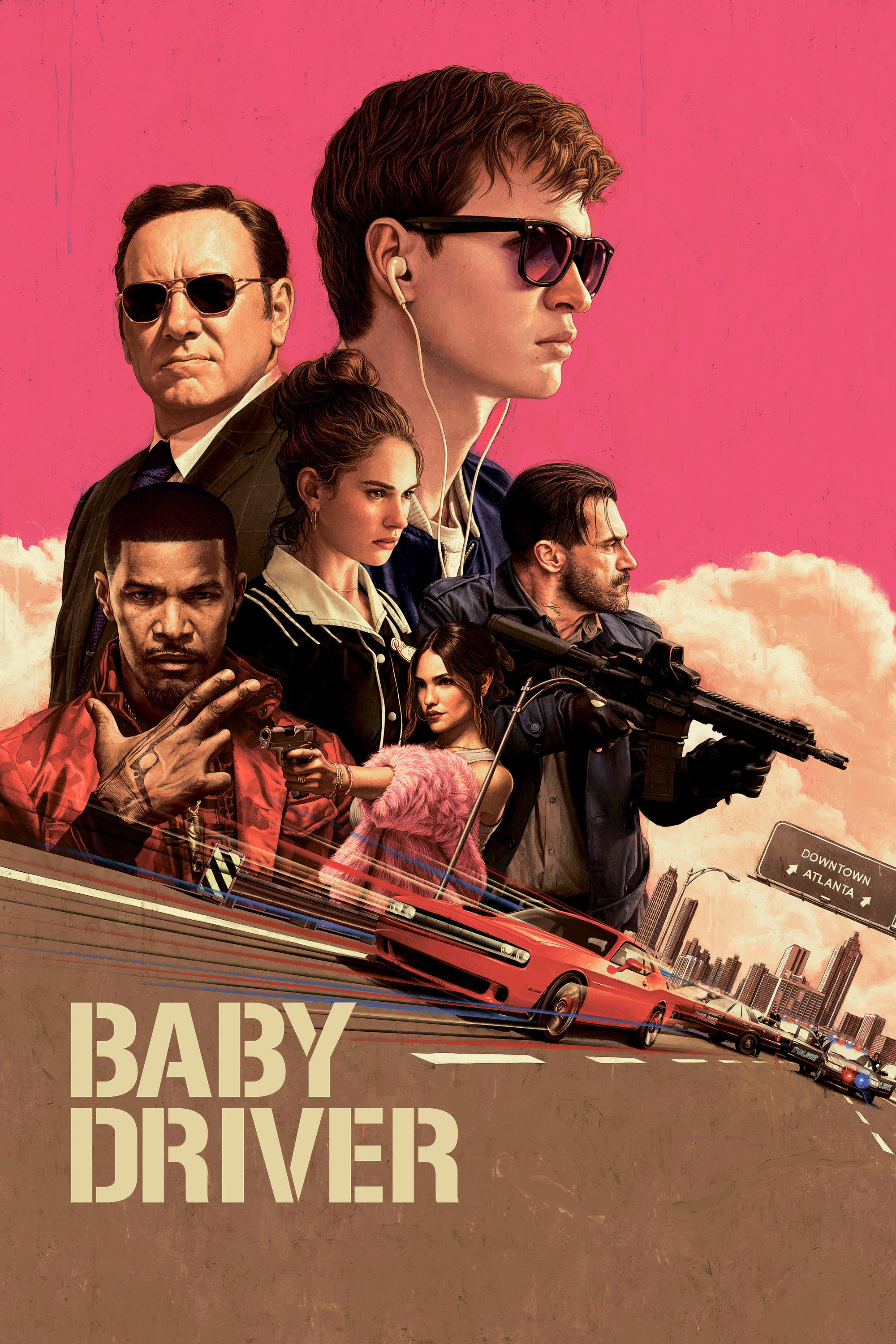
This is unmistakably an Edgar Wright film. Chung-hoon Chung’s camera is restless without being incoherent, Paul Machliss cuts on the beat the way he did on Baby Driver, and Steven Price’s score drives the thing forward like an engine. Where the 1987 film kept Richards in a single stadium, Wright sends him across a whole grimy city, so the action keeps changing shape: a foot chase becomes a car chase becomes a siege. The satire is sharpened rather than subtle. The on-screen graphics, the audience-participation gimmicks, the way a death is packaged for replay, all of it lands the media critique without slowing the chase down. At 133 minutes it occasionally feels its length in the middle act, but Wright is too good a builder of sequences to let the energy sag for long.
How it stacks up
The obvious comparison is the Schwarzenegger version, and this is the better film, more faithful to King and far angrier about the world it shows. Beyond that it sits in good company: the death-game lineage of Battle Royale and The Hunger Games, and the broadcast satire of Network, whose fury at television as a machine for manufacturing consent runs right through this. Wright’s own Baby Driver is the closest stylistic cousin, the same marriage of music, motion and editing, pointed now at something with more bite. It is less playful than Hot Fuzz or Shaun of the Dead and the better for it; the comedy here cuts.
Critics versus the rest of us
Critics are divided. The reviews sit around 61%, with the split running between those who admire the energy and the media satire and those who find the relentless pace exhausting or the politics too on-the-nose. Audiences are warmer, in the high seventies, and I think they have the right of it. The complaint that the message is unsubtle rather misses how unsubtle the source material always was; King was not writing nuance, he was writing rage. The film is loud and it means to be.
Verdict
This is the kind of thing I come to the cinema for: intelligent dystopian science fiction that has actually thought about surveillance and media control, wrapped in a chase picture that never stops moving. It is angrier and smarter than its trailers suggest, Powell is genuinely good in it, and the craft is everywhere. It loses a little momentum in the middle and the satire sometimes shouts where a murmur would cut deeper, which is what keeps it off the very top shelf. But it is enormously entertaining, it rewards a second watch, and it does right by a book that has waited a long time for a proper adaptation. 8⁄10.
Availability: On general release in UK cinemas now.
Update
Added since this review first appeared: the film has since arrived on digital and on 4K UHD, Blu-ray and DVD, and streams on Paramount+. It has settled into its reputation as the Running Man adaptation that finally honoured King’s novel, and as one of the stronger entries in a busy year of King screen adaptations.
BBFC content advice
Rated 15 by the BBFC for strong bloody violence, language, brief sex references. The notes below may contain spoilers.
Violence: People are shot, stabbed, slashed and decapitated in scenes which include blood spurts and blood in the aftermath. A negative character briefly stamps on a man’s wound. In another scene, a man removes a glass shard from his eye. Milder scenes include those in which people are set on fire, run over a by a car, electrocuted and beaten.
Threat and horror: There are several intense and prolonged sequences of suspense and threat throughout the film. Hunters chase their targets through various environments, creating a sustained sense of menace. Car chases include vehicle crashes. Characters are threatened with weapons including guns and grenades.
Language: Strong language (‘fk’, ‘motherfker’) occurs. There is also implied strong language, milder terms (‘dick’, ‘son of a bitch’, ‘bitch’, ‘pussy’, ‘asshole’, ‘shit’, ‘bullshit’, ‘ass’, ‘balls’, ‘bastard’, ‘piss’, ‘crap’, ‘damn’, ‘hell’, ‘God’, ‘Jesus Christ’, ‘goddamn’, ‘jerk’), and rude gestures.
Sex: A group of seemingly naked women with nudity obscured lie on a bed with a man who makes sexual comments. In a milder scene, a scantily-clad female pole-dancer dances suggestively. There are also references to sex workers.
Drugs: Characters briefly smoke marijuana joints; however, drug misuse is not condoned by the film as a whole.
Suicide and self-harm: There is a passing verbal suicide reference.
Nudity: There is a scene of non-sexual nudity in which a man’s buttocks are briefly visible.
Theme: References are made to cancer and illness. A child is shown unwell in a hospital setting.
Source: British Board of Film Classification (bbfc.co.uk).