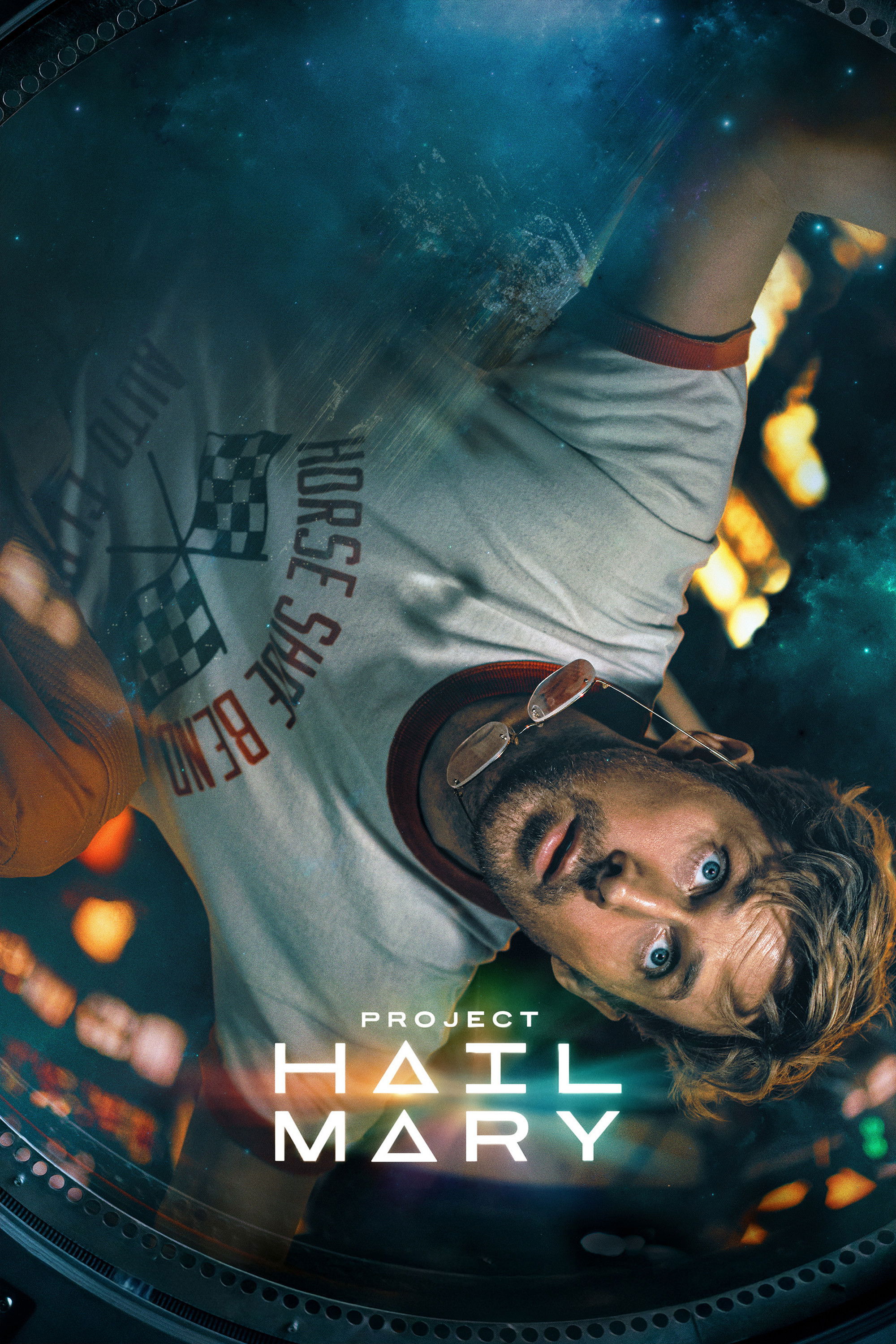

- UK release: March 2026
- Director: Phil Lord and Christopher Miller · Writer: Drew Goddard
- Studio / distributor: Amazon MGM Studios; Pascal Pictures; Lord Miller
- Genre: Science fiction survival adventure / first-contact drama · Runtime: 156 minutes (BBFC 12A)
- Main cast: Ryan Gosling (Blade Runner 2049, First Man) as Ryland Grace; Sandra Hüller (Anatomy of a Fall, The Zone of Interest) as Eva Stratt; James Ortiz as Rocky
- IMDb: 8.3 / 10 · Rotten Tomatoes: 94% critics / 98% audience · My rating: 9 / 10
Andy Weir writes the kind of science fiction where the hero gets out of trouble with a whiteboard and a periodic table, and The Martian showed in 2015 that the approach could carry a film as well as a novel. Project Hail Mary is his next book to make the trip, and the names attached set an interesting expectation. Drew Goddard, who adapted The Martian, writes again. The directors are Phil Lord and Christopher Miller, better known for The Lego Movie and 21 Jump Street, an odd fit for a survival story until you remember that the Weir formula runs on humour as much as on competence. The worry going in is that a book built almost entirely out of one man thinking out loud might not have anywhere to go on screen. It does, and the place it goes is the thing you will be talking about afterwards.
The setup
A man wakes in a small white room with two corpses for company, no memory of his own name, and a body wasted by a coma. He is Ryland Grace (Ryan Gosling), and the room is a spacecraft a very long way from home. As his memory returns in fragments, so does the size of the problem: the sun is dimming, Earth is facing extinction within a generation, and he is the surviving crew member of a one-way mission sent to work out why. What he does not expect is to find that he is not the only species to have sent someone. The film keeps its larger turns back, and I will keep them back too, but the engine of it is two intelligences with the same deadline and no shared language, trying to save two worlds at once.
The cast
This is a film that rests almost entirely on one actor, and Gosling is the right choice for it. Stripped of memory and then of certainty, he has to carry exposition, panic, grief and dry comedy often in the same scene, and he plays the science teacher as a man who is frightened but cannot stop being curious. It is closer to his haunted, contained work in First Man than to anything showier. Sandra Hüller, as the mission’s architect Eva Stratt, anchors the flashbacks to Earth with a cold, unsentimental authority; she is the person willing to make the decisions nobody else will. The film’s real second lead, though, is Rocky, an alien engineer rendered through performance and effects work, and the relationship that grows between Grace and Rocky is the warmest thing in it. It should not work. Two beings who cannot breathe the same air and communicate in tones, building a friendship out of shared engineering problems, has no business being this moving.
The craft
Greig Fraser shoots the ship as a cramped, functional place and the space around it as genuinely vast, and the contrast does a lot of the film’s work. After the immersive scale he brought to Dune, he knows how to make hard surfaces and empty distance feel overwhelming rather than sterile. Lord and Miller turn out to be a shrewder pairing than the marquee suggests; their instinct for comic timing keeps the long stretches of one man solving problems from curdling into a lecture, and they trust the audience to follow the science rather than have it spelled out twice. Daniel Pemberton’s score is propulsive without crowding the quiet, and the design of Rocky and its corner of the ship is the kind of practical, lived-in invention that rewards a second viewing. At a little over two and a half hours the film earns its length; the pacing rarely sags, because the problem keeps changing shape.
How it stacks up
The obvious comparison is The Martian, and Project Hail Mary shares its DNA: the same delight in competence, the same humour under pressure, the same faith that watching a clever person work is dramatic in itself. Where it reaches further is in the first-contact strand, which puts it in conversation with Arrival and, further back, Contact, films about the difficulty and the wonder of talking across an unbridgeable gap. There is a little of Interstellar in its scale and its sentiment, and a clear debt to Enemy Mine, that 1985 oddity in which two enemies stranded together learn to need each other. It is less austere than Arrival and less self-serious than Interstellar, and it is the better for splitting the difference.
Critics versus the rest of us
For once critics and audiences are in close agreement, and both are enthusiastic. The reviews sit at 94%, the audience score higher still at 98%, and an IMDb rating already past 8.3 puts it among the best-received films of the year. The praise lands where you would expect: Gosling, the fidelity to Weir’s problem-solving science, and the friendship at the centre. The only reservation worth airing is that the film wears its emotions plainly and the science, while clever, is occasionally tidier than real physics would allow. Neither bothered me. This is a film that knows exactly what it is trying to be.
Verdict
I came to this primed to like it. The Martian is one of my favourite science fiction films and the book is better still, and a Weir adaptation with the same screenwriter was always going to start ahead on my scoreboard. It clears the bar anyway. It is intelligent science fiction that respects the audience, it has genuine world-building in the alien half of its story, and the central friendship gives it an emotional weight that pure survival films usually lack. It is funny, it is tense, and it is the rare blockbuster I would happily watch again the same week. The reservations are minor and the pleasures are large. 9⁄10.
Availability: On general release in UK cinemas now, and worth catching on the largest IMAX screen you can reach.
Update
Added since this review first appeared: the film went on to become one of the biggest hits of 2026 and broke into the IMDb Top 250, a rare distinction for a film in its release year. It reached UK digital purchase and rental in May 2026 and now streams on Prime Video, fitting given Amazon MGM produced it. It has settled in alongside The Martian as the second pillar of the screen Weir adaptations, and the two make an excellent double bill.
BBFC content advice
Rated 12A by the BBFC for moderate threat, rude humour, drug references, implied strong language. The notes below may contain spoilers.
Threat and horror: A sustained sequence of threat involves the loss of control of a spaceship, causing an astronaut to be knocked unconscious. The blast from a huge explosion throws people to the ground. Milder scenes include children worrying about a catastrophic threat to Earth.
Language: There is implied strong language with infrequent wordplay around the term ‘fudge’. There is also use of milder bad language (‘bugger’, ‘piss’, ‘damn’, ‘God’).
Drugs: Undetailed references are made to heroin and to being stoned.
Injury detail: There is infrequent sight of blood in the aftermath of an accident and dead bodies.
Suicide and self-harm: An undetailed reference to suicide is made.
Rude humour: An alien comically misspeaks ‘fist bump’ as ‘fist my bump’. A human, unfamiliar with the alien’s anatomy, is alarmed when he thinks it feeds itself through its bottom.
Theme: Upsetting scenes are centred on death and bereavement.
Alcohol and smoking: Adults are seen drinking alcohol.
Flashing/flickering: This work contains flashing images which may affect viewers who are susceptible to photosensitive epilepsy.
Source: British Board of Film Classification (bbfc.co.uk).