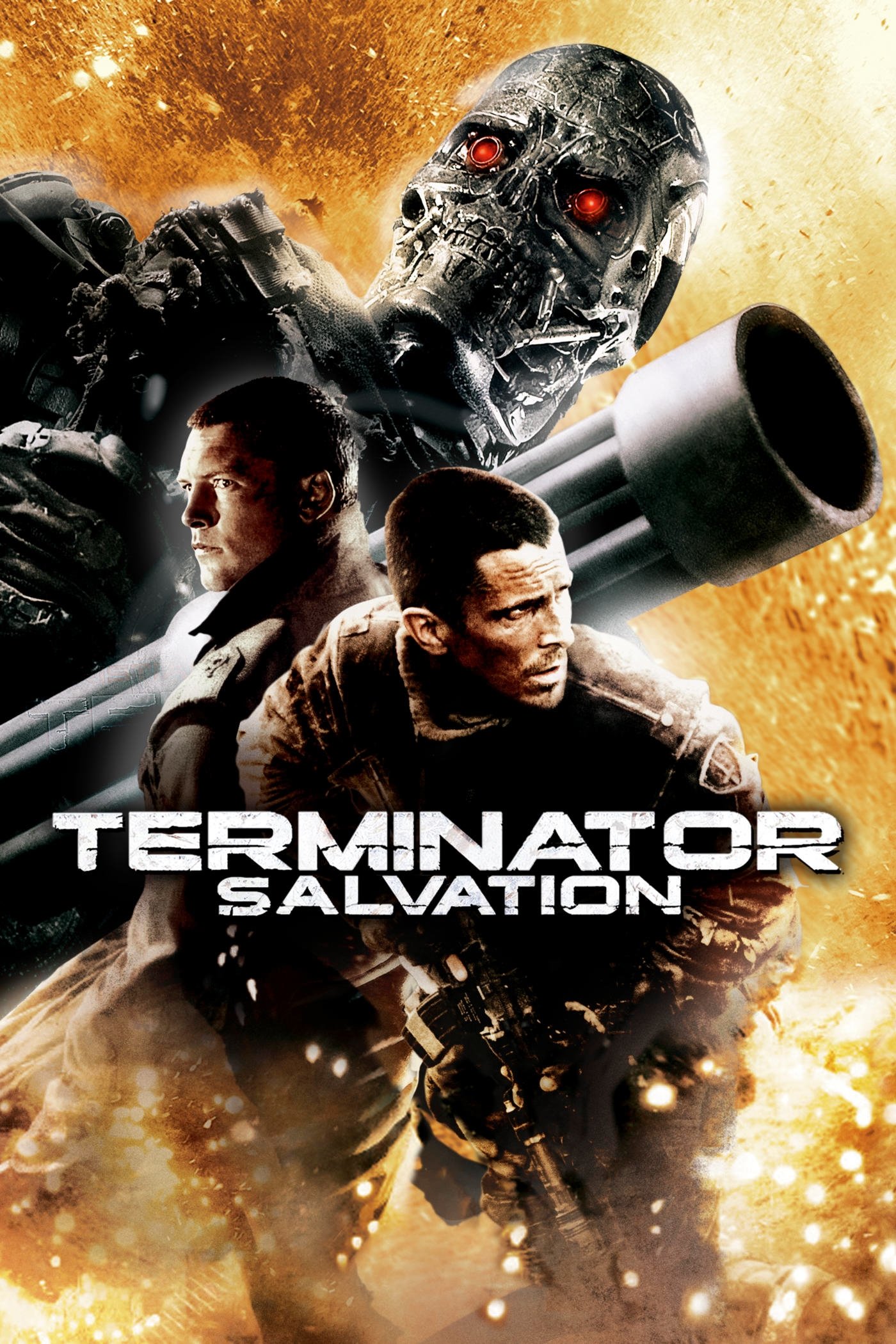

- UK release: June 2009
- Director: McG · Writers: John Brancato; Michael Ferris
- Studio / distributor: The Halcyon Company; Warner Bros.; Sony Pictures
- Genre: Post-apocalyptic science fiction action · Runtime: 115 minutes (BBFC 12A)
- Main cast: Christian Bale (The Dark Knight, American Psycho) as John Connor; Sam Worthington as Marcus Wright; Anton Yelchin (Alpha Dog, Charlie Bartlett) as Kyle Reese; Moon Bloodgood (Pathfinder) as Blair Williams
- IMDb: 6.7 / 10 · Rotten Tomatoes: 33% critics / 54% audience · My rating: 7 / 10
Every Terminator film so far has been about the future leaking into the present: a machine sent back, a hero sent back, the apocalypse always a rumour glimpsed in flash-forwards and Sarah Connor’s nightmares. Terminator Salvation does the thing the series has dodged for twenty-five years and plants itself in 2018, in the rubble, after Judgement Day. No time travel, no suburban kitchen, no liquid-metal cop walking through a present that does not know what is coming. This is the war the other films only described, and handing it to McG, of Charlie’s Angels, looked on paper like a recipe for disaster. It is not the disaster the trailers and the critics have decided it is.
The setup
It is 2018. Skynet has happened, the bombs have fallen, and what is left of humanity fights as a scattered Resistance under a command structure that John Connor (Christian Bale) does not yet run but is plainly destined to. Into this ash-grey world walks Marcus Wright (Sam Worthington), a man who wakes with no clear sense of how he got there or what the world has become, and whose path bends inevitably towards Connor’s. Skynet, meanwhile, is hunting specific people for reasons that matter to the timeline fans already carry in their heads, chief among them a young Kyle Reese (Anton Yelchin). I will leave it there, because the one genuine idea the script has is best met cold.
The cast
Bale plays Connor as clenched, hoarse and permanently furious, which is roughly the only register the part allows. He is not given much to do beyond broadcast grim resolve, and you can feel a serious actor straining against a hero who exists mainly to be prophesied about. The film’s real centre is Worthington’s Marcus, the outsider trying to work out his own nature, and he carries the human stakes more convincingly than the nominal lead. Worthington has presence and a watchful stillness that the part needs. Yelchin is a clever piece of casting as the young Reese, catching enough of the wiry, motormouth survivor Michael Biehn gave us in 1984 to land the connection without doing an impression. Moon Bloodgood’s Blair supplies most of what warmth there is.
The craft
This is where the film earns its keep. Shane Hurlbut’s photography gives the wasteland a bleached, sun-hammered grandeur, all desaturated greys and rust, and the production design builds a believable machine ecology: hunter-killers, towering harvester robots that pluck humans off the ground, motorbike drones that peel off a larger chassis mid-chase. The action is heavy, physical and largely practical-feeling, and one unbroken sequence around a petrol station, staged to look like a single take, is as good as anything the summer has offered. Danny Elfman’s score nods to Brad Fiedel’s original clanging theme without leaning on it. The intelligence here is in the engineering, not the screenplay, but the series has always been a machine-builder’s franchise, so that is not the betrayal it might be elsewhere.
How it stacks up
The comparisons are unforgiving, because the bar is The Terminator and Terminator 2, two of the best action films ever made, and nothing here touches them. Cameron’s films were lean, frightening and built around a relentless forward pulse; this one is busier and less scary, an ensemble war movie where they were chases. Set against the wider post-apocalyptic field it does better. It owes a clear debt to Mad Max in its scavenged, sun-blasted texture, and it is a more coherent piece of world-building than The Matrix Revolutions managed for its own machine war. As the first attempt to actually film the future war rather than trail it, it is a more interesting failure, and a partial success, than the scores suggest.
Critics versus the rest of us
The critics have largely written it off, sitting around a third positive, with the recurring complaint that the storytelling is as mechanical as the villains and the heart of Cameron’s films is missing. Audiences are warmer, a little over half, and that gap is the honest one. The criticism is fair: the script is over-plotted, the characterisation thin, and the emotional spark that made you care whether the Connors lived flickers rather than burns. But the consensus reads the film as worthless, and it is not. It is a competent, frequently exciting piece of spectacle that happens to be carrying a famous name it cannot live up to.
Verdict
I liked this more than I expected to, and more than its reputation allows for. Judged as the fourth chapter of a series with two masterpieces in it, it falls short, and the missing heart is a real absence rather than a quibble. Judged as a post-apocalyptic action film on its own terms, it is well made, well shot, and genuinely gripping in stretches, with a central mystery that gives the spectacle something to hang on. It is not a film I expect to return to often, which keeps it short of the top tier, but it does the difficult job of building the war the franchise has only ever promised, and it does it with more craft than it has been given credit for. 7⁄10.
Availability: On general release in UK cinemas now.
Update
Added since this review first appeared: Salvation turned out to be the end of this particular attempt at a Terminator future, with the rights moving on and the next entries, Terminator Genisys (2015) and Terminator: Dark Fate (2019), rebooting the timeline back towards Cameron’s originals rather than continuing the war picked up here. McG’s film has settled into the franchise as the curio that finally showed the future and then was quietly disowned, better remembered for its production design and its troubled shoot than for its place in the story. It is now widely available on disc and digital, and streams across the usual platforms depending on your region.
BBFC content advice
Rated 12A by the BBFC for moderate violence and intense action sequences. The notes below may contain spoilers.
Violence: There are some battle sequences with heavy explosions and gunfire, and which include sight of many robots being destroyed, including a close-up shot of a robotic head being crushed by a helicopter. Most of the damage and injury is caused to the robotic characters, while the human characters generally emerge unscathed. There is also some injury detail; however, these sequences do not dwell on detail. The film as a whole also has an unrelenting intensity; however, the tone is comparatively light.
Source: British Board of Film Classification (bbfc.co.uk).