
- UK release: March 2009
- Director: Alex Proyas · Writers: Ryne Douglas Pearson; Juliet Snowden; Stiles White
- Studio / distributor: Summit Entertainment / Escape Artists; E1 Films in the UK
- Genre: Science-fiction disaster thriller / apocalyptic mystery · Runtime: 121 minutes (BBFC 15)
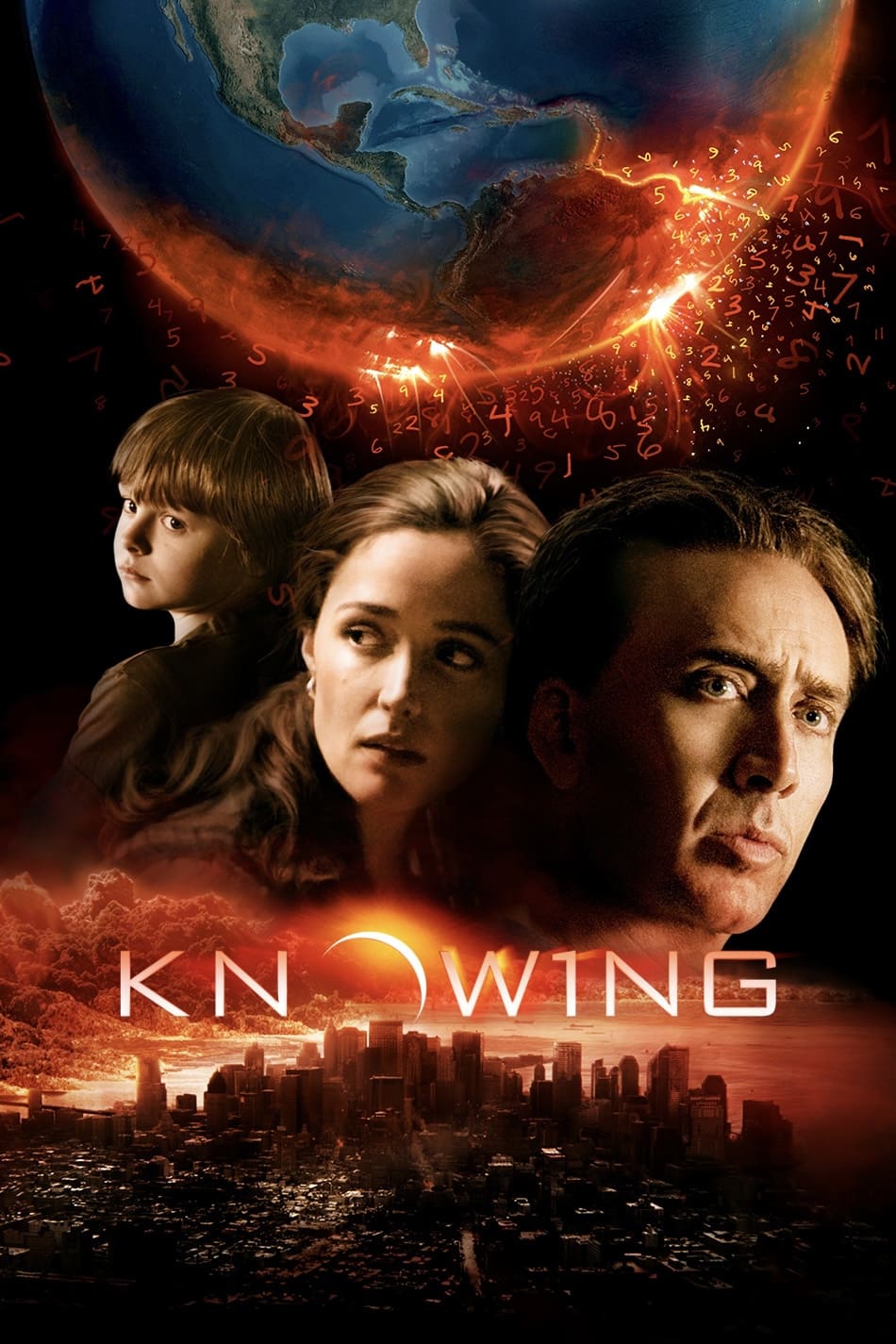
- Main cast: Nicolas Cage (Leaving Las Vegas, Face/Off) as John Koestler; Rose Byrne (Sunshine, 28 Weeks Later) as Diana Wayland; Chandler Canterbury as Caleb Koestler; Lara Robinson as Lucinda Embry / Abby Wayland
- Rotten Tomatoes: 33% critics / 42% audience · My rating: 8 / 10
Alex Proyas has spent his career building worlds that feel a half-step removed from ours. Dark City was a city dreamed by aliens; I, Robot was Asimov filtered through a Will Smith vehicle. Knowing is the most restrained-looking of the three and, oddly, the strangest, because it dresses cosmic dread in the clothes of an ordinary suburban thriller and then refuses to wink at you even once. That commitment to its own daft, enormous premise is exactly what is splitting the room. The reviews coming in are scathing; I walked out genuinely unsettled, which for this kind of film counts as the picture doing its job.
The setup
In 1959 a schoolgirl fills a sheet of paper with what looks like gibberish and seals it in a time capsule. Fifty years on the capsule is opened and the page lands with John Koestler (Nicolas Cage), an MIT astrophysicist and recently widowed father. He works out that the digits are not random: they are dates, death tolls and map coordinates for every major disaster of the past half century, accurate to the body count. A short stack of the numbers has not happened yet. Koestler, a man who insists the universe is just noise, finds himself chasing a pattern he cannot explain, with his son Caleb (Chandler Canterbury) pulled steadily closer to the centre of it.
It is a premise that could tip into the silly at any moment, and the film knows it. What keeps it upright is that Proyas treats determinism versus chance as a real question rather than a hook, and lets the dread accumulate rather than spending it early.
The cast
This is Cage in his committed register rather than his unhinged one, and the difference matters. Koestler is a grieving rationalist watching his rationalism come apart, and Cage plays the unravelling with a clammy, sleepless intensity that grounds the bigger ideas. He is best in the quiet scenes, lecturing on randomness while plainly not believing a word of his own comfort. Rose Byrne, as the daughter of the girl who wrote the page, arrives later and gives the film a second frightened adult to bounce the mystery against; she is good at the particular panic of someone who half-knew this was coming. The two children, Chandler Canterbury and Lara Robinson, carry the eeriest material without overplaying it, which is harder than the adults make it look.
The craft
Proyas and cinematographer Simon Duggan shoot suburban Massachusetts in cold greys and sodium-lit dark, so that when catastrophe does arrive it lands like a violation of an ordinary day. Two of the disaster set pieces are staged in long, near-unbroken takes, and they are the best work in the film: no cutting away to spare you, just the camera holding on as everything comes apart in real time. It is genuinely alarming, and a reminder that Proyas can do visceral as well as he does mood. Marco Beltrami’s score leans on a low, dissonant thrum that keeps the unease simmering between the big moments, and there is a recurring use of the Beethoven that ties the cosmic to the domestic. The film does run long, and a stretch in the middle sags as Koestler does his detective work, but the craft on the spectacle is not in doubt.
How it stacks up
The obvious neighbour is Signs, another film about a lapsed believer (here a scientist rather than a priest) reading a terrible pattern into the world and being proved right. Knowing is bleaker and less consoling than Shyamalan’s film, and more willing to follow its idea to the end of the line. It also sits close to The Mothman Prophecies, with its small-town omens and its sense of a larger intelligence brushing against ordinary lives, and it reaches knowingly back to Close Encounters of the Third Kind, whose awestruck-rather-than-hostile view of contact it clearly admires. Set against Proyas’s own Dark City, this is the warmer, more emotional film, less interested in the architecture of its mystery than in what the mystery does to a father and a son.
Critics versus the rest of us
The critical reception is rough, and the consensus is not hard to read: a 33% on Rotten Tomatoes, with the recurring complaint that the plot is absurd and the film far too solemn about it. Audiences are warmer but still split, at 42%. The dissenters are loud, though. Roger Ebert in particular has come out swinging for it, calling it one of the most effective of its kind, and that is roughly where I land. The objections are fair on paper, the premise is preposterous and the tone never lightens, but they describe a different, more cautious film than the one Proyas actually made. He bet everything on playing it straight, and for me the bet pays off in unease rather than eye-rolling.
Verdict
Knowing is a flawed, ambitious, oddly haunting film that is braver than its reputation suggests. It is too long, it asks you to swallow a great deal, and the seriousness that critics are mocking is, to my mind, the whole reason it works: a jokier version would have let the audience off the hook. The disaster sequences are some of the most frightening I have seen in a mainstream picture, Cage is properly invested, and the ending commits to its convictions instead of fudging them. I have not gone back to it since, and I suspect it is more of a single overwhelming experience than a repeat fixture, but as that experience it got under my skin and stayed there. 8⁄10.
Availability: On general release in UK cinemas now from E1 Films, certificate 15. Worth a big screen and a good sound system for the set pieces.
Update
Added since this review first appeared: Knowing arrived on DVD and Blu-ray in the UK in summer 2009 and has since become a fixture of late-night television. Its standing has softened a little over time, and a run of retrospective pieces now argues it was underrated, singling out the disaster sequences and Proyas’s refusal to blink. It currently streams on the usual rental platforms in the UK and turns up periodically on subscription services depending on the rights of the day.
BBFC content advice
Rated 15 by the BBFC for strong threat and intense disaster scenes. The notes below may contain spoilers.
Ratings info: Contains strong threat and intense disaster scenes.
The BBFC’s cinema record for this 2009 release (classified 11 March 2009, 121 minutes, distributed by E1 Films / Contender) carries only the short ratings-info line above and does not publish a per-category Content Advice breakdown (Violence, Language, and so on), as is common for titles of this period.
Source: British Board of Film Classification (bbfc.co.uk).