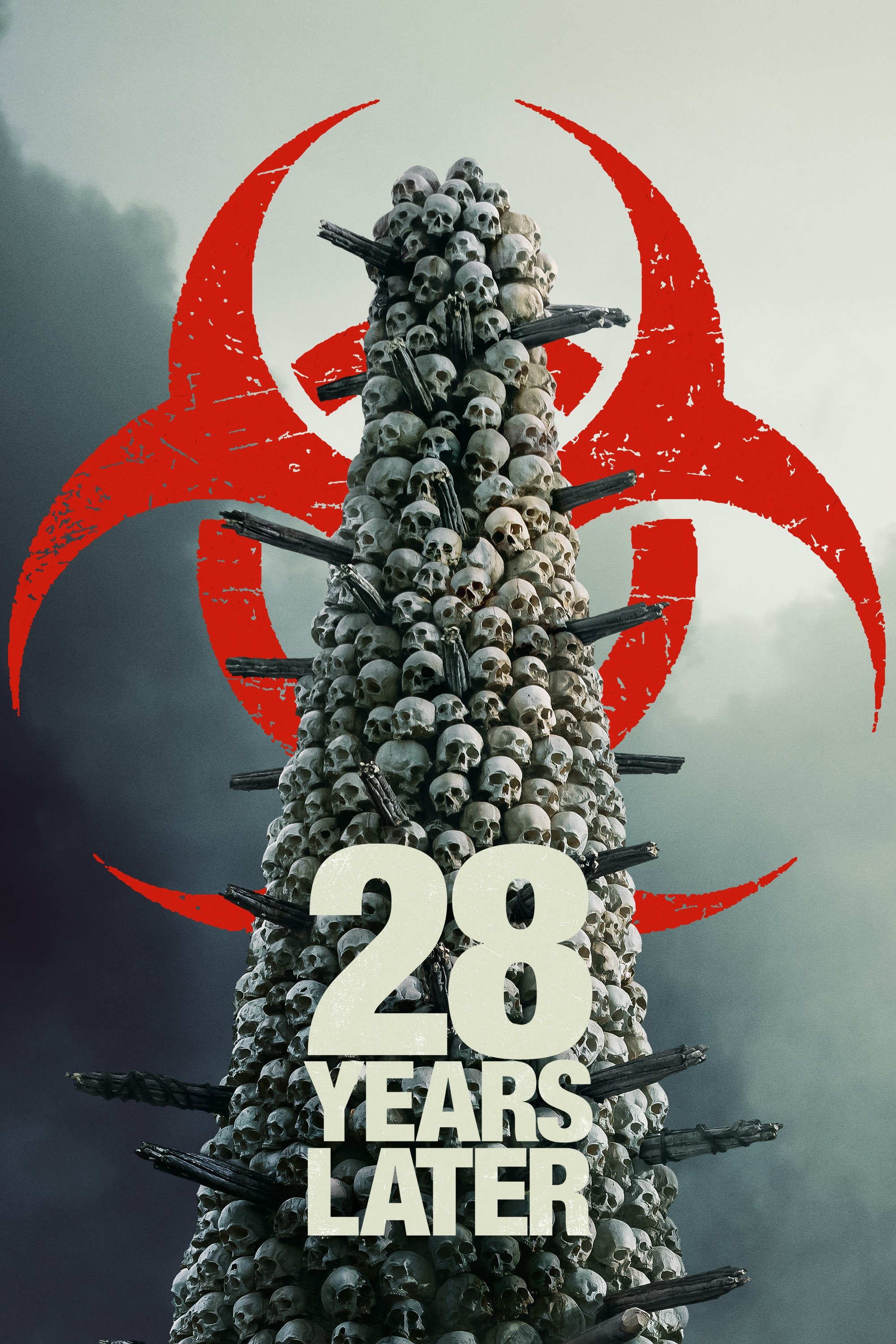
- UK release: June 2025
- Director: Danny Boyle · Writer: Alex Garland
- Studio / distributor: Columbia Pictures; DNA Films; Sony Pictures Releasing
- Genre: Post-apocalyptic survival horror · Runtime: 115 minutes (BBFC 18)
- Main cast: Jodie Comer (Killing Eve, The Last Duel) as Isla; Aaron Taylor-Johnson (Kick-Ass, Bullet Train) as Jamie; Alfie Williams as Spike; Ralph Fiennes (Schindler’s List, Conclave) as Dr Ian Kelson
- IMDb: 7.2 / 10 · Rotten Tomatoes: 90% critics / 67% audience · My rating: 8 / 10
It has been eighteen years since Danny Boyle and Alex Garland first turned an empty London into the most frightening image in modern British horror, and the wonder of 28 Days Later was always that it found dread in stillness before it found it in motion. The pair have gone their separate ways since, Boyle to Slumdog Millionaire and an Olympic opening ceremony, Garland into directing his own cold, clever pictures, and 28 Weeks Later carried the franchise on without them. So the first question hanging over 28 Years Later is whether two people who have changed this much still remember how to scare a room. The surprise is that they have come back to make something quieter and odder than a straight horror sequel, and it is the strangeness you come out thinking about.
The setup
The Rage virus never left Britain. Nearly three decades on, the mainland is a quarantined ruin and a few hundred survivors have walled themselves onto Lindisfarne, the tidal island off the Northumberland coast, reachable only by a causeway the sea swallows twice a day. Into this fragile order comes Spike (Alfie Williams), a boy of twelve raised entirely inside the safety of the community, taken by his father Jamie (Aaron Taylor-Johnson) on his first crossing to the mainland as a rite of passage, to learn how to kill the infected. What Spike finds out there, and what it does to his certainty about the people who raised him, is the real journey. His mother Isla (Jodie Comer) is gravely ill back home, and the rumour of a doctor still living somewhere on the mainland gives the boy a reason to go back out alone.
The cast
This is Alfie Williams’s film, and he carries it with a watchfulness that never tips into precocity. Spike is a child working out, in real time, that the adults around him have been lying by omission, and Williams plays that dawning without italics. Comer does a great deal with a part that could have been a bedbound symbol, giving Isla a wandering lucidity that is genuinely upsetting to watch. Taylor-Johnson is all coiled, performative competence as a father who has confused survival with virtue. Ralph Fiennes arrives late as Dr Kelson, and gives the film its strangest, most humane note, a man who has built an entire philosophy out of the dead. It is the kind of supporting turn that reorders everything around it.
The craft
Boyle shoots this the way only Boyle would. Anthony Dod Mantle’s camera lurches between formats, much of it captured on rigs of iPhones, and the result has the same queasy immediacy that the digital video gave the original, scaled up to wide Northumbrian landscape. There are bursts of expressionist editing, flickers of archive war footage cut against the chase, that announce this as a film with something on its mind beyond the next kill. The Young Fathers score is abrasive and percussive and used sparingly, which makes the silences land. The infected have evolved, and the design of what they have become is genuinely unsettling without leaning on the usual jump-scare grammar. Some of the slow-motion flourishes during the kills push their luck, but Boyle has earned a little excess.
How it stacks up
The obvious lineage is the original 28 Days Later and the bigger, blunter 28 Weeks Later, and this sits closer to the first in spirit, more interested in grief and Englishness than in spectacle. The deeper comparison is Children of Men, another British apocalypse that treats catastrophe as a backdrop for one fragile thread of hope, and like that film this one keeps finding beauty in the ruin. There is some of The Last of Us in the bond between a hardened guide and a child crossing a poisoned country, though 28 Years Later is stranger and less consoling than that. What sets it apart is how willing it is to stop being a horror film for long stretches and become a coming-of-age story instead.
Critics versus the rest of us
Critics have largely welcomed the reunion, with notices sitting around 90% and a recurring line that this is the boldest the franchise has been. Audiences are more divided, closer to 67%, and the split is easy to read: people came for a fast, frightening outbreak picture and got a melancholic mainland odyssey with a tonal swing in its final stretch that some find baffling and others find inspired. I lean towards the second camp. The shifts are deliberate, the ending is plainly a doorway to more, and the parts that frustrate a thrill-seeker are the parts I found most interesting.
Verdict
This is a sequel that respects its audience enough to be difficult. It is unsettling, often beautiful, anchored by a remarkable child performance, and confident enough to make a horror franchise sit still and grieve. It loses a little for a closing turn that feels more like a trailer for the next film than an ending in its own right, and the format experiments occasionally show off. But the world-building is rich, the British setting is used with real feeling, and I would happily watch it again to catch what Boyle is doing in the margins. A strange, sad, ambitious return that more than earns its long absence. 8⁄10.
Availability: In UK cinemas now, the sort of film worth seeing on a big screen with a good sound system before it reaches home release.
Update
Added since this review first appeared: this is the opening chapter of a planned new trilogy, with a direct follow-up, 28 Years Later: The Bone Temple, shot back to back and arriving soon after. The cliffhanger ending reads more generously once it is clear how quickly the next instalment lands. The film is now available on digital and disc, and streams depending on region.
BBFC content advice
Rated 18 by the BBFC for strong bloody violence, gore, horror, very strong language. The notes below may contain spoilers.
Violence: Strong violence - much of it inflicted on the zombie-like ‘infected’ - includes gruesome decapitations, bloody shootings, bludgeonings, impalements and immolation. A deer is torn apart, resulting in grisly aftermath images, but there is no evidence of real animal cruelty. In another scene, a man slaps his child across the face.
Threat and horror: Strong horror occurs throughout, as terrified people, including children, are chased and attacked by victims of an infectious virus that induces murderous rage.
Language: There is infrequent use of very strong language (‘ct’), as well as more frequent use of strong language (‘fk’). Milder terms include ‘dick’, ‘shit’, ‘bollocks’, ‘piss’, ‘bastard’ and ‘bloody’.
Sex: A couple are briefly seen engaging in oral sex, without graphic detail.
Injury detail: Gory detail includes bloodied corpses, severed body parts, and sight of people vomiting blood after infection by an extremely virulent disease. Further bloody images occur during a fantastical and potentially disturbing scene of childbirth.
Nudity: There are instances of breast, rear and full-frontal nudity in a non-sexual context.
Theme: There are upsetting scenes involving illness, bereavement and emotional distress.
Source: British Board of Film Classification (bbfc.co.uk).