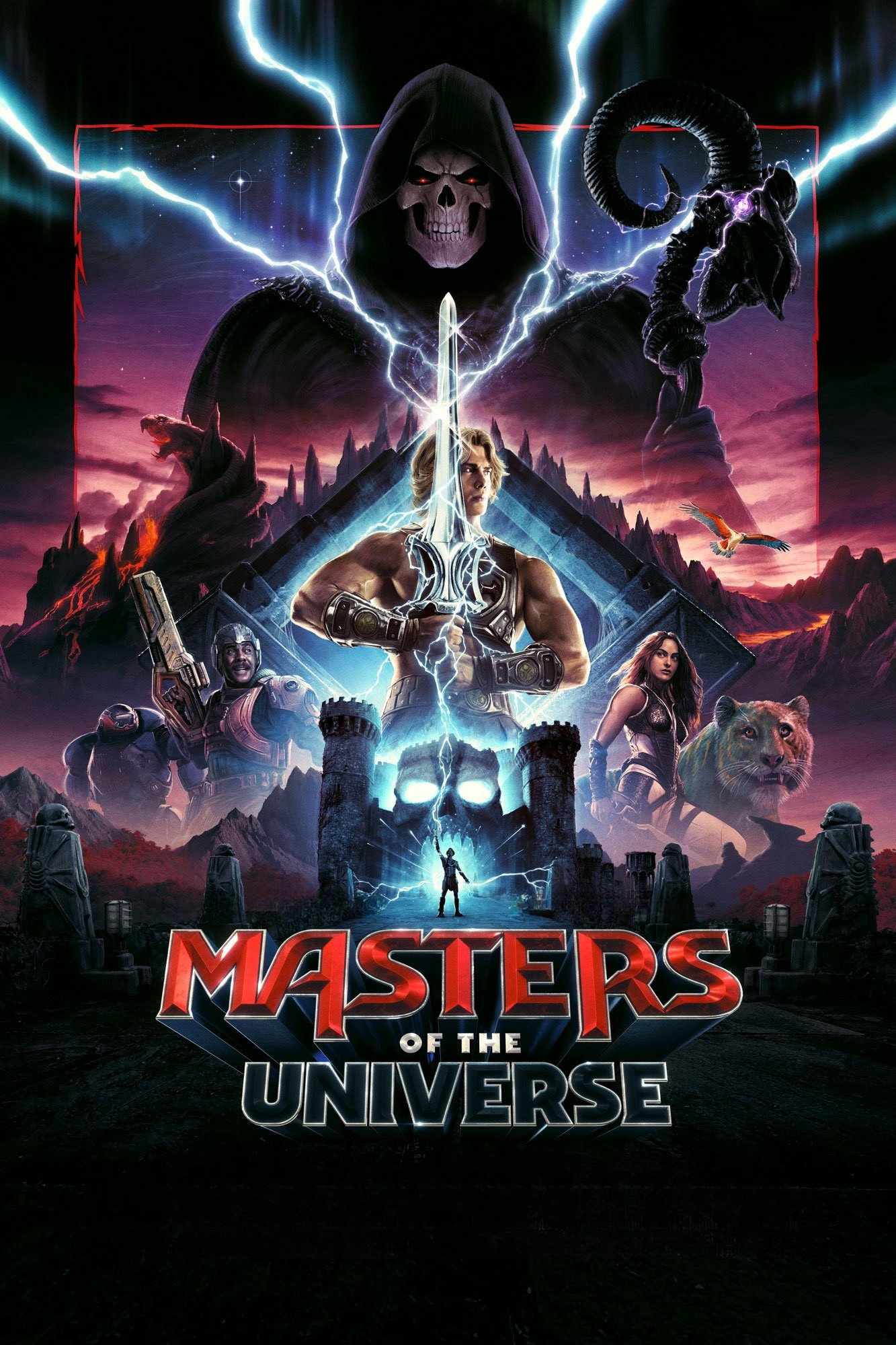
- UK release: June 2026
- Director: Travis Knight · Writers: Chris Butler, Aaron Nee, Adam Nee, Dave Callaham
- Studio / distributor: Amazon MGM Studios; Mattel Films; Escape Artists
- Genre: Science-fantasy action adventure · Runtime: 140 minutes (BBFC 12A)
- Main cast: Nicholas Galitzine (Red, White & Royal Blue, The Idea of You) as Prince Adam / He-Man; Camila Mendes (Do Revenge) as Teela; Jared Leto (Blade Runner 2049, Dallas Buyers Club) as Skeletor; Alison Brie (GLOW, The Post) as Evil-Lyn; Idris Elba (Luther, Pacific Rim) as Man-at-Arms
- IMDb: 7.1 / 10 · Rotten Tomatoes: 66% critics / 88% audience · My rating: 8 / 10
A live-action Masters of the Universe has been threatening to happen for the best part of forty years, ever since Cannon’s 1987 version put Dolph Lundgren in a loincloth and most of the budget on screen before the money ran out. Since then the project has died, been revived, swapped studios and directors, and collected enough abandoned screenplays to fill a small library. So the first surprise of the 2026 film is simply that it exists at all, and the second is that Travis Knight, of all the people who circled it, was the one to land the plane. Knight came up through Laika stop-motion and then took the keys to a Hasbro toy box and made Bumblebee, the one Transformers film with a heartbeat. He has done something similar here: taken a property that exists to sell action figures and given it a world worth caring about.
The setup
Prince Adam (Nicholas Galitzine) has spent fifteen years on Earth, hidden and ordinary, with no memory of where he came from. When the Sword of Power finds him, it pulls him back across the stars to Eternia, a planet he discovers in ruins, its order shattered and its people scattered under the rule of the sorcerer Skeletor (Jared Leto). To get his home and his family back, Adam has to work out what the sword is for, fall in with the warrior Teela (Camila Mendes) and the engineer-soldier Man-at-Arms (Idris Elba), and grow into the title the toys have been promising since 1982. The shape of the story is a coming-of-age fantasy quest, which suits the material better than the campy excess earlier versions reached for.
The cast
Galitzine is the right kind of lead for this. He has the physical presence the role needs and, more usefully, an unforced charm that keeps Adam likeable while he is still a callow young man rather than the hero on the box. He plays the gap between the two well, and the eventual transformation lands because he earns it. Mendes gives Teela more spine than the script strictly requires, and she and Galitzine have an easy, scrappy chemistry that the film leans on. Idris Elba is exactly the steadying presence Man-at-Arms should be, all gravel and patience, and he sells the technology of Eternia as something lived-in rather than decorative.
The villains are where the film gambles hardest. Jared Leto’s Skeletor is a committed, theatrical piece of work, hissing and preening behind the skull, and your tolerance for him will track fairly closely with your tolerance for Leto generally. I found him more fun than not. Alison Brie’s Evil-Lyn is the sharper threat of the two, cold and calculating where Skeletor is all appetite, and she gives the film a villain you can actually take seriously.
The craft
This is the part that lifts the film. Fabian Wagner shoots Eternia with real scale and a painterly eye, and the production design commits to a science-fantasy look, Castle Grayskull and ray-guns and sorcery sharing the same frame, without apologising for any of it. Knight’s stop-motion instincts show in how tangible everything feels: weighty creatures, practical-looking armour, action you can follow because the geography of a scene is always clear. Bear McCreary’s score is the other engine, big and thematic in the way the best fantasy scores are, and it does a lot to make the climaxes feel earned. At 140 minutes the film is generous, and the middle sags slightly, but it keeps finding new corners of its world to show you, which buys back the runtime.
How it stacks up
The obvious comparison is Knight’s own Bumblebee, and it holds: both take a cynical toy-shelf brand and find the sincerity inside it. Reach wider and the film sits in a line that runs from The Lord of the Rings for its world-building ambition to Thor: Ragnarok for the knowing, colourful tone, though this is a touch more earnest than the latter. Against the 1987 Cannon film there is no contest. Where that one borrowed from Star Wars and shot most of its Eternia in a quarry, this one actually builds the place. It is the rare reboot that justifies itself by being straightforwardly better made than what came before.
Critics versus the rest of us
Critics are split, sitting around 66%, with the praise going to Knight’s craftsmanship and the spectacle, and the reservations aimed at tonal wobble and a suspicion that nostalgia is doing some of the lifting. Audiences are markedly warmer at 88%, the highest the franchise has ever scored. That gap is familiar territory: a crowd-pleasing adventure that critics grade against prestige and audiences grade against a good night out. On this one I am closer to the crowd. The tonal seams the reviews flag are real, but they did not spoil the ride.
Verdict
This is a properly entertaining fantasy adventure, the one Masters of the Universe film that treats the material as a world rather than a joke. The world-building is generous, the craft is genuinely good, the cast is well chosen, and McCreary’s score gives it the lift it needs. It is not flawless, the middle drags and the tone occasionally wobbles between earnest and arch, but it is exactly the kind of big, sincere, rewatchable spectacle I will happily go back to. Four decades of false starts, and they finally got it right. 8⁄10.
Availability: On general release in UK cinemas now. Worth the largest screen you can find.
Update
Added since this review first appeared: this section will carry any sequel or franchise follow-up news, awards recognition, and the film’s settled reputation once they exist. For now the only thing to add is the home-viewing route: keep an eye on a digital and disc release later in the year, with streaming expected to land on Prime Video given the Amazon MGM backing.
BBFC content advice
Rated 12A by the BBFC for moderate fantasy violence, innuendo, language. The notes below may contain spoilers.
Violence: There are frequent scenes of intense fantasy violence which include gunfire, stabbings, sword fights and fist fights. In one scene, a fantastical character’s jaw is ripped apart. In another, a person’s arm is ripped off. A character extracts a blade from their chest in close-up detail. The violence is mostly depicted without any sight of bloody detail.
Threat and horror: There are frequent scenes of intense fantasy threats in which characters are in danger. Occasionally, there are mildly scary moments, such as sight of skulls impaled on spikes.
Language: There is implied strong language (‘f***k’) as well as use of the moderate term ‘pussy’; other language is mild and includes terms such as ‘shit’, ‘asshole’, ‘moron’, hell’, ‘damn’ and ‘God’.
Sex: There is comic innuendo relating to a character called ‘Fisto’, and also to the size of a character’s sword. Implied references are made to oral sex.
Drugs: A character says ‘I swear I’m not high’. There is no on-screen drug misuse.
Injury detail: A person spits blood after becoming injured during a fight. There is occasional sight of blood on characters’ faces in the aftermath of violence.
Rude humour: A drunk man vomits and burps.
Source: British Board of Film Classification (bbfc.co.uk).