
- UK release: November 2022
- Director: Mark Mylod · Writers: Seth Reiss, Will Tracy
- Studio / distributor: Searchlight Pictures; Hyperobject Industries
- Genre: Dark comedy thriller / social satire · Runtime: 107 minutes (BBFC 15)
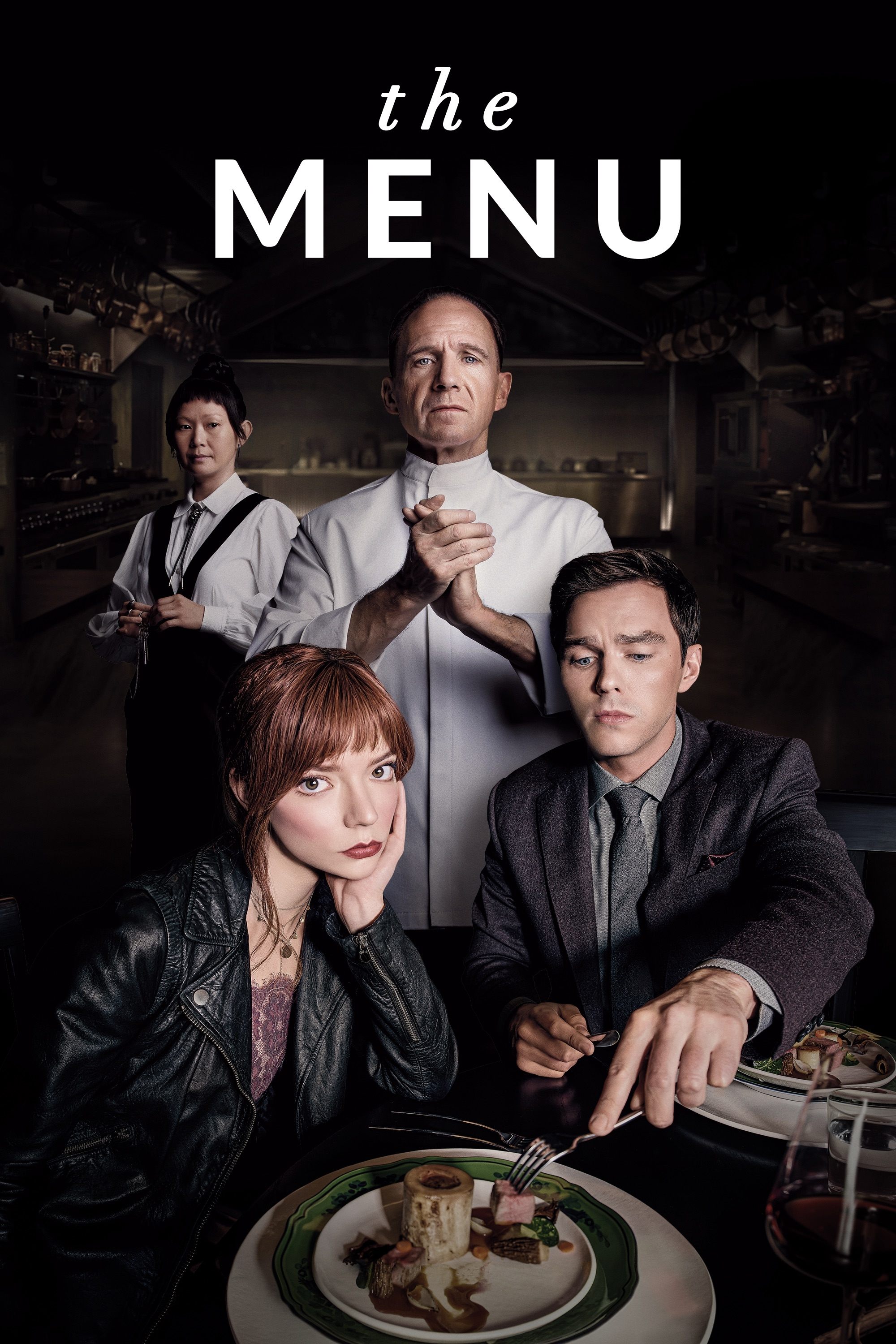
- Main cast: Ralph Fiennes (Schindler’s List, The Grand Budapest Hotel) as Chef Slowik; Anya Taylor-Joy (The Queen’s Gambit) as Margot; Nicholas Hoult (Mad Max: Fury Road, The Great) as Tyler; Hong Chau (Downsizing) as Elsa
- Rotten Tomatoes: 88% critics / 76% audience · My rating: 7.5 / 10
Mark Mylod has spent the last few years directing the cruellest episodes of Succession, the ones where the rich say the unspeakable to each other across beautifully laid tables, and The Menu is what happens when he is handed a film, a private island and Ralph Fiennes in a chef’s whites. It belongs to the small run of recent pictures that have worked out you can dress a horror structure in a dinner jacket and sell it as comedy: a closed group of the wealthy and the smug, gathered somewhere they cannot leave, picked off by a host who has clearly thought about this evening for a very long time. The promise is that the eating of the rich will be both literal and funny. For most of its length it keeps that promise.
The setup
A dozen guests take a boat to Hawthorne, an exclusive restaurant on a private island where the celebrated Chef Slowik (Ralph Fiennes) serves a tasting menu that costs more than a fortnight’s wages and is spoken of in hushed, reverent tones. Among them are Tyler (Nicholas Hoult), a besotted foodie who has waited his whole life for this table, and his last-minute date Margot (Anya Taylor-Joy), who can see from the first amuse-bouche that she does not belong here and is not especially sorry about it. The courses arrive with theatrical precision, each one introduced by Slowik with a sharp clap and a little speech, and it becomes clear fairly quickly that the menu has been designed around the specific people in the room. What it has been designed to do to them is the question that keeps you in your seat.
The cast
Fiennes is the reason the film holds. He plays Slowik as a man who has burned all the joy out of his vocation and replaced it with control, and he can move from soft-spoken hospitality to absolute menace inside a single sentence without raising his voice. It is a performance built on stillness and exactness, and it is very funny in a way that never winks at you. Anya Taylor-Joy gives Margot the one set of eyes in the room that sees the whole apparatus for what it is, and her flat, unimpressed refusal to be awed is the film’s anchor and its way in. Nicholas Hoult is having a wonderful time as Tyler, whose reverence for the chef curdles into something pitiful and squirm-inducing, and Hong Chau, as the front-of-house manager Elsa, delivers her threats with a hospitality-industry serenity that is among the best things in the film. The diners around them are sketched a little thinly, which is partly the point and partly a limitation I will come back to.
The craft
This is a handsome, tightly run film. Peter Deming shoots the restaurant as a cool, immaculate, faintly clinical space, all engineered sightlines and recessed lighting, so that the kitchen drilling away in the background feels less like a workplace than a small standing army. The courses themselves are presented with on-screen captions, which lets the film treat each dish as a beat in a structure, and Colin Stetson’s score keeps a low, anxious pressure under the comedy. Mylod paces it like a service: each course tightens the screw, the speeches get shorter and stranger, and the comic timing is precise enough that the laughs and the dread arrive together rather than taking turns. At 107 minutes it does not overstay, which matters for a film whose central trick can only be sprung once.
How it stacks up
The obvious neighbour is Parasite, which did the rich-versus-the-rest material with more layers and more heart, and the wider field of one-location social satires that have been arriving lately, the country-house whodunnit comedies and the eat-the-wealthy provocations. The Menu is more disciplined than most of them and less interested in surprising you with plot. Its real lineage is the trap film, the Saw-style premise where a controlling figure has arranged an evening of lessons for people who have wronged him, only here the apparatus is a Michelin kitchen and the lesson is about what we do to the things we claim to love. It is closer to a savage episode of prestige television than to a thriller, which makes sense given where its director has been working.
Critics versus the rest of us
Critics have taken to it warmly, sitting around 88%, drawn to the performances and the cool precision of the satire. Audiences are a touch cooler at 76%, and I think the gap is honest. The film is sharp on a real target, the way fine dining and the people who worship it can drain all the pleasure out of food, but its aim widens as it goes, and by the closing courses it is gesturing at art, money, critics and customers all at once, which softens the bite rather than sharpening it. The diners exist to be punished rather than understood, so once you grasp the shape of the evening there is less to discover than the build-up implies.
Verdict
I enjoyed this a great deal more than I expected to. It is funny, it looks immaculate, Fiennes is magnetic and Taylor-Joy gives it a centre to root for, and the central conceit is clever enough to carry a whole film. It loses a little in the back half, where the satire spreads thin and the supporting guests stay flat, and it is not a world I will be in any hurry to revisit the way I would a film with more under the surface. But as a single, well-served, very dark evening it works, and the best dish here is the simplest one. 7.5⁄10.
Availability: In UK cinemas now, on general release through Searchlight.
Update
Added since this review first appeared: the film became a steady streaming success once it landed on Disney+, where it found a larger audience than its modest cinema run suggested, and Ralph Fiennes’s Chef Slowik has settled in as one of his most quoted recent roles. It sits comfortably alongside the run of wealth-skewering satires either side of it, including Ruben Ostlund’s Triangle of Sadness and Rian Johnson’s Glass Onion, all arriving within months of each other, and it streams on Disney+ in the UK with the usual digital rental and disc options.
BBFC content advice
Rated 15 by the BBFC for strong violence, threat, suicide, language, sex references. The notes below may contain spoilers.
Violence: A woman is stabbed in the throat with a knife, resulting in blood spurting from the wound. A man’s finger is chopped off, with sight of bloody injury detail. There are fight scenes in which characters are hit in the head with objects such as a saucepan and kitchen machinery. A man is stabbed in the thigh with scissors.
Threat and horror: Frightened characters are menaced in various ways that escalate throughout the film, and they are threatened with death. Men are made to run through darkened woods to escape capture. There are scenes of knife and gun threat.
Language: There is strong language (‘motherfker’, ‘fk’) and milder terms like ‘bitch’, ‘whore’, ‘prick’, ‘shit’, ‘ass’, ‘Jesus’, ‘Christ’ and ‘God’.
Sex: There is a verbal reference to a man masturbating in front of a woman.
Suicide and self-harm: A man shoots himself in the head, resulting in a spurt of blood, and another man sets himself on fire. A man is found hanging, but we do not see this act take place.
Additional issues: There are verbal references to the domestic abuse a man witnessed his drunk father inflict upon his mother when he was a boy. A woman talks about being sexually harassed in her workplace.
Source: British Board of Film Classification (bbfc.co.uk).