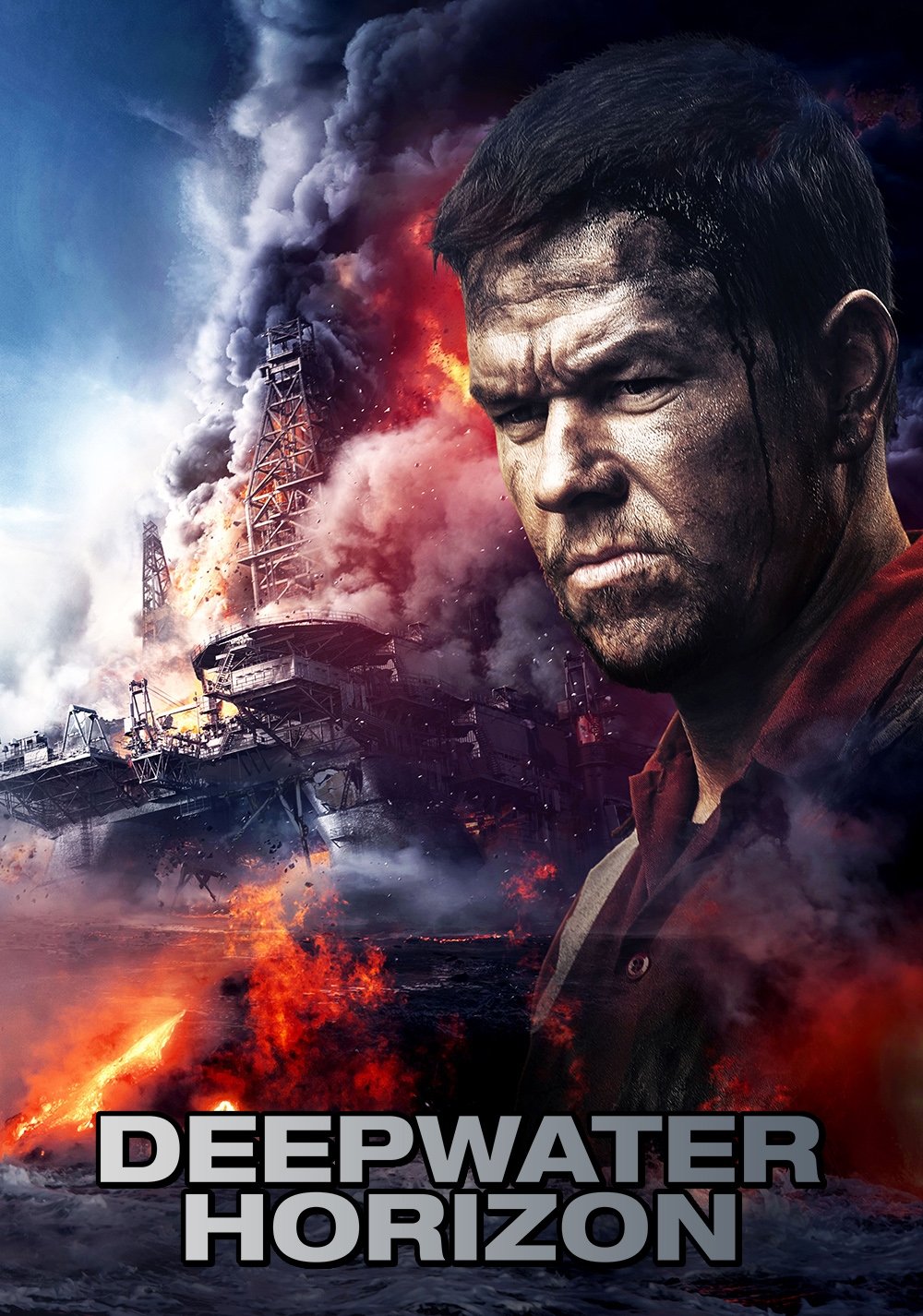

- UK release: September 2016
- Director: Peter Berg · Writers: Matthew Michael Carnahan, Matthew Sand
- Studio / distributor: Summit Entertainment; Participant Media; Di Bonaventura Pictures
- Genre: Disaster thriller / true-story survival drama · Runtime: 107 minutes (BBFC 12A)
- Main cast: Mark Wahlberg (The Departed, Lone Survivor) as Mike Williams; Kurt Russell (The Thing, Tombstone) as Jimmy Harrell; Gina Rodriguez (Jane the Virgin) as Andrea Fleytas; John Malkovich (Being John Malkovich, In the Line of Fire) as Donald Vidrine
- Rotten Tomatoes: 83% critics / 82% audience · My rating: 8 / 10
The phrase “based on a true story” usually arrives with a sinking feeling, because it tends to mean a tidy three-act sermon bolted onto something that was actually chaotic and unfair. Peter Berg, reteaming with Mark Wahlberg after Lone Survivor, has worked out a better trick. He treats the 2010 blowout on BP’s Macondo well as a job that went wrong, and lets you understand the job first. By the time the rig is on fire you know where the drill floor is, who answers to whom, and roughly how a column of high-pressure mud is supposed to behave. It is the rare disaster film that does its homework before it lights the fuse.
The setup
Mike Williams (Mark Wahlberg) is the chief electronics technician on the Deepwater Horizon, a vast floating drilling platform a mile above the seabed in the Gulf of Mexico. He kisses his wife and daughter goodbye and helicopters out for another three-week hitch under rig boss Jimmy Harrell (Kurt Russell), only to find the BP men on board, led by Donald Vidrine (John Malkovich), pushing to skip a safety test and move the project along. The well is forty-three days behind schedule and haemorrhaging money. The crew know the cement job has not been checked. The film walks you, calmly and then less calmly, from a routine shift into the moment the seabed answers back.
That is as far as a synopsis needs to go, and the film is honest enough not to pretend you do not already know how it ends. The tension is not whether disaster comes but how, and at what human cost, and who decided it was an acceptable risk.
The cast
Wahlberg is on home ground as a competent working man, and he is good at it: no speeches, just a tradesman who notices things are wrong before the people in charge will admit it. Kurt Russell gives Jimmy Harrell a weathered, unhurried authority, the old hand who has seen enough wells to distrust anyone in a clean shirt, and his early stand-off with the BP team carries more menace than any explosion. Gina Rodriguez, as bridge officer Andrea Fleytas, is the film’s nerve-ends, a young crew member suddenly making decisions no training quite prepared her for. John Malkovich, drawling through a thick Louisiana accent, makes Vidrine a study in corporate certainty rather than a moustache-twirler, a man genuinely persuaded that the numbers are on his side. The performances are unshowy and exact, which is the right register for people whose job is not to panic.
The craft
This is where Berg earns the ticket. He stages the rig as a real place, all noise and grease and procedure, so that when it fails the geography of the failure makes sense. Enrique Chediak’s camerawork stays close and physical; the sound design, all groaning metal and the deep cough of escaping gas, does as much work as the visual effects. When the blowout finally tears through the platform it is genuinely frightening, a sustained sequence of fire, falling bodies and disorientation that never tips into the weightless spectacle of a CGI demolition reel. Berg keeps the human scale: a leg trapped in twisted steel, a jump into burning water, a colleague you cannot reach. At 107 minutes the film is lean, and it spends its patience up front so the chaos at the back lands.
How it stacks up
The obvious neighbours are the recent run of competence-under-pressure true stories: Captain Phillips, with its procedural build and its everyman caught in someone else’s catastrophe, and Sully, another short, sober reconstruction of professionals doing their jobs in an impossible window. Reach further back and the model is Apollo 13, which understood that watching skilled people solve a technical problem is its own kind of thriller. Deepwater Horizon sits comfortably in that company, and it shares with Berg and Wahlberg’s own Lone Survivor a real interest in physical hardship and the loyalty of men in a tight crew. Where it is thinner is the politics. The corporate villainy is real but broad, and the film is more interested in the rig than the boardroom that doomed it.
Critics versus the rest of us
Critics are largely won over, sitting around 83%, praising the craft, the tension and the plain respect for the workers, while flagging that the BP figures are drawn in heavy strokes and that the structure is, finally, a well-built disaster movie. Audiences are right alongside them at 82%. I land with both. The simplification of the suits is the one place the film settles for less than it could have, and you can feel it reaching for an outrage it never quite dramatises. But the thing it sets out to do, putting you on that floor as it comes apart, it does about as well as the form allows.
Verdict
What stays with me is the discipline. Berg resists the disaster genre’s worst habits, the cheap heroics and the empty spectacle, and instead builds something that respects both the engineering and the people standing on top of it. The villains are too neat and the closing real-world coda lays the sentiment on a touch thick, but the central hour is gripping, intelligent and grounded, and the survival sequence is among the most convincing put on screen in years. It is not a film I will reach for on a quiet Sunday the way I would a favourite science fiction picture, but as a piece of tense, well-made true-story filmmaking it is a clear success. 8⁄10.
Availability: On general release in UK cinemas now; worth the big screen and the big sound for the blowout sequence alone.
Update
Added since this review first appeared: Berg and Wahlberg completed an unofficial trilogy of true-story dramas with Patriots Day (2016), about the Boston Marathon bombing, released within weeks of this one, and the pairing went on to Mile 22 and beyond. Deepwater Horizon has settled into a reputation as one of the more respected disaster films of its decade, admired for its craft even by those who find its corporate villains broad. It is now widely available on Blu-ray, 4K UHD and digital, and turns up on the major streaming and rental services depending on your region.
BBFC content advice
Rated 12A by the BBFC for moderate threat, occasional gory moments, infrequent strong language. The notes below may contain spoilers.
Threat and horror: There are a number of scenes of moderate threat as explosions rip through the oil rig, with workers being enveloped by flames and hit by flying debris.
Injury detail: There are some images of bloody injuries, most notably a scene in which a man’s broken leg has to be manipulated to free him from twisted metal, and a shot of a man pulling broken glass and shards of metal from his feet.
Language: There is a single use of strong language (‘f***k’), which is used purely for emphasis rather than as a threat or insult.
Source: British Board of Film Classification (bbfc.co.uk).