- UK release: September 2012
- Director: Pete Travis · Writer: Alex Garland
- Studio / distributor: DNA Films / Lionsgate
- Genre: Dystopian science fiction action / comic-book thriller · Runtime: 95 minutes (BBFC 18)
- Main cast: Karl Urban (The Lord of the Rings: The Fellowship of the Ring, Star Trek) as Judge Dredd; Olivia Thirlby (Juno) as Judge Cassandra Anderson; Lena Headey (300, The Brothers Grimm) as Ma-Ma; Wood Harris (The Wire, Remember the Titans) as Kay
- IMDb: 7.1 / 10 · Rotten Tomatoes: 79% critics / 72% audience · My rating: 8 / 10
There is a long shadow over any new attempt at Judge Dredd, and it is shaped like Sylvester Stallone’s chin. The 1995 film took 2000 AD’s masked fascist lawman, removed the helmet within twenty minutes, gave him a love interest and a comedy sidekick, and missed the joke entirely. So the first thing to say about this version, written by Alex Garland and directed by Pete Travis, is that it has read the strip. The helmet stays on. The city stays ugly. Nobody learns to love. Garland, who gave Danny Boyle the scripts for 28 Days Later and Sunshine, has clearly decided that the way to honour Dredd is not to widen him out into an epic but to shrink the whole thing down to a single bad afternoon.
The setup
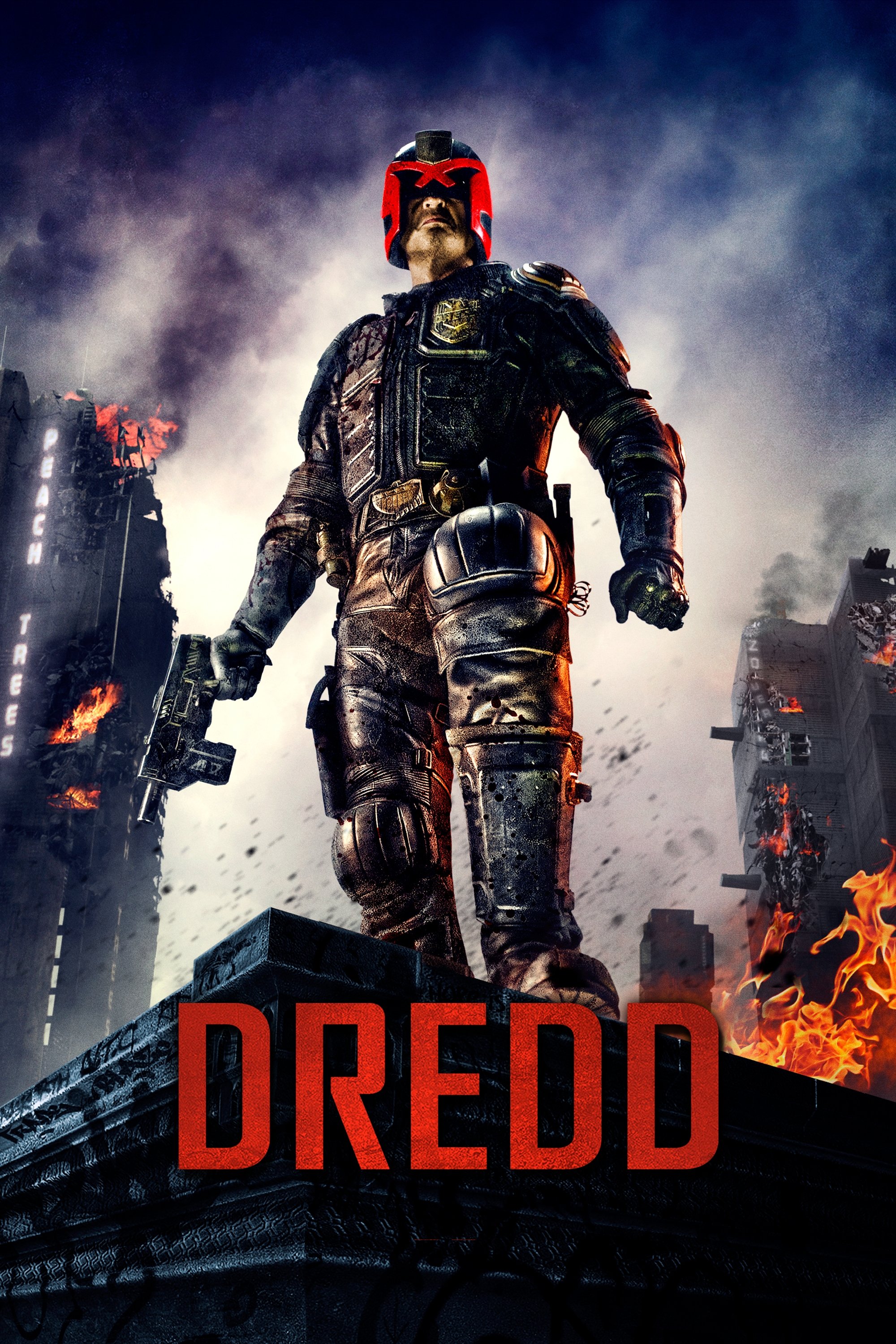
Mega-City One is eight hundred million people crammed into one continuous slab of concrete between the radioactive deserts, and the Judges are the only law: police, jury and executioner in one armoured uniform. Dredd (Karl Urban), the hardest of them, is handed a rookie to assess, Cassandra Anderson (Olivia Thirlby), a mutant with weak aptitude scores but powerful psychic ability. Their routine call is a triple homicide at Peach Trees, a two-hundred-storey tower block run as a private fiefdom by a scarred drug baron called Ma-Ma (Lena Headey), who is pushing a narcotic that slows the user’s sense of time to a crawl. When the two Judges take a witness into custody, Ma-Ma seals the block, puts its entire population on a bounty, and turns the building into a single vertical killing floor. There is no wider plot to untangle. There is a building, two Judges, and a great many people who want them dead, and the film is the climb.
The cast
Urban does the thing the 1995 film would not allow: he acts the entire role from the mouth down, jaw set, voice a flat permanent growl, and somehow makes a man you never fully see into a presence you cannot look away from. It is a performance of pure restraint, and a small act of faith in the source. Thirlby has the harder and more interesting part. Anderson is the film’s only window, the one character allowed doubt, fear and mercy, and Thirlby plays her growing competence without ever turning her soft. Headey, meanwhile, gives Ma-Ma a tired, scarred ruthlessness that is far more unsettling than scenery-chewing would have been; she runs her tower the way a bored manager runs a failing branch. Wood Harris, as the captured gang lieutenant cuffed between the two leads, keeps the human stakes ticking under the gunfire.
The craft
Travis and cinematographer Anthony Dod Mantle find a genuinely grimy future, all wet concrete, sodium light and dead air, that owes more to the original comic’s squalor than to any gleaming science-fiction city. The clever flourish is the drug, Slo-Mo, which lets the film drop into hyper-detailed slow motion: water beading off skin, glass blooming apart, a face distending around a bullet, rendered in saturated, hallucinatory colour. It could have been a gimmick. Instead it becomes the film’s signature, the one moment of beauty in a world with none, and it earns its 3D in a way most films released this year do not. Paul Leonard-Morgan’s score grinds along underneath like industrial machinery. At ninety-five minutes the thing never sags, because there is nothing in it that does not need to be there.
How it stacks up
The obvious comparison, and the one every viewer will reach for, is The Raid, the Indonesian film with almost the identical premise of cops fighting up through a tower block of armed criminals. Both arrived within months of each other, and both prove how much tension you can wring from a stairwell. Where The Raid is a martial-arts ballet, Dredd is a gunfight, blunter and colder. The deeper lineage runs back through RoboCop, with its satirical view of law as a product, and Escape from New York and Assault on Precinct 13, those lean John Carpenter siege pictures where a small number of professionals hold a position against the dark. Dredd belongs in that company. It is a B-movie in the best sense: tight, cheap-feeling in the right places, expensive only where it counts.
Critics versus the rest of us
Critics have largely come round, sitting near 79%, praising exactly the discipline that makes it work: the refusal to explain, the commitment to its tone, the clarity of the action. Audiences are a little cooler at 72%, and the box office has been frankly poor, which is the real worry here, since this is plainly built as the first chapter of something larger. That is a shame, because the very things keeping casual viewers away, the bleakness, the lack of an origin story, the masked unknowable lead, are the things that make it good. The gap between its reputation and its takings is the kind that usually closes on disc, where word of mouth does the work the marketing could not.
Verdict
This is the rare adaptation that understands what it is adapting and has the nerve to deliver it without apology. It is violent, narrow and grim, and it knows it; it is also sharply made, genuinely thrilling and endlessly rewatchable, the sort of ninety-five minutes you can put on again knowing exactly what you are getting. I would happily take its single-block focus over a bloated franchise opener any day. It does not reinvent the siege thriller, but it executes one about as cleanly as the form allows, and Urban’s growl deserves a sequel the numbers may not give him. 8⁄10.
Availability: In UK cinemas now, including in 3D, where the Slo-Mo sequences are worth the surcharge.
Update
Added since this review first appeared: the sequel the box office withheld never came, but Peach Trees did not stay sealed. Dredd’s strong cult afterlife on disc, fuelled by exactly the home-viewing word of mouth predicted above, drove a long fan campaign for more, which eventually produced Judge Dredd: Mega-City One, a television series kept in development by Rebellion. The film itself has settled into its reputation as the definitive screen Dredd and one of the best comic-book films of its decade, and it streams across the usual rental and subscription platforms depending on region, with the 3D Slo-Mo work still its calling card.
BBFC content advice
Rated 18 by the BBFC for frequent strong bloody violence and gore. The notes below may contain spoilers.
The BBFC release page for Dredd could not be retrieved at the time of writing (the site returned a server error), so the full category-by-category Content Advice is not reproduced here. The points below are the verified BBFC notes confirmed from the Board’s own listing and announcement.
Rating reason: “Contains frequent strong bloody violence and gore.”
Violence: Frequent strong violence, much of it bloody and gory, with some moments that dwell on the infliction of pain and injury.
Drugs: Frequent use of a futuristic drug, Slo-Mo, which slows the user’s perception of time.
Language: Frequent use of strong language.
Sex: A brief and discreet scene implies a violent sexual fantasy inside a criminal’s mind.
Source: British Board of Film Classification (bbfc.co.uk).