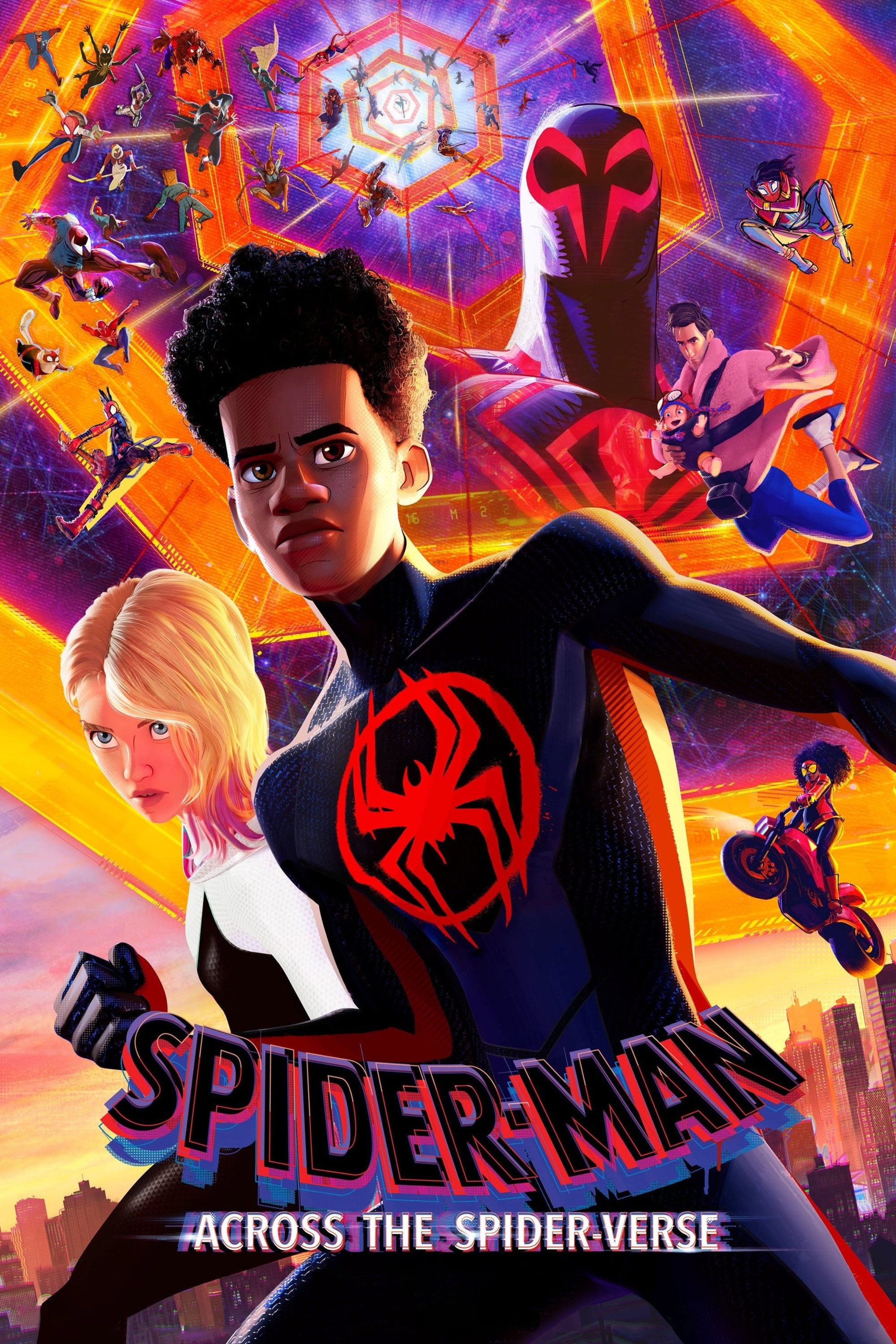

- UK release: June 2023
- Directors: Joaquim Dos Santos, Kemp Powers, Justin K. Thompson · Writers: Phil Lord, Christopher Miller, Dave Callaham
- Studio / distributor: Columbia Pictures; Sony Pictures Animation
- Genre: Animated superhero multiverse adventure · Runtime: 140 minutes (BBFC PG)
- Main cast: Shameik Moore (Into the Spider-Verse, Dope) as Miles Morales; Hailee Steinfeld (True Grit, Hawkeye) as Gwen Stacy; Oscar Isaac (Ex Machina, Dune) as Miguel O’Hara; Jason Schwartzman (Rushmore) as The Spot
- IMDb: 9.0 / 10 · Rotten Tomatoes: 95% critics / 95% audience · My rating: 8.5 / 10
Five years ago Spider-Man: Into the Spider-Verse did something nobody quite expected from a Sony animation about the wrong Spider-Man: it walked off with the Academy Award and rewrote what a superhero cartoon was allowed to look like. The problem with making the best film of its kind is that the sequel has to follow it, and follow-ups to beloved animated originals do not have a happy history. Across the Spider-Verse turns up with that weight on its shoulders and a clear answer to it, which is to make almost everything larger: more worlds, more Spider-people, more styles of drawing on screen at once than your eye can comfortably hold.
The setup
A year or so on from the first film, Miles Morales is still the only Spider-Man in his Brooklyn, juggling school, his parents and the job nobody knows he does. Gwen Stacy drops back into his life and pulls him through to a vast organisation of Spider-people from across the multiverse, run by the severe Miguel O’Hara, who polices the dimensions and the rules that hold them together. There is a villain, the Spot, a man riddled with portals who starts as a joke and stops being one. But the real conflict is about fate: the society insists that certain losses are fixed points every Spider-Man must suffer, and Miles, being Miles, refuses to accept that his story has to break the same way everyone else’s does.
The cast
Shameik Moore has grown into Miles completely. The character is older, funnier and more frustrated here, caught between parents who want the truth and a hero’s life that depends on hiding it, and Moore plays the gap between the two with real warmth. Hailee Steinfeld gets the heavier lift this time: Gwen carries her own film for a long opening stretch, estranged from her police-officer father, and Steinfeld gives her a bruised, guarded quality that the first film only hinted at. Oscar Isaac brings exactly the right granite authority to Miguel, a Spider-Man with no patience and a great deal of grief, and Jason Schwartzman makes the Spot genuinely unsettling once the laughs run out. The voice work never feels like celebrities reading lines; it feels cast.
The craft
This is where the film is close to untouchable. The first Spider-Verse invented a comic-book look, halftone dots, printing misregistration, hand-lettered sound; the sequel takes that idea and shatters it into a different visual language for every universe. Gwen’s world is wet watercolour that shifts colour with her mood; Miguel’s future is hard chrome; the Spot is loose ink on white. Hold a dozen of those styles in one frame, as the film repeatedly does, and it should be a mess. It is instead the most visually inventive thing in cinemas. Daniel Pemberton’s score and a strong song line keep the energy high, and the action set pieces, a chase through Mumbattan, the long pursuit through Miguel’s headquarters, are staged with real spatial wit. The only craft complaint is length: at 140 minutes it is full, and you feel the film straining to fit everything in.
How it stacks up
Against Into the Spider-Verse it is the bigger, more ambitious film and the slightly less complete one, because it is plainly half a story. As multiverse cinema it embarrasses most of the live-action competition; where Spider-Man: No Way Home used its parallel worlds for nostalgia and cameos, this uses them to ask what a Spider-Man story is actually for. The closest cousin in spirit is Everything Everywhere All at Once, another film that treats infinite realities as a way into one family’s grief rather than an excuse for spectacle. It is the rare sequel that earns the comparison to its own predecessor instead of hiding behind it.
Critics versus the rest of us
Critics are close to unanimous, sitting at 95% and praising the animation, the emotional reach and the sheer density of invention, with the only real reservation being the ending, which stops mid-sentence. Audiences are matching them at 95%, and IMDb users have pushed it to the top of the superhero pile. The single complaint that recurs, the cliffhanger, is fair, and it is the main reason my own number lands a little below the chorus. A film that asks you to wait for part two before it resolves anything has not quite earned a top mark on its own.
Verdict
I value world-building, visual ambition and films that use a wild premise to say something real, and on all three this delivers handsomely. It looks like nothing else, the central idea about fate and refusal has genuine weight, and it is endlessly rewatchable for the craft alone. What holds it just short is the structure: it is the first half of a film, and it leaves you hanging rather than landing. That is a real cost, not a quibble. Even so, this is animation at the height of its powers and the most exciting blockbuster of the year. 8.5⁄10.
Availability: On general release in UK cinemas now. See it on the biggest screen you can find; the frame is doing too much to waste on a phone.
Update
Added since this review first appeared: the second half, Spider-Man: Beyond the Spider-Verse, was announced to follow but slipped well past its original date, which makes that cliffhanger ending sting more in hindsight than it did opening week. Across the Spider-Verse has held its standing as one of the best-reviewed animated films of its decade and a high-water mark for the form. It now streams on Netflix in the UK and is available on 4K Blu-ray and digital.
BBFC content advice
Rated PG by the BBFC for mild threat, violence, injury detail, language. The notes below may contain spoilers.
Violence: There are frequent action sequences which feature characters fighting one another; punches and kicks are thrown as well as occasional chokeholds.
Threat and horror: There are frequent scenes of prolonged threat in which Spider-heroes fight each other and villains, as well as rescue people from dangerous situations such as falling debris. A character is tied up against their will and threatened by another; the scene is brief but fairly intense and tonally dark. There is a brief scene of gun threat.
Language: Mild terms include use of ‘ass’, ‘crap’ and ‘bloody’, as well as other terms such as ‘butt’, ‘God’, ‘hell’, ‘jeez’ and ‘shot’.
Sex: A man covered in dots makes references to his ‘holes’. A woman describes her husband as being ‘hot’. There are also several references to a teenage boy and girl fancying each other.
Rude humour: A boy is caught doing his zip up. There is a very brief shot of a fantastical character patting their bottom.
Drugs: A man exclaims ‘What does he do? Deal drugs?’.
Injury detail: After fighting, characters are shown with cuts and bruises.
Theme: There are references to death and bereavement, as well as occasional references to mental health. Neither issue is dwelt upon and both themes are handled sensitively.
Flashing/flickering lights: This work contains flashing images which may affect viewers who are susceptible to photosensitive epilepsy.
Source: British Board of Film Classification (bbfc.co.uk).