
- UK release: November 2016
- Director: Denis Villeneuve · Writer: Eric Heisserer (from the Ted Chiang story)
- Studio / distributor: Paramount Pictures; Entertainment One (UK)
- Genre: Science fiction drama / first-contact mystery · Runtime: 116 minutes (BBFC 12A)
- Main cast: Amy Adams (The Fighter, American Hustle) as Louise Banks; Jeremy Renner (The Hurt Locker, The Town) as Ian Donnelly; Forest Whitaker (The Last King of Scotland) as Colonel Weber; Michael Stuhlbarg (A Serious Man) as Agent Halpern
- IMDb: 7.9 / 10 · Rotten Tomatoes: 94% critics / 82% audience · My rating: 8.5 / 10
Denis Villeneuve has spent the last few years making serious genre films that behave like dramas: a kidnapping thriller that turned into a moral test in Prisoners, a border procedural that curdled into dread in Sicario. Arrival is the moment he points all of that control at science fiction, and it is the genre that suits him best. Twelve alien craft appear over twelve places on Earth, hang in the air doing nothing, and the film that follows is not about the spaceships. It is about a linguist trying to ask them a question, and what the asking does to her.
The setup
Louise Banks (Amy Adams) is a university linguistics professor, recruited by the US military after one of the ships settles over Montana. Nobody knows why the visitors are here, the world is sliding towards panic, and the only way to find out is to teach two species to talk to each other from scratch. Paired with theoretical physicist Ian Donnelly (Jeremy Renner) and managed by an impatient Colonel Weber (Forest Whitaker), Louise starts at the beginning: a single written word, held up against the glass. The further she gets into the visitors’ language, the more her own sense of time begins to loosen, and the film threads that private unravelling through grief she seems already to be carrying. To say much more would spoil a structure that rewards going in cold.
The cast
This is Amy Adams’s film, and she holds it almost single-handed. Louise is the rare science fiction lead who solves things by thinking, listening and being patient, and Adams makes that watchable: tired, frightened, stubbornly curious, and quietly wrecked underneath. After The Fighter and American Hustle she has the range for it, and here she works mostly in stillness and reaction, which is harder. Jeremy Renner, who knows how to play a competent man under pressure from The Hurt Locker, is sensibly cast against type as the lighter of the two, the physicist who cracks jokes while Louise does the real work. Forest Whitaker gives Weber a weary decency rather than the usual military bark, and Michael Stuhlbarg’s nervy CIA man supplies the institutional fear that keeps tightening the screws. The performances are calibrated low, which is exactly right for the tone.
The craft
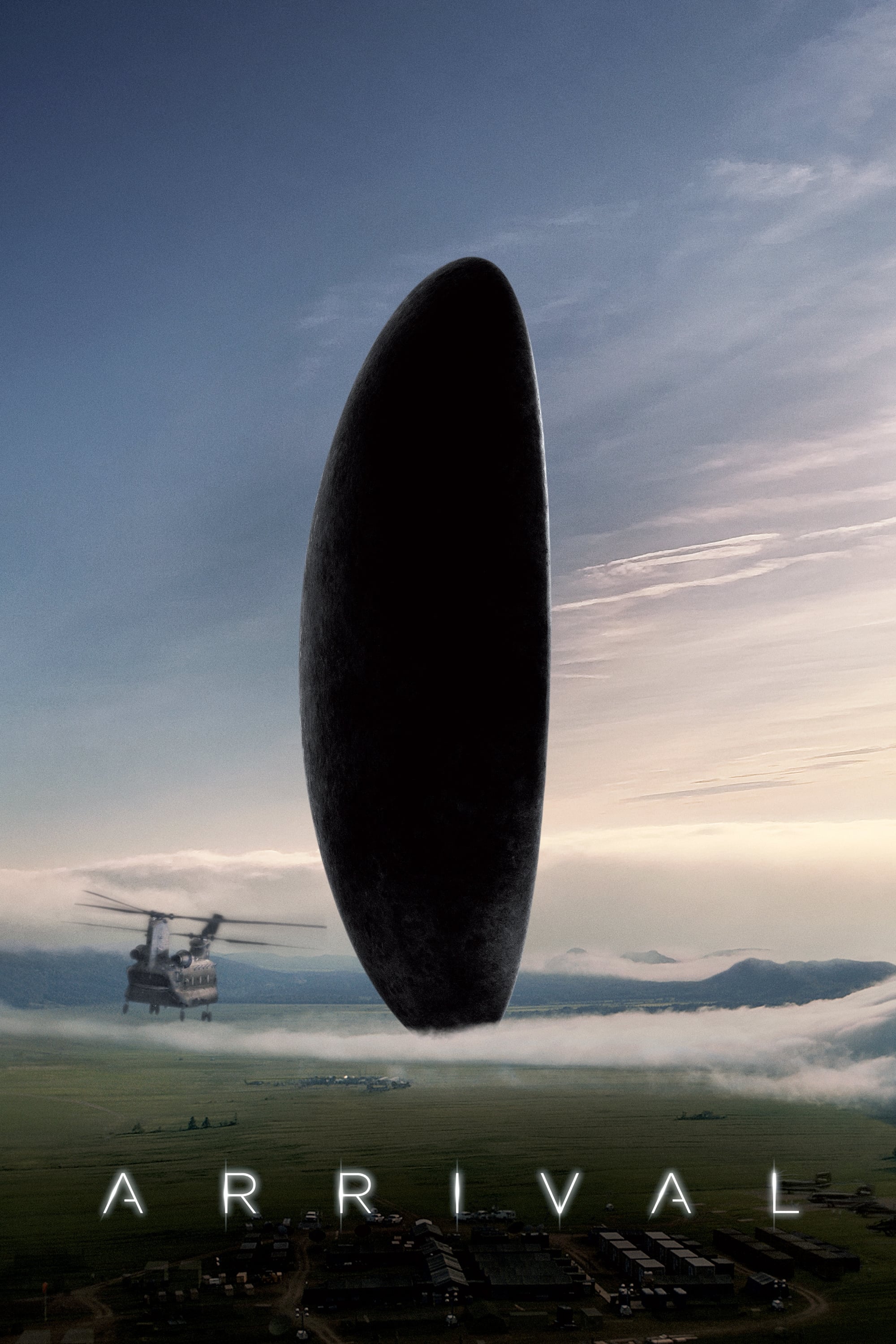
Villeneuve and his cinematographer Bradford Young shoot the whole thing in muted greys and greens, with the alien ship, a smooth black lozenge tipped on its end, looking less like a machine than a held breath. The visitors, when we meet them, are revealed slowly and through fog, and the restraint pays off; this is a first-contact film that understands awe is mostly about what you do not show. Jóhann Jóhannsson’s score is the other half of the atmosphere, all low drones and human voices used as texture, unsettling and mournful at once. The visual design of the alien written language, circular smoke-rings of ink, is the cleverest single idea in the film, because it ties the look directly to the theme: a way of writing that has no beginning or end. The pacing is deliberate and a couple of viewers around me clearly wanted it faster. It does not need to be.
How it stacks up
The obvious touchstones are Contact and Close Encounters of the Third Kind, and Arrival earns the company. Like Contact it takes a scientist-protagonist and a genuinely intellectual problem seriously, and like Close Encounters it treats first contact as wonder rather than invasion. Where it goes further than either is in making the actual mechanics of communication the drama: not a translation montage, but the slow, frustrating, exhilarating business of building shared meaning from nothing. Set it beside Villeneuve’s own Sicario from the year before and you see the same director, the same patience and dread, pointed at hope instead of despair. It is closer in spirit to the cerebral end of Interstellar than to anything with a laser in it.
Critics versus the rest of us
Critics are close to unanimous, sitting at 94%, praising the intelligence, Adams, and the way the film carries real emotion through a high-concept idea. Audiences are warm but more divided at 82%, and the gap is easy to explain: this is a slow, structurally tricky film that asks you to keep up and then asks you to feel something at the end, and not everyone wants that from a film about spaceships. Some of the audience cooling is people who came for an invasion and got a grammar lesson with a gut-punch. I am firmly on the critics’ side here, with one reservation I will come to.
Verdict
This is intelligent science fiction of the kind I will always make time for: a film that respects the audience, builds its world through ideas rather than spectacle, and trusts atmosphere over noise. Adams is superb, the look and sound are immaculate, and the central conceit is genuinely clever rather than merely complicated. My one hesitation is rewatchability. So much of the film’s power lives in its structure that the second viewing is a different, cooler experience, more admiration than discovery, which keeps it a notch below the films I return to most. That single reservation is the only thing standing between it and a higher mark. Everything else about it is close to faultless. 8.5⁄10.
Availability: On general release in UK cinemas now. Worth a proper screen and a quiet, attentive crowd.
Update
Added since this review first appeared: Arrival went on to a Best Picture nomination and a string of awards, and Villeneuve followed it straight into Blade Runner 2049 (2017) and then Dune (2021), confirming the run of intelligent, controlled science fiction this film announced. Jóhann Jóhannsson, who scored it, died in 2018, which gives the music an extra weight on a rewatch. It has settled in as one of the most respected science fiction films of its decade and is now widely available on disc, digital and streaming depending on region.
BBFC content advice
Rated 12A by the BBFC for infrequent strong language. The notes below may contain spoilers.
Language: Infrequent strong language (‘f**k’) as well as milder terms including ‘bastard’, ‘screw’ and ‘oh my God’.
Additional issues: There are several sequences of mild threat in which people come into contact with the aliens and are scared of them, and scenes in the style of news footage showing people panicking and rioting around the world. There are also scenes showing a woman crying and visibly upset after the death of her young daughter.
Source: British Board of Film Classification (bbfc.co.uk).