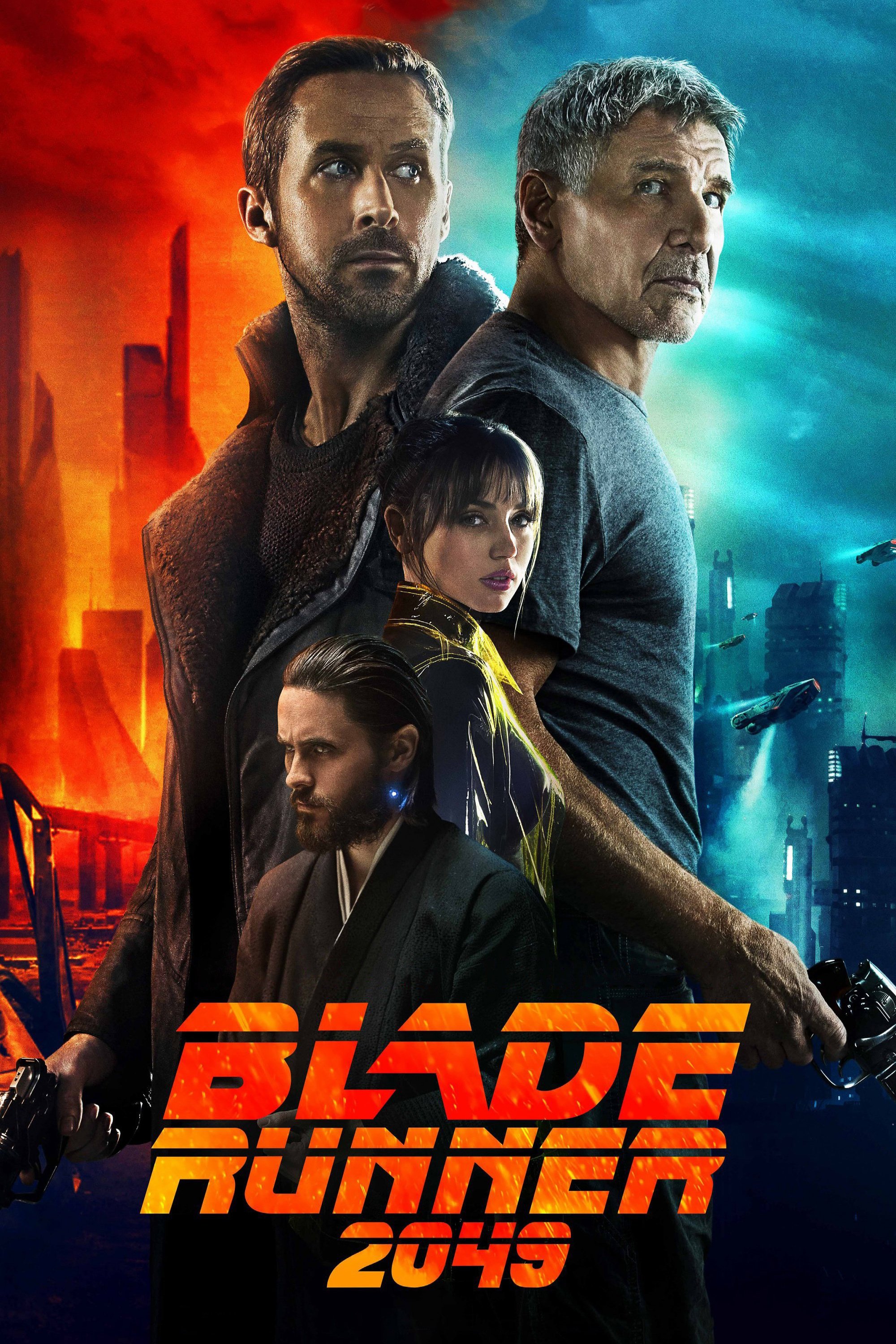

- UK release: October 2017
- Director: Denis Villeneuve · Writers: Hampton Fancher, Michael Green
- Studio / distributor: Alcon Entertainment; Columbia Pictures; Warner Bros.
- Genre: Neo-noir science fiction / cyberpunk mystery · Runtime: 164 minutes (BBFC 15)
- Main cast: Ryan Gosling (Drive, Half Nelson) as K; Harrison Ford (Blade Runner, Raiders of the Lost Ark) as Rick Deckard; Ana de Armas (Knock Knock) as Joi; Sylvia Hoeks as Luv
- IMDb: 8.0 / 10 · Rotten Tomatoes: 88% critics / 81% audience · My rating: 9.5 / 10
A sequel to Blade Runner has always been the project nobody dared finish. Ridley Scott’s 1982 film took years to be understood, gathered cuts the way other films gather sequels, and ended up the founding text of cyberpunk, the rain-soaked, neon-drowned future every science fiction film since has borrowed from. Following it is a fool’s errand, which is exactly why the choice of Denis Villeneuve to direct felt less reckless than it should have. After Sicario and Arrival, here is a director who understands patience and dread, who lets a frame breathe, and who treats science fiction as a place to ask questions rather than stage fireworks. The astonishing thing is that he has pulled it off.
The setup
K (Ryan Gosling) is a blade runner working the same grim trade as Deckard before him, hunting and retiring the older replicants who are still out there hiding among humans. He is himself a replicant, a newer and more obedient model, and he knows it. A routine job turns up something buried at a remote farm that should not exist, a discovery that quietly threatens the line between the manufactured and the born. As K pulls at the thread, the investigation drags him out across a ruined, irradiated America and towards a man who vanished three decades ago. To say much more would spoil a story built on slow revelation, so I will leave it there.
The cast
Gosling is the right kind of blank: watchful, contained, a man trained not to feel who keeps catching himself feeling anyway. It is a performance of small movements, and he carries a two-and-three-quarter-hour film almost single-handed without ever forcing it. Ana de Armas is the surprise as Joi, K’s holographic companion, a relationship the film treats with genuine tenderness rather than as a gadget, and de Armas finds real longing in something that may be no more than software. Sylvia Hoeks is genuinely frightening as Luv, the corporate enforcer who weeps while she kills. And then there is Harrison Ford, used sparingly and well, bringing a weary, wounded weight to Deckard that the original never asked of him. The handover from one generation of the story to the next is handled with real grace.
The craft
This is where the film moves from very good to extraordinary. Roger Deakins shoots it, and after a career of near-misses at the awards he has finally been handed a world worthy of him: the toxic amber of a dead Las Vegas, the cold grey sheets of rain over Los Angeles, an interrogation lit only by the rippling light off water. Every frame is composed to be hung on a wall. Villeneuve’s pacing is deliberate and unhurried, closer to 2001 than to a modern blockbuster, and the Hans Zimmer and Benjamin Wallfisch score lands like tectonic plates shifting, a vast synthesised groan that owes a debt to Vangelis without ever copying him. The world-building is faultless: this feels like the original’s future actually aged thirty years, decayed and expanded with total conviction. For atmosphere alone it is one of the most immersive things I have seen in a decade.
How it stacks up
The obvious comparison is the 1982 original, and 2049 does the rarest thing a sequel can: it honours the source without imitating it, then deepens its themes about memory, manufactured humanity and what counts as a real life. Set it beside Villeneuve’s own Arrival and you see the same patient, melancholy intelligence at work. It also sits comfortably next to Spike Jonze’s Her, another film willing to take an artificial relationship seriously rather than mock it. What it is not is Mad Max: Fury Road, and anyone arriving expecting that pace will check their watch. This is science fiction as contemplation, the kind that trusts you to sit with an idea.
Critics versus the rest of us
Critics are largely won over, sitting at 88%, with near-universal praise for Deakins, the design and Villeneuve’s control, and the only recurring complaint is the running time and the unhurried tempo. Audiences are a touch cooler at 81%, and that gap tells its own story: this is a slow, demanding, two-and-three-quarter-hour film that asks more of a Friday-night crowd than it gives back in spectacle, and its disappointing box office reflects that. I land firmly on the critics’ side and then some. The deliberation that frustrated some viewers is the thing I most admire.
Verdict
This is as close to a perfect film as the genre gives me. It is intelligent science fiction with flawless world-building, an atmosphere you can sink into completely, a soundtrack that gets under your skin, and a mystery that respects your attention. It asks for patience and rewards it many times over, and it is the rare blockbuster-scale film I want to watch again the moment it ends, partly to live in those images a while longer. The slowness that lost it the multiplex is the slowness I love. A sequel nobody could make, made better than it had any right to be. 9.5⁄10.
Availability: On general release in UK cinemas now, and worth the largest screen and the best sound system you can find.
Update
Added since this review first appeared: the film went on to win Academy Awards for Roger Deakins’ cinematography and for visual effects, the recognition Deakins had been owed for a generation. It remains a commercial cautionary tale, a film admired far more than it was seen on release, and its reputation has only grown as audiences caught up with it at home. It is now widely available on 4K Blu-ray and digital, where Deakins’ images survive the move to a smaller screen better than most, and streams on various platforms depending on your region.
BBFC content advice
Rated 15 by the BBFC for strong violence, language, sexualised nudity. The notes below may contain spoilers.
Violence: Scenes of strong violence include fights with guns and knives, resulting in spurts of blood and detail of bloody injuries. More moderate violence includes occasional crunchy fistfights, as well as undetailed shootings and stabbings.
Threat and horror: Scenes of moderate threat include people being chased and nearly drowning.
Language: There is occasional strong language (‘f**k’) as well as milder bad language including ‘prick’, ‘shit’, ‘bullshit’, ‘bastard’, ‘hell’ and ‘damn’.
Sex: There are occasional moderate sex references, including references to sex work.
Injury detail: Moderate gore includes a brief shot of an eyeball in a bag.
Nudity: There is sexualised female breast and buttock nudity.
Alcohol and smoking: Characters smoke and drink.
Source: British Board of Film Classification (bbfc.co.uk).