
- UK release: August 2021
- Director: Shawn Levy · Writers: Matt Lieberman, Zak Penn
- Studio / distributor: 20th Century Studios; 21 Laps; Maximum Effort
- Genre: Science fiction action comedy / video-game adventure · Runtime: 115 minutes (BBFC 12A)
- Main cast: Ryan Reynolds (Deadpool) as Guy; Jodie Comer (Killing Eve) as Millie / Molotov Girl; Joe Keery (Stranger Things) as Keys; Taika Waititi (Thor: Ragnarok, Jojo Rabbit) as Antwan
- IMDb: 7.1 / 10 · Rotten Tomatoes: 80% critics / 94% audience · My rating: 8 / 10
The studio comedy built around a single big concept has a poor recent record, and the studio comedy built around a video game is worse still, so Free Guy arrives with the odds stacked against it. It is a Ryan Reynolds vehicle with no existing fanbase to lean on, directed by Shawn Levy, whose Night at the Museum films were broad and family-shaped rather than sharp. The pleasant surprise is that the high concept here is a good one, and the film is smart enough to play it straight rather than wink at the camera until the joke wears through.
The setup
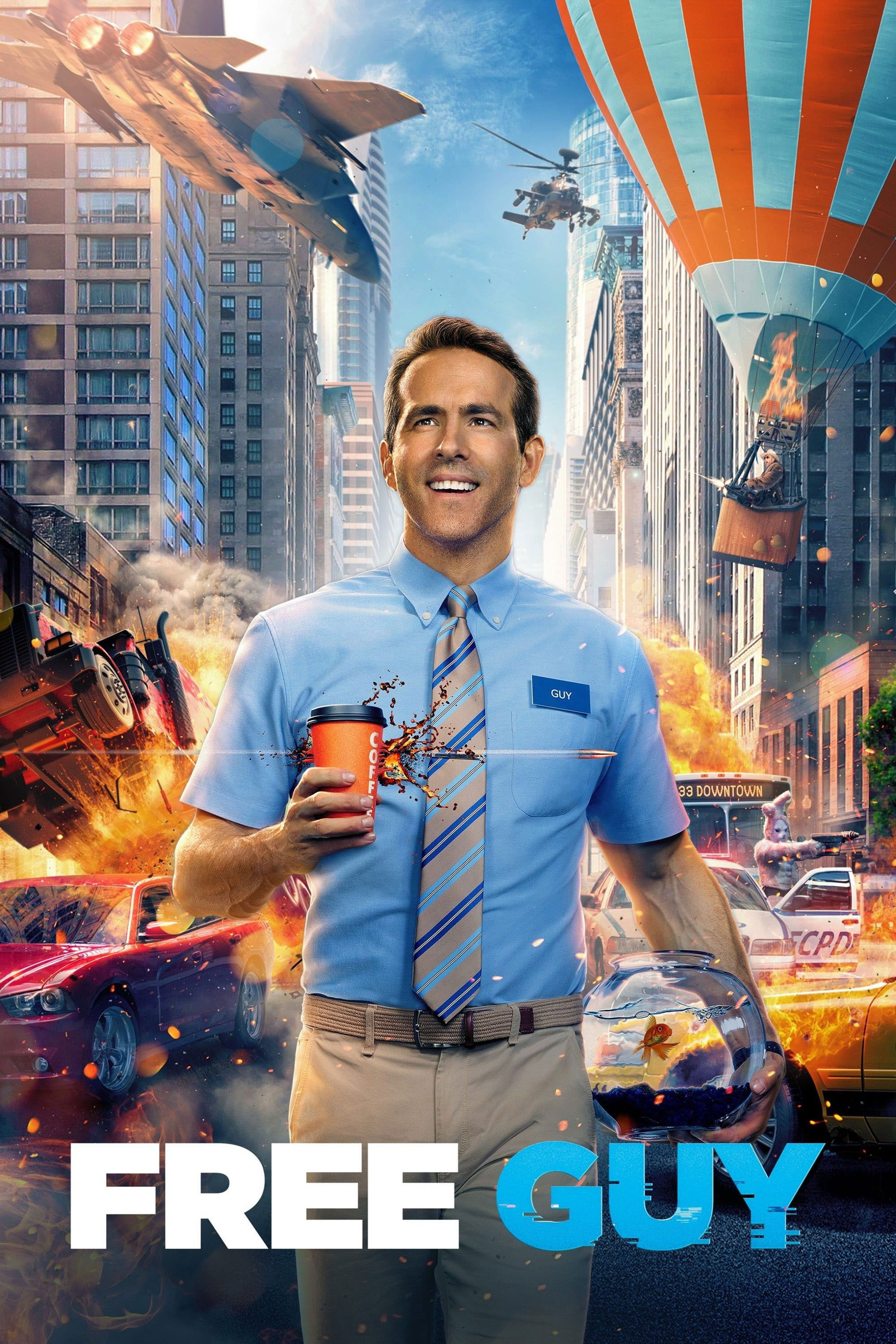
Guy (Ryan Reynolds) is a bank teller in Free City, a chaotic open-world online game where the human players run riot in sunglasses and the non-player characters cheerfully absorb the carnage as scenery. He greets the same day every morning, gets robbed at gunpoint on schedule, and is perfectly content. Then he sees a woman, breaks his loop to chase her, and starts to suspect that the world he lives in is not the whole story. The woman is Millie (Jodie Comer), a real player hunting through the game for proof that her stolen code is buried inside it. What begins as one NPC straying off script becomes a question about whether the thing waking up inside the software counts as alive, and who owns it if it does.
The cast
Reynolds is doing something slightly different from his usual register here, and it suits him. Guy is sincere rather than sardonic, an unfailingly nice man discovering the world is larger and stranger than his script allowed, and Reynolds plays the wonder without smothering it in irony. He is funny, but the comedy comes from innocence rather than the motormouth snark of his more familiar roles. Jodie Comer carries the film’s spine, splitting cleanly between the guarded, frustrated programmer Millie and her in-game avatar, all leather and attitude, and she makes the two read as the same person. Joe Keery brings a rumpled decency to Keys, the coder who knows what was taken from him and cannot prove it. Taika Waititi has the loosest time of anyone as Antwan, the games-studio boss, a preening tech executive turned up just past the point of plausibility, and your tolerance for the film’s broadest swing will track your tolerance for him.
The craft
Levy and cinematographer George Richmond make Free City bright, busy and legible, which matters more than it sounds: the gag of an ordinary man calmly walking through other people’s mayhem only works if you can always see the mayhem clearly. The film is sharp about the texture of online games, the heads-up displays, the loot crates, the players who treat every passer-by as target practice, and it stays affectionate rather than sneering about the people who live there. Christophe Beck’s score keeps the energy up without flattening the quieter beats, and the editing keeps a busy plot moving at a pace that never lets the concept curdle into a lecture. The effects work is generous, and there is one mid-film visual joke about a familiar piece of pop-culture property that lands as well as anything in the genre this year.
How it stacks up
The obvious ancestor is The Truman Show, another film about a contented man who does not know his world is manufactured, though Free Guy is sunnier and lighter on its feet than Peter Weir’s film, and less interested in cruelty. It shares DNA with Wreck-It Ralph and The Lego Movie, both of which found real feeling inside a toy-box premise, and it is doing what Ready Player One tried and mostly missed: building a digital playground that feels populated rather than just referenced. Where it pulls ahead of the recent run of game adaptations is that it is not adapting anything. There is no canon to honour and no fanbase to placate, so it can simply use the language of games to tell its own story.
Critics versus the rest of us
Critics have been warm without quite committing, sitting around 80%, and the common reservation is that the corporate satire is soft: Antwan is a cartoon, and the film’s argument about who owns a piece of emergent code is gestured at more than argued. That is a fair note. Audiences are noticeably more enthusiastic, near the mid-90s, and I think they have it right. The film is not pretending to be a serious essay on artificial intelligence. It is a bright, generous crowd-pleaser with a genuine idea at the centre, and it commits to that idea with more conviction than its detractors give it credit for.
Verdict
What pushes my score above a polite recommendation is how rewatchable it is. The premise is clever, the lead performances are warm, and the science fiction idea underneath, a piece of code becoming aware of itself and choosing kindness, is handled with real charm rather than cynicism. It loses a point for the villain, who belongs in a broader film than the one around him, and for a final act that resolves a little too tidily. But it is funny, it is good-hearted, and it understands the world it is set in. I came out happier than I went in, which is most of what this kind of film is for. 8⁄10.
Availability: In UK cinemas now. A strong candidate for the biggest screen you can find, since Free City is built to be looked at.
Update
Added since this review first appeared: the film became one of the surprise commercial hits of its year and, for a while, talk of a sequel followed, though nothing had materialised on screen at the time of writing. Its standing has held up as a rare original studio crowd-pleaser in a release calendar dominated by franchises, and its reading of AI self-awareness as something gentle rather than threatening looks more pointed as the conversation around artificial intelligence has sharpened. It is now widely available on digital and disc and streams on Disney+ depending on your region.
BBFC content advice
Rated 12A by the BBFC for moderate violence, sex references, infrequent strong language. The notes below may contain spoilers.
Violence: There are frequent scenes of moderate violence which take place within a video game setting and include shootings, impactful fist fights, an undetailed head butt and arm-break, and characters hit by vehicles. There is also occasional sight of bloody injury. The video game context establishes that it is not ‘real’ people getting hurt and that characters who ‘die’ come back to life immediately. The action is also played out to a consistent comic tone.
Language: There is infrequent strong language (‘f**k’), as well as milder terms such as ‘God’ ‘hell’, ‘shit’, ‘damn’, ‘ass’, ‘asshole’, ‘screw’, ‘biatch’, ‘piss’, dick’, ‘freaking’ and ‘fricking’. There are also rude middle finger gestures.
Sex: There are moderate sex references, including references to strippers, virginity and masturbation. There is also innuendo when a woman sits astride a man and asks, ‘Is that a Glock in your pocket?’
Threat and horror: There is unrealistic and comic threat throughout, in a video game context.
Injury detail: There is also occasional sight of bloody injury after violence, but all within a computer game context in which real people are not harmed.
Source: British Board of Film Classification (bbfc.co.uk).