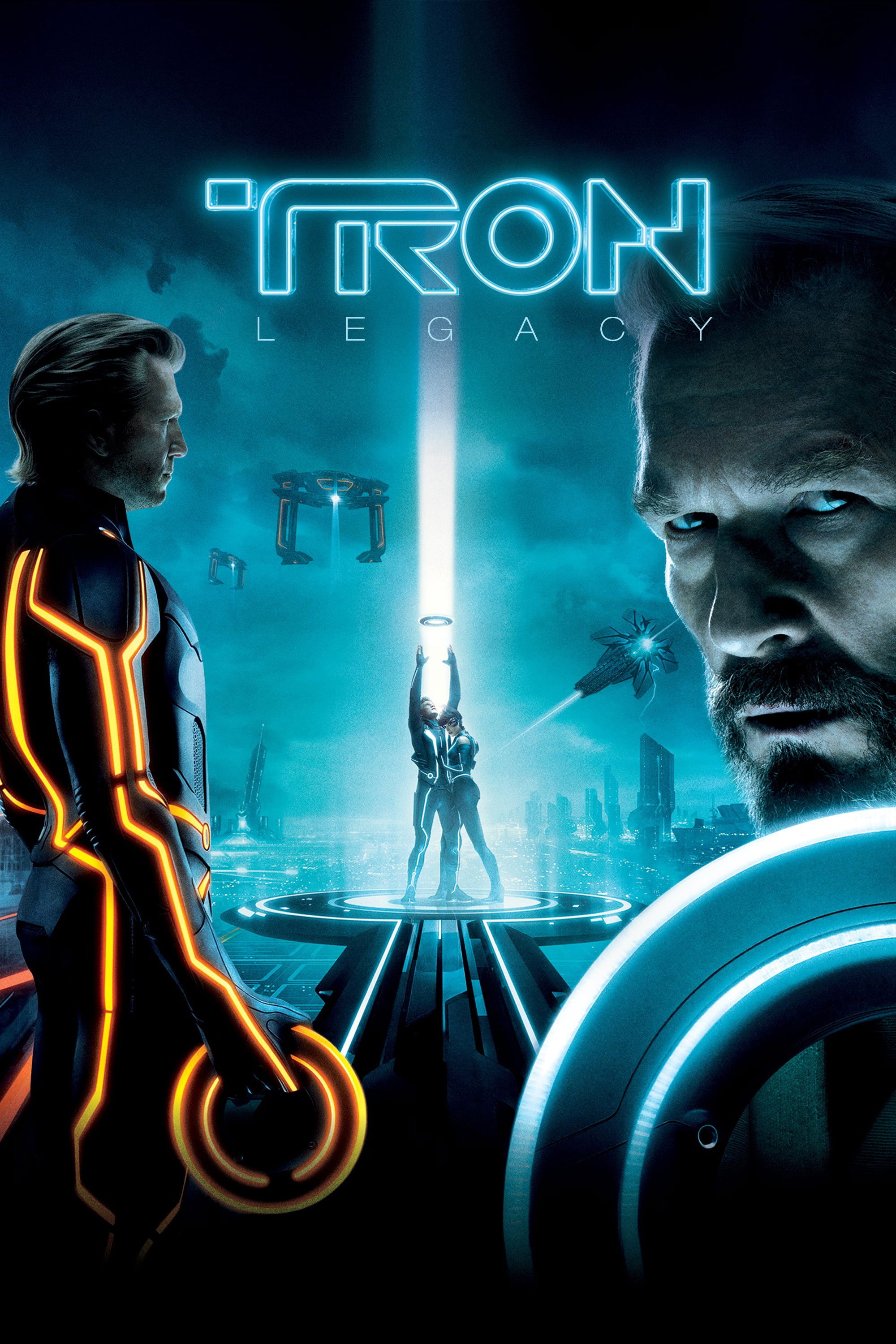

- UK release: December 2010
- Director: Joseph Kosinski · Writers: Edward Kitsis, Adam Horowitz
- Studio / distributor: Walt Disney Pictures
- Genre: Science fiction adventure / cyber-fantasy · Runtime: 125 minutes (BBFC 12)
- Main cast: Garrett Hedlund (Friday Night Lights) as Sam Flynn; Jeff Bridges (The Big Lebowski, Tron) as Kevin Flynn / Clu; Olivia Wilde as Quorra; Michael Sheen (Frost/Nixon) as Castor / Zuse; Bruce Boxleitner (Tron) as Alan Bradley / Tron
- Rotten Tomatoes: 51% critics / 63% audience · My rating: 9 / 10
In 1982, Disney released a film about a man pulled inside a computer that almost nobody went to see, and which a small, stubborn audience then spent the next three decades quietly canonising. Tron was a commercial misfire and a design landmark, the first major film to put a human being inside a glowing electronic world, and it has lived on as a cult object far larger than its box office. Reviving it now, twenty-eight years later, is a strange bet: the brand means a great deal to a few people and almost nothing to everyone else. What Disney has done is hand the keys to a first-time director, pour the budget into the look and the sound, and hope the Grid still casts a spell. For me, reader, it absolutely does.
The setup
Sam Flynn (Garrett Hedlund) is the grown son of Kevin Flynn (Jeff Bridges), the games visionary who vanished without trace when Sam was a boy. A late-night tip sends Sam to his father’s shuttered arcade, and from there into the Grid, the digital world Kevin built and then disappeared into. Inside, Sam finds the place running under a perfected, ageless version of his father’s own programme, Clu, who governs with the cold logic of something built to make a system flawless and never told when to stop. With the help of Quorra (Olivia Wilde), Sam has to find the real Kevin and keep Clu’s ambitions from reaching beyond the screen. It is a rescue, a chase and a father-and-son reunion, staged inside a world made of light.
The cast
Jeff Bridges is doing two jobs and clearly enjoying both. His Kevin Flynn is older and stranger than the cocky programmer of 1982, a man who has spent too long alone in a world of his own making and talks like a guru who has half-forgotten the outside. His Clu is the same face rebuilt by computer to look young again, an effect that is uncanny in both senses, not quite convincing as skin yet exactly right as an idea: a copy that resents its original. Hedlund has the harder, plainer task as the audience’s way in, and he is solid rather than magnetic. Olivia Wilde’s Quorra supplies the film’s curiosity and warmth, wide-eyed about a real world she has never seen. Michael Sheen turns up as Castor, a preening Grid impresario, and walks off with every second of his screen time, all cane and lipstick and menace. Bruce Boxleitner, back from the original, keeps the bloodline honest.
The craft
This is where the film earns its keep. Joseph Kosinski comes from architecture and commercials, and it shows in the cleanest possible way: the Grid is a real designed space, all black glass and hard light, severe and beautiful. The light-cycle sequences, the disc battles, the descent into the city all carry a weight and a sheen that the 1982 film could only gesture at. Claudio Miranda shoots it like a luxury object. And then there is the score. Handing a science fiction landscape to Daft Punk is the single best decision anyone made here; their music does not sit on top of the images, it drives them, pulsing and orchestral by turns, and it is the thing I find myself reaching for long after the plot has faded. Two hours in this world go quickly, because every frame has been built to be looked at.
How it stacks up
The obvious comparison is the original Tron, and Legacy honours it without being trapped by it: same mythology, vastly more horsepower. Beyond the franchise, it sits in the lineage of films that treat the inside of a machine as a place you can stand in, from The Matrix and its rules-as-architecture to the rain-soaked future-noir of Blade Runner, whose mood of beautiful melancholy this shares more than its plot. It is closer to those films in feel than in substance: it wants the atmosphere of intelligent science fiction more than it wants the ideas. As a piece of design-led, music-led cinema it stands with the best of them; as a story it is content to be a straight line.
Critics versus the rest of us
The critics are not sold. Reviews are landing around the halfway mark, and the recurring complaint is fair on its own terms: the script is thin, the emotional beats are signposted, and the human story never matches the world it moves through. Audiences are warmer, and I am warmer still. The disagreement comes down to what you came for. If you want a tight screenplay, the critics have a point. If you came to be immersed in a world, scored within an inch of its life and rendered with real care, the shortfall in the writing matters far less than the reviews suggest. I knew within twenty minutes that this was a film I would be putting on again.
Verdict
I am well aware my number sits a long way above the consensus, and I am not going to pretend otherwise. The story is the weakest thing here, the characters rarely deepen, and a colder viewer will find the whole exercise more surface than substance. None of that has stopped me watching it again and again. I value atmosphere, world-building, a great soundtrack and the simple pleasure of being somewhere, and on every one of those this delivers completely. The Daft Punk score alone would carry a lesser film; wrapped around visuals this clean, it makes for the most rewatchable science fiction of the year. It is gorgeous, it is hypnotic, and it is exactly my kind of thing. 9⁄10.
Availability: On general release in UK cinemas now. See it in 3D and on the largest IMAX screen you can reach; this is a film built for the biggest, loudest room available.
Update
Added since this review first appeared: the Daft Punk score has comfortably outlasted the film’s mixed reception, settling in as one of the most admired film soundtracks of its era and arguably the most enduring part of the whole project. A long-promised third Tron film spent years in development limbo before resurfacing, a sign of how much affection the world still commands even when the box office did not justify it. Legacy itself now streams on Disney+ and is widely available on Blu-ray and 4K, where the black-glass Grid and that score still reward the best screen and speakers you can give them.
BBFC content advice
Rated 12 by the BBFC for moderate fantasy violence. The notes below may contain spoilers.
Violence: There are frequent scenes of moderate fantasy violence, including fistfights and use of futuristic weapons against electronic beings who shatter into pixels when attacked. A woman’s arm is cut off, but the injury is bloodless and her limb regenerates.
Additional issues: Very mild bad language includes use of the terms ‘son of a gun’ and ‘screwed up’.
Source: British Board of Film Classification (bbfc.co.uk).