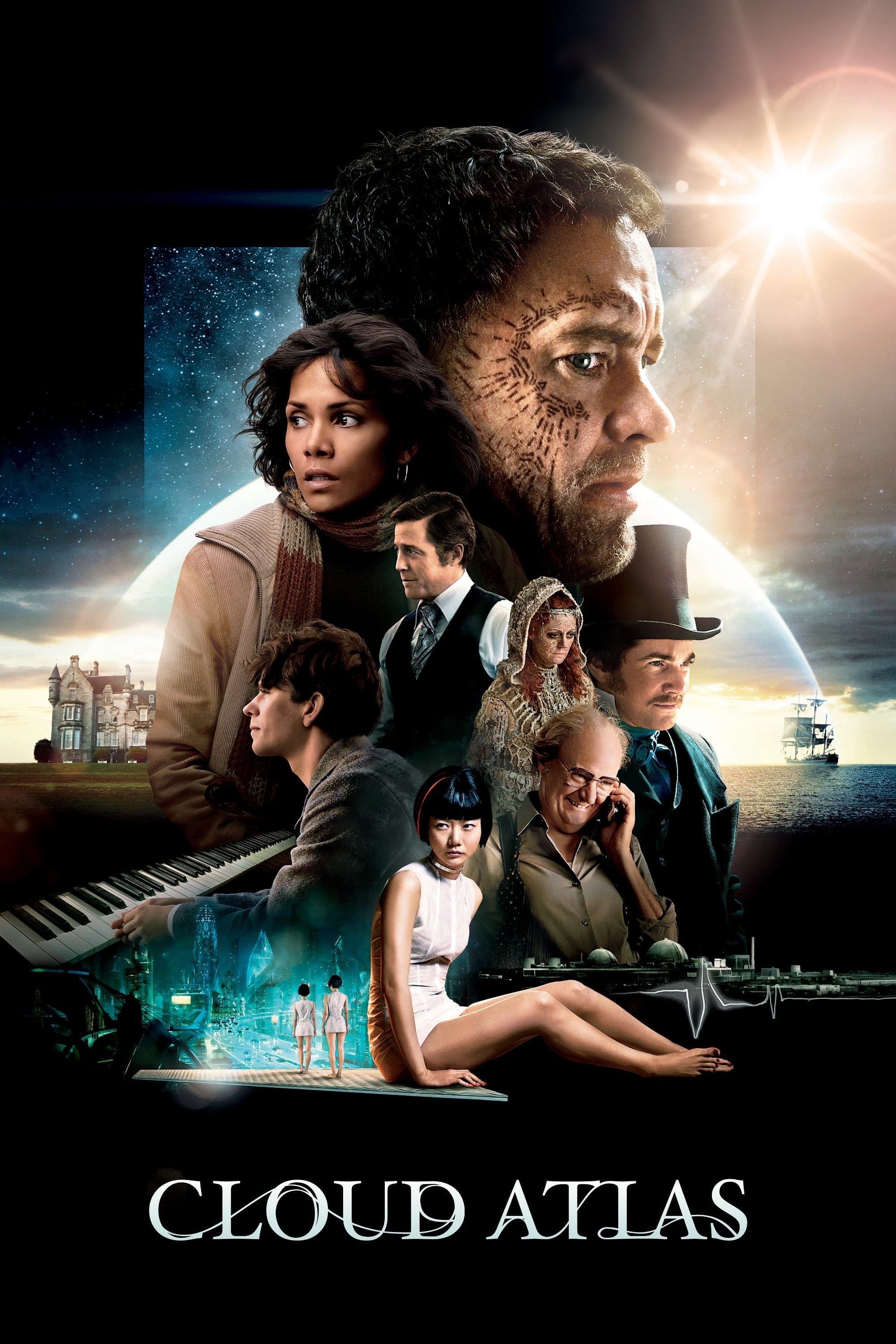

- UK release: February 2013
- Directors: Lana and Andy Wachowski; Tom Tykwer · Writers: Lana and Andy Wachowski; Tom Tykwer
- Studio / distributor: Cloud Atlas Productions; X Filme Creative Pool; Warner Bros.
- Source: the novel by David Mitchell
- Genre: Science fiction drama / historical fantasy · Runtime: 172 minutes (BBFC 15)
- Main cast: Tom Hanks (Forrest Gump, Cast Away) in multiple roles; Halle Berry (Monster’s Ball, X-Men) in multiple roles; Jim Broadbent (Iris, Moulin Rouge!) in multiple roles; Hugo Weaving (The Matrix, The Lord of the Rings) in multiple roles; Doona Bae (The Host) as Sonmi-451 and others
- Rotten Tomatoes: 67% critics / 66% audience · My rating: 8 / 10
David Mitchell’s Cloud Atlas was the book everyone agreed could not be filmed: six nested stories spread across five hundred years, each in a different genre and a different voice, folded one inside the next like a Russian doll. So of course someone tried, and the someone turned out to be the Wachowskis, fresh off the diminishing returns of the Matrix sequels, in harness with Tom Tykwer, the German director of Run Lola Run. Three directors, three timelines each, one of the largest independently financed productions ever mounted, and a flat refusal to make it easy on anybody. Whatever else it is, nobody can accuse it of playing safe.
The setup
The stories run from a Pacific voyage in the 1840s to a far-future Hawaii long after a civilisation has fallen, by way of a 1930s composer in Edinburgh, a 1970s journalist chasing a nuclear cover-up, a present-day publisher locked in a nursing home against his will, and a cloned server in a neon Korea who starts to want more than the life she was grown for. A diary is read by the composer; the composer’s music reaches the journalist; the journalist’s story becomes a manuscript; the manuscript becomes a film the publisher watches; the publisher’s escape becomes scripture to the clone. Acts of kindness, cowardice and cruelty echo down the chain, and the same souls keep turning up wearing different faces. That last conceit is the whole experiment: one ensemble plays through every era, so you spend the film hunting Tom Hanks and Halle Berry across centuries like a very expensive game of where’s-who.
The cast
The casting trick is the film’s nerve and its biggest liability. Hanks ranges from a murderous ship’s doctor to a foul-mouthed gangster novelist to the haunted future tribesman who anchors the final act, and he is loosest and best when he is least like Tom Hanks. Berry is the steadier presence, strongest as the seventies reporter with a conscience and a deadline. Jim Broadbent walks off with the whole film as the bullied publisher, a stretch of broad English farce that has no business working as well as it does. Hugo Weaving recurs as the face of whatever system is doing the oppressing this century, from slaver to assassin to a nightmare green-suited devil. Doona Bae, as the clone Sonmi-451, gives the most genuinely moving performance in the picture, the still centre the louder strands orbit. The makeup that ages, races and re-sexes the cast is where the gamble shows: sometimes seamless, sometimes a distraction you cannot unsee, and in a couple of the Korean-set transformations frankly a misjudgement.
The craft
For a film assembled by three directors on two continents, the surprise is how little it feels stitched together. The six worlds are realised with real conviction, the future Seoul a glittering vertical city and the post-collapse Hawaii a sun-bleached ruin, and the editing braids them so the emotional beats rhyme across eras rather than simply cutting between them. A chord struck in 1936 lands as a memory in 2012. Tykwer’s own score, written with Johnny Klimek and Reinhold Heil, threads the whole thing together, the Cloud Atlas Sextet recurring as the connective tissue the plot keeps promising. At 172 minutes it asks a great deal, and it earns most of it through sheer momentum, though there are stretches in the back half where the ambition outruns the grip.
How it stacks up
The obvious cousin is The Fountain, Aronofsky’s three-era meditation on love and death, and Cloud Atlas shares its reach and its risk of preciousness while being far more generous with incident and humour. It works the same multi-strand territory as Babel, but where that film let its threads only graze each other, this one insists they are the same thread. Set against the Wachowskis’ own Matrix, it trades that film’s clean genre engine for something baggier and warmer and a good deal stranger. As an unfilmable-book adaptation it belongs with the brave failures more than the clean successes, except that it is not quite a failure.
Critics versus the rest of us
The reception is split almost exactly down the middle, critics at 67% and audiences a notch behind at 66%, and the divide is less about quality than tolerance. The admirers call it a moving mosaic; the unconvinced call it a magnificent folly, too long, too earnest, and queasy about the racial makeup. Both camps are describing the same film accurately. It is sentimental, it overreaches, and the soul-reincarnation framework is the kind of cosmic uplift that makes hard-headed viewers wince. It is also one of the few recent blockbusters with a genuine idea in its head and the budget to chase it down. Given a choice between a tidy film with nothing to say and an untidy one swinging for everything, I will take the swing.
Verdict
This lands well above the critical midpoint for me because of what it values: intelligent science fiction, dense world-building, a structure you want to map out on a second viewing, and a score that does real work. The flaws are real. It is overlong, the makeup occasionally undoes the spell, and the philosophy is laid on with a trowel. None of that cancels the pleasure of a film this ambitious that mostly holds, or the pull of a puzzle box you finish wanting to open again. It is the rare three-hour epic I would happily rewatch, partly to catch the connections I missed. Flawed, overreaching, and far more alive than the safe films around it. 8⁄10.
Availability: In UK cinemas now, where its scale and its sound design make the case for the big screen. A Blu-ray and DVD release will follow later in the year.
Update
Added since this review first appeared: Lana Wachowski’s sister, credited here as Andy, later came out as Lilly Wachowski, and the pair are now known as the Wachowskis. The trio’s interest in braided, multi-character storytelling carried straight into Sense8 (2015), the Netflix series the Wachowskis made with Tykwer, which extended the same one-soul-many-bodies idea over television length. Cloud Atlas has settled where it opened, a film people either treasure or bounce off, with little middle ground, and it has quietly grown a devoted following among those who treasure it. It streams across the usual platforms depending on region and is available on disc, including a Blu-ray that flatters the design work.
BBFC content advice
Rated 15 by the BBFC for strong language, once very strong, strong violence and sex. The notes below may contain spoilers.
Violence: There are several scenes of strong bloody violence. For example, during a battle between rival tribes, some people are hit with machetes, including sight of a man’s throat being cut. Elsewhere in the film, characters are shot, resulting in blood spurts, and a man is thrown from a high rise flat, landing with a bloody impact on the pavement below.
Language: There are multiple uses of strong language (‘fk’) and a single use of very strong language (‘ct’).
Sex: Sex scenes include one in which a woman’s bare breasts and buttocks are visible as she sits astride her partner and thrusts up and down. There are also some verbal sex references as a man is accused of sodomy.
Additional issues: The film also contains some verbal references to suicide and a man killing himself with a gun, off screen. There is use of the word ‘n****r’ in a story set during the era of the slave trade.
Source: British Board of Film Classification (bbfc.co.uk).