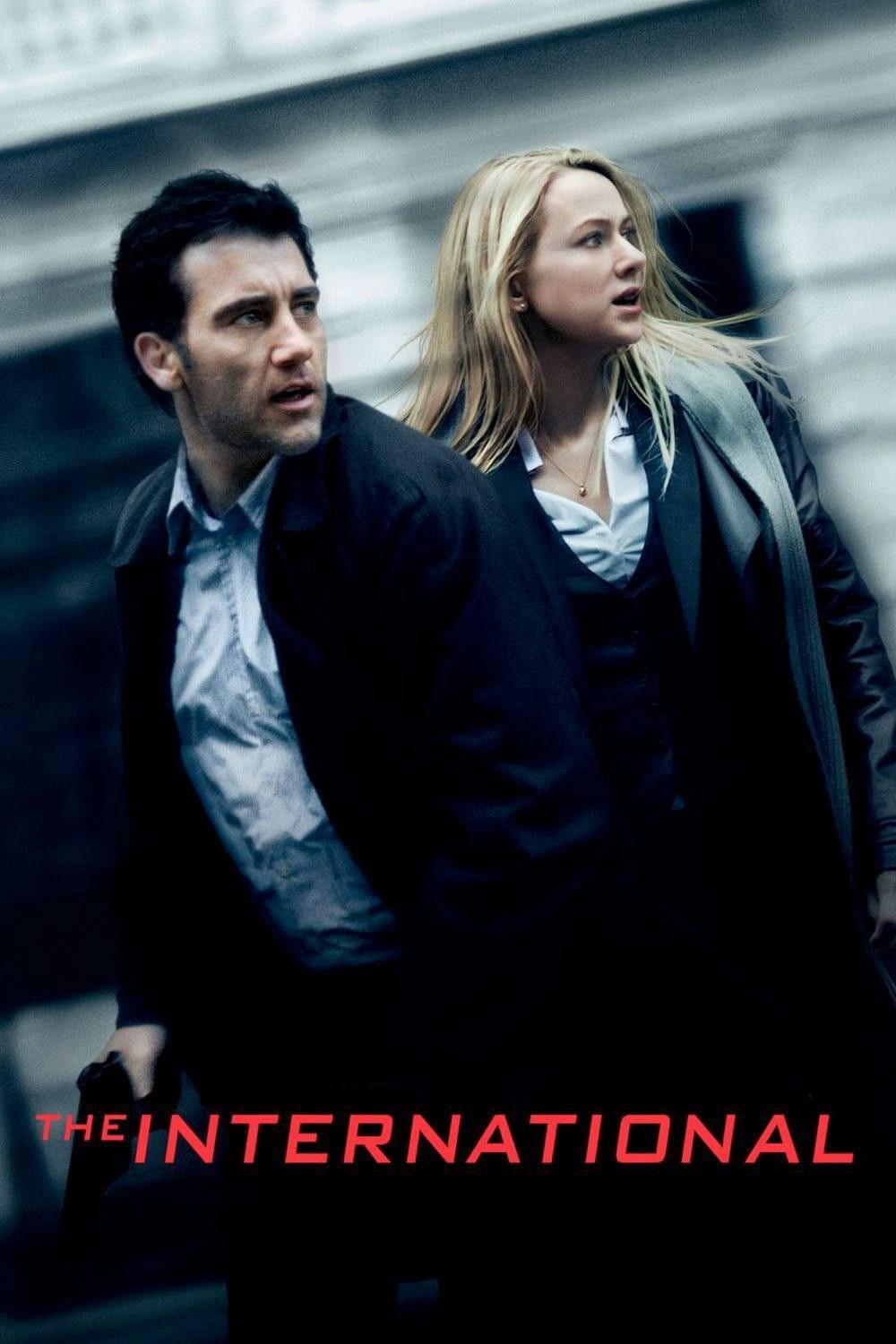

- UK release: February 2009
- Director: Tom Tykwer · Writer: Eric Warren Singer
- Studio / distributor: Columbia Pictures; Relativity Media; Atlas Entertainment
- Genre: Conspiracy thriller / financial-political thriller · Runtime: 118 minutes (BBFC 15)
- Main cast: Clive Owen (Children of Men, Closer) as Louis Salinger; Naomi Watts (Mulholland Drive, King Kong) as Eleanor Whitman; Armin Mueller-Stahl (Eastern Promises, Shine) as Wilhelm Wexler; Brian F. O’Byrne (Million Dollar Baby, Before the Devil Knows You’re Dead) as The Consultant
- IMDb: 6.5 / 10 · Rotten Tomatoes: 58% critics / 37% audience · My rating: 7 / 10
The timing could hardly be sharper. As the banks of the world stand exposed and half-nationalised, along comes a thriller in which the villain is not a rogue state or a lone madman but a merchant bank, and the weapon is its balance sheet. Tom Tykwer, the German director who made his name with the kinetic Run Lola Run and the strange, sumptuous Perfume, here reaches back past his own work to the paranoid American thrillers of the 1970s, the world of The Parallax View and Three Days of the Condor, where the institutions are too big to fight and the hero keeps pulling the thread anyway. It is an unfashionable kind of film to make in 2009, and that is most of its appeal.
The setup
Louis Salinger (Clive Owen) is an Interpol agent who has spent years trying to bring down the IBBC, a powerful international bank he is convinced is brokering arms deals and bankrolling conflict for its own balance sheet. Alongside him is Eleanor Whitman (Naomi Watts), a New York prosecutor with her own stake in the case. Every time they get close to a witness, the witness dies, and every death is tidy enough to look like something else. The chase runs from Berlin to Milan to New York to Istanbul, and the further they get, the clearer it becomes that the bank does not need to win in a courtroom it can simply outlast anyone who comes for it. The pleasure of the setup is its bleak logic: the enemy is not hiding, it is in plain sight, audited and respectable.
The cast
Clive Owen is well cast as a man running on grievance and too little sleep. He has done this weary, dogged register before, not least in Children of Men, and he brings the same crumpled persistence here, a decent man who has stopped expecting the system to help him. He carries most of the film on that scowl. Naomi Watts is given rather less to do; Whitman is written as the more cautious, procedural half of the partnership, and Watts plays the constraint honestly rather than fighting it, though the script keeps her at arm’s length from the real momentum. The standout is Armin Mueller-Stahl as Wilhelm Wexler, the bank’s adviser, an old man with a long and compromised past who lends the film its only genuine moral weather. Brian F. O’Byrne, as the bank’s nameless Consultant, is the quiet professional who does the killing, and his very ordinariness is the point.
The craft
Tykwer and his regular cinematographer Frank Griebe shoot the film as a tour of glass and stone, the architecture of money: atriums, foyers, boardrooms, the cool surfaces that power likes to hide behind. It looks expensive and it looks cold, which is exactly right. The score, which Tykwer wrote himself with Johnny Klimek and Reinhold Heil, hums under the procedural scenes and keeps the pulse up. And then there is the centrepiece, a shoot-out staged inside the spiralling white rotunda of the Guggenheim in New York, which tears the film’s composure to shreds for ten minutes of genuinely thrilling, plaster-shattering chaos. It is the sequence everyone will talk about, and rightly: it is the moment the controlled style of the film breaks open and the violence becomes physical and close. Mathilde Bonnefoy’s editing keeps the talkier stretches moving, even when the plot is asking the audience to swallow a great deal.
How it stacks up
The obvious ancestors are the 1970s conspiracy pictures, and The International wears that lineage openly. It does not have the political nerve of The Parallax View or the lived-in dread of Three Days of the Condor, and it lacks the human texture that makes a film like Michael Clayton, released only two years ago, land its punches; that film understood that a corporate thriller lives or dies on character, and gave you people to care about. The International is more interested in the machinery. Set against the Bourne films, which by now own the European-chase template, it is slower and more talkative, trading their breathless cutting for something more deliberate. The comparison it most wants is to those older paranoia thrillers, and on mood and architecture it earns it. On conviction it falls a little short.
Critics versus the rest of us
The critical response is divided, and the split is revealing. Critics sit around the high fifties, praising the locations and the Guggenheim sequence while complaining that the plot is preposterous and the characters thin. Audiences have been harsher still, drifting away from a thriller that asks them to think rather than sprint. Both objections are fair. The conspiracy does not entirely hold together if you press on it, and Salinger and Whitman never quite become people you ache for. But I think the colder reception slightly undervalues what the film does well. It is timely without being smug, it looks superb, and it commits to the unglamorous idea that the most powerful villains never get caught. That is a harder and more honest ending than the genre usually allows.
Verdict
This is a thriller I enjoyed more than its scores suggest, while seeing exactly why others did not. The plot creaks, the partnership lacks spark, and the politics are gestural rather than deep. But Tykwer delivers atmosphere, a real sense of place across some of the best-looking locations a thriller has used in years, and one set piece good enough to carry the whole film. I like the genre, I like the bleak refusal of an easy win, and I would happily watch it again on a wet evening for the Guggenheim alone. It is a solid, grown-up thriller rather than a great one, and a perfectly satisfying way to spend two hours. 7⁄10.
Availability: On general release in UK cinemas now, with a DVD and Blu-ray release to follow later in the year.
Update
Added since this review first appeared: The International has settled into the role of a respectable also-ran, the post-crash banking thriller that is more admired in retrospect for its Guggenheim shoot-out than for anything else. Tykwer went on to the vast, fragmented Cloud Atlas with the Wachowskis, a film that makes this one look positively restrained. It is now widely available on disc and turns up regularly on streaming and broadcast schedules, where its cool style and that one extraordinary set piece still hold up.
BBFC content advice
Rated 15 by the BBFC for strong bloody violence and language. The notes below may contain spoilers.
Violence: A man is shot in the neck and there is significant focus on his injury in the aftermath of the shooting with blood visible streaming from his injury. During a fight, a character sticks their thumb into the existing injury of an opponent causing blood to flow out of the wound.
Language: There are eight uses of strong language (‘f**k’).
Source: British Board of Film Classification (bbfc.co.uk).