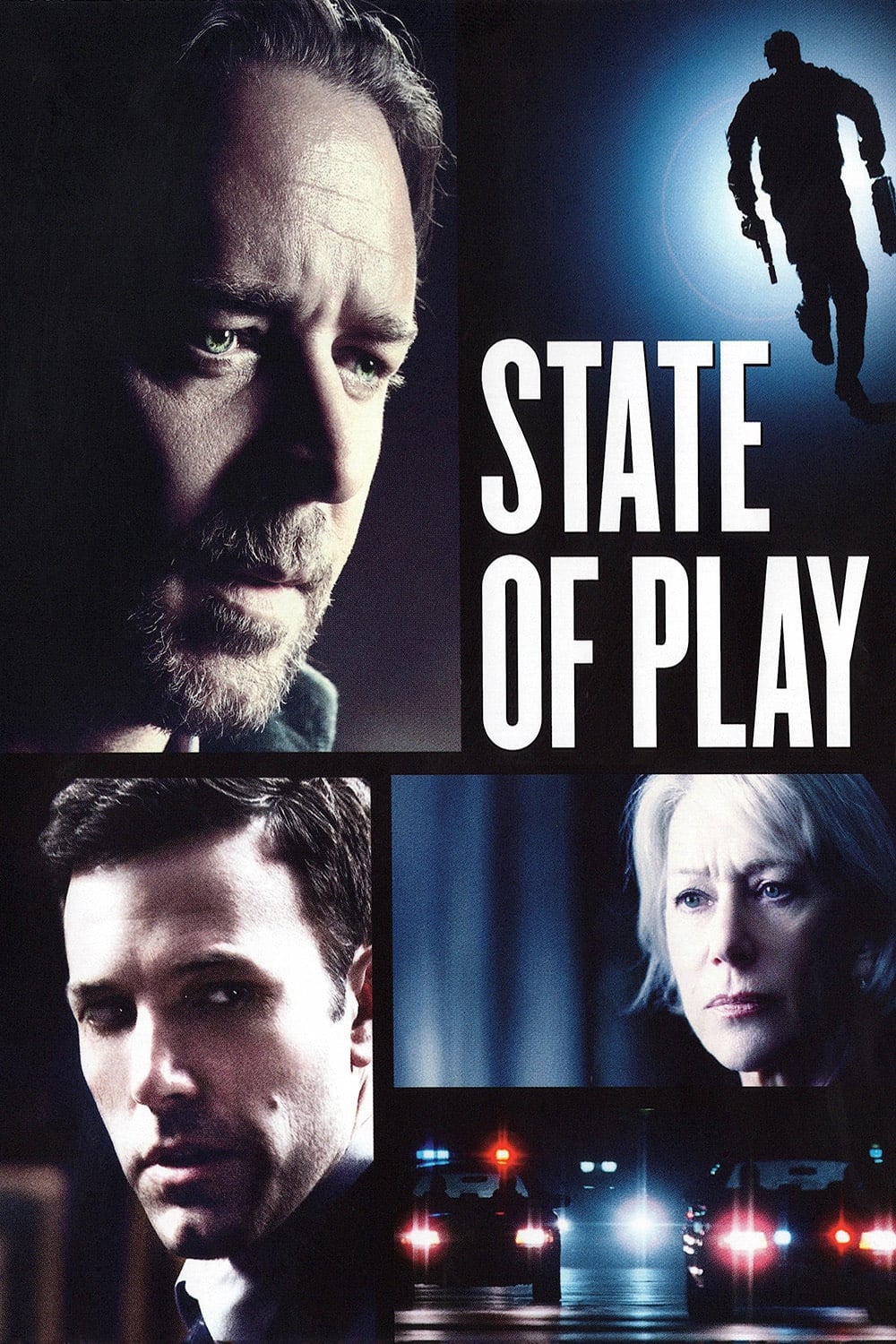
- UK release: April 2009
- Director: Kevin Macdonald · Writers: Matthew Michael Carnahan, Tony Gilroy, Billy Ray
- Studio / distributor: Working Title; StudioCanal; Universal Pictures
- Genre: Political and journalism thriller · Runtime: 127 minutes (BBFC 15)
- Main cast: Russell Crowe (Gladiator, L.A. Confidential) as Cal McAffrey; Ben Affleck (Good Will Hunting, Pearl Harbor) as Stephen Collins; Rachel McAdams (The Notebook, Wedding Crashers) as Della Frye; Helen Mirren (The Queen, Gosford Park) as Cameron Lynne; Jason Bateman (Arrested Development, Juno) as Dominic Foy
- IMDb: 7.1 / 10 · Rotten Tomatoes: 84% critics / 73% audience · My rating: 8 / 10
Paul Abbott’s State of Play ran on BBC One in 2003 as a six-hour serial, one of the best things British television produced that decade, so the news that Hollywood had bought it and squeezed it into two hours was always going to invite a flinch. The setting has moved from Westminster to Washington, John Simm and David Morrissey have become Russell Crowe and Ben Affleck, and the director is Kevin Macdonald, who came to drama from documentary with Touching the Void and won Forest Whitaker an Oscar in The Last King of Scotland. Three credited writers is rarely a good omen. What survives the transplant is the thing that mattered most: a thriller about a dying trade, the print newspaper, told by people who clearly mourn it.
The setup
Cal McAffrey (Russell Crowe) is a veteran reporter at the Washington Globe, a rumpled man who still works the phones and the streets while the paper around him is being remade for the web. Two deaths land on his desk that have no business being connected, a petty thief shot in an alley and a young woman who falls under a train. The woman was the lead researcher, and the mistress, of Congressman Stephen Collins (Ben Affleck), a rising Democrat chairing a committee that is about to embarrass a private defence contractor. Collins is also Cal’s old college friend, which is the knot the whole film pulls on. Paired with Della Frye (Rachel McAdams), the paper’s blogger, Cal starts to trace the line between a private grief and a public conspiracy, while his editor Cameron Lynne (Helen Mirren) wants the story filed before the lawyers and the proprietors close it down.
The cast
Crowe is the centre of gravity and he is very good, playing Cal as shambling, stubborn and a little compromised, a man whose friendships are also his sources. It is a deliberately unglamorous turn, all takeaway cartons and a parked car full of notebooks, and it anchors everything around it. Affleck has the harder job, the handsome politician who has to stay sympathetic while looking guilty, and he just about holds it. McAdams gives Della more spine than the print-versus-pixels setup suggests on paper; the generational needle between her and Crowe never tips into a lecture. Mirren has only a handful of scenes as the editor caught between journalism and the balance sheet, and makes every one of them count. The surprise is Jason Bateman, who turns up late as a sleazy PR fixer and walks off with two reels, the comic energy the film needs exactly when it needs it.
The craft
Macdonald shoots Washington as a city of car parks, corridors and strip-lit newsrooms rather than monuments, and Rodrigo Prieto’s camera keeps the palette cold and procedural. The film is at its best in the mechanics of reporting: the door-knock, the bluff, the moment a source decides whether to talk. Alex Heffes scores it lightly, letting the rooms stay tense on their own. At 127 minutes it moves, and Justine Wright’s editing keeps the multiple strands legible, which is no small feat given how much serial plot has been poured into the running time. The price of that compression shows in the final stretch, where the story reaches for one twist too many and a couple of the joins are visible. It is a smart film that does not quite trust you to leave a thread untied.
How it stacks up
The reference point the film reaches for, and earns more often than not, is All the President’s Men, the same faith in shoe-leather reporting and the same belief that the boring parts of the job are the suspenseful ones. There is some of The Parallax View in its paranoia, and a clear cousin in Tony Gilroy’s Michael Clayton, another recent grown-up thriller about an ordinary professional pulling a thread he should leave alone, which is no coincidence given Gilroy’s hand in this script. Against the BBC serial it cannot win, and it would be foolish to pretend otherwise; six hours simply hold more rooms and more people than two. Taken on its own terms as a studio thriller for adults, a category Hollywood barely bothers to make any more, it stands up well.
Critics versus the rest of us
Critics have been warm, sitting around 84%, praising the cast, the pace and the unfashionable seriousness, with the standard caveat that the plotting wobbles and that the original was richer. Audiences are a notch cooler at 73%, which I read as the gap between people who wanted a Russell Crowe action vehicle and the patient newsroom procedural they actually got. I am closer to the critics here, with one reservation of my own: the conspiracy machinery in the last half hour is the weakest part, and the film would have been stronger trusting its smaller, human story of a friendship that cannot survive the truth.
Verdict
This sits squarely in my wheelhouse: institutional investigation, a conspiracy with corporate money behind it, and the unglamorous craft of finding things out. It is intelligent, well acted and built for grown-ups, and it honours the trade it is about even as it watches that trade decline. The ending overreaches and the source it adapts will always loom over it, so it lands just short of the front rank of the genre rather than among it. But it is a film I would happily put on again on a wet Sunday, which for a thriller is the test that counts. 8⁄10.
Availability: On general release in UK cinemas now, with a DVD and Blu-ray release to follow later in the year.
Update
Added since this review first appeared: the film has settled into a quiet reputation as one of the last of its kind, a mid-budget adult thriller from before the studios abandoned the form to streaming. Its newspaper-in-decline anxieties read as more pointed every year, and it pairs naturally with Spotlight (2015), which gave Rachel McAdams a far more celebrated turn in the same investigative register. It now streams on the usual subscription and rental platforms depending on region, and the Paul Abbott BBC serial that started it all remains the better way in if you have the six hours.
BBFC content advice
Rated 15 by the BBFC for moderate violence, one use of strong language. The notes below may contain spoilers.
Violence: In one scene, a man is shot dead, and there is a brief blood spurt and subsequent sight of blood dripping on the floor.
Language: There is infrequent strong language (‘f**k’).
Additional issues: The film also contains brief drug misuse references, and some moderate verbal sex references.
Source: British Board of Film Classification (bbfc.co.uk).