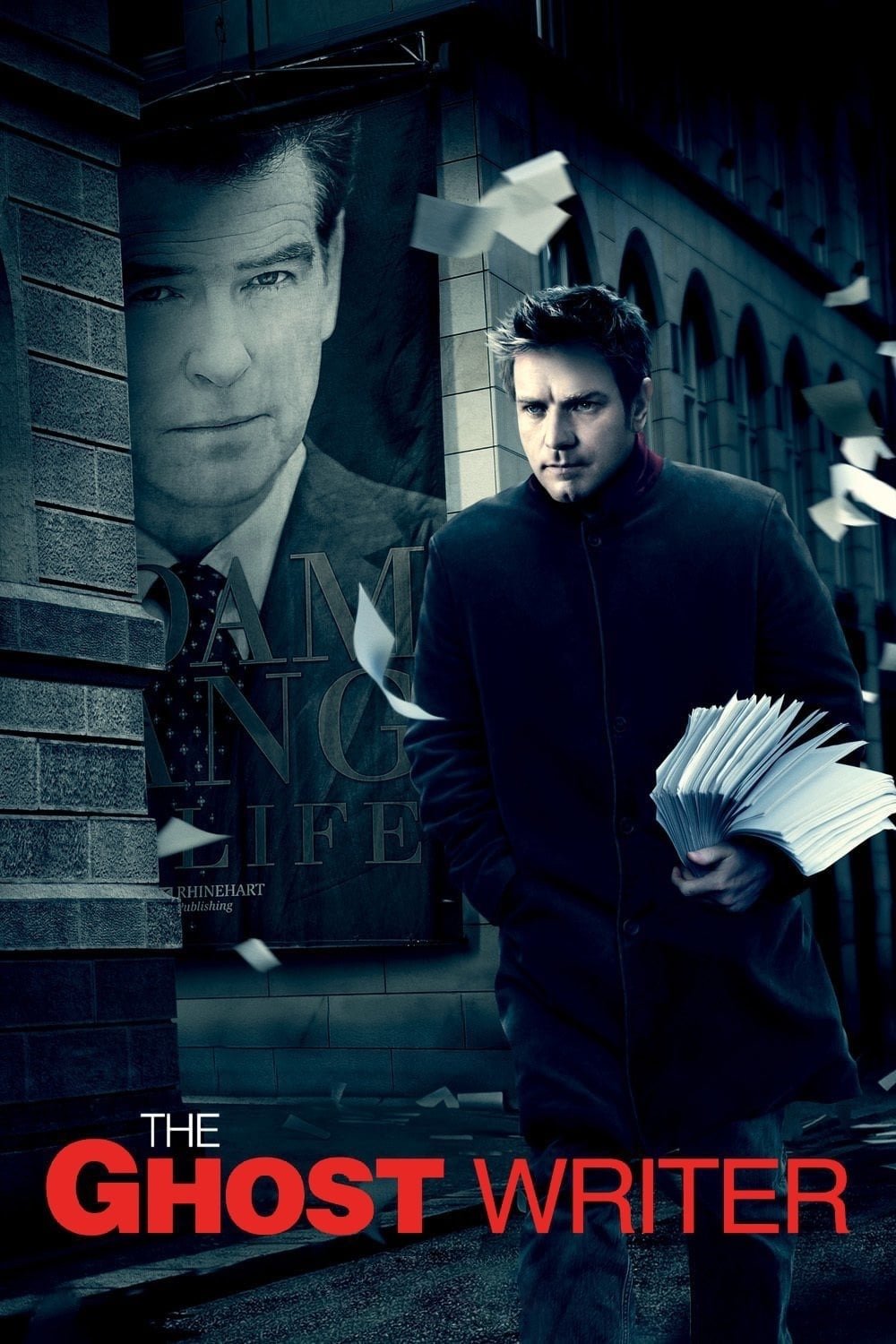

- UK release: April 2010 (as The Ghost)
- Director: Roman Polanski · Writers: Robert Harris, Roman Polanski
- Studio / distributor: RP Productions; Studio Babelsberg · Optimum Releasing (UK)
- Genre: Political conspiracy thriller · Runtime: 128 minutes (BBFC 15)
- Main cast: Ewan McGregor (Trainspotting, Moulin Rouge!) as the Ghost; Pierce Brosnan (GoldenEye, The Thomas Crown Affair) as Adam Lang; Olivia Williams (An Education) as Ruth Lang; Kim Cattrall (Big Trouble in Little China) as Amelia Bly; Tom Wilkinson (Michael Clayton, In the Bedroom) as Paul Emmett
- Rotten Tomatoes: 84% critics / 70% audience · My rating: 8 / 10
There is a particular pleasure in watching a director who has nothing left to prove choose to make something this controlled. The Ghost Writer is Roman Polanski adapting Robert Harris, and it arrives carrying two reputations: Polanski’s, as the man who made Chinatown and Rosemary’s Baby and whose own legal situation hangs over every line of press about the film, and Harris’s, as the writer who turns plausible political machinery into page-turning fiction. What they have made together is a paranoia thriller in the old style, the kind that trusts a grey sky and a locked door to do more work than any chase. It is the most assured thing either of them has put on screen in years.
The setup
A writer, never named, is hired to ghost the memoirs of Adam Lang, a recently retired British prime minister with an obvious resemblance to the kind of leader who followed America into a war and never quite explained why. The previous ghost drowned in circumstances nobody wants to look at too closely. Our man inherits the manuscript, the deadline, and the dead man’s room in a bleak modernist house on a wind-scoured American island, where Lang and his entourage are holed up while a war-crimes storm gathers around them. He came to tidy up a dull book. He stays to work out why the last person who held this job is in the ground.
The cast
McGregor plays the Ghost as a professional cynic who is good at his job and bad at minding his own business, and the trick of the performance is how ordinary he keeps him: no special skills, no training, just a man asking one question too many. Brosnan gives Lang the easy, hollow charm of a politician who has spent decades being liked, and lets you see the panic working underneath the tan. The sharpest turn is Olivia Williams as Ruth, Lang’s wife, watchful and bitter and several moves ahead of everyone, including the audience. Kim Cattrall is the brittle gatekeeper running interference, and Tom Wilkinson surfaces late as a Harvard academic whose politeness is its own kind of threat. Nobody overplays it. The film is too cold for that.
The craft
This is where the film earns its keep. Pawel Edelman shoots the island in slate greys and rain, and Polanski stages the whole thing as a slow tightening rather than a series of shocks. The house itself, all glass and concrete and sightlines, becomes a trap you can see the whole way through and still cannot leave. Alexandre Desplat’s score needles away underneath, all unease and forward motion, never letting the quiet settle. Polanski has always understood enclosed spaces and watched people, and he uses both here with total economy: a satnav that keeps its directions, a bicycle on a ferry, a manuscript read the way it was meant to be read. The suspense is built from documents and weather, and it holds.
How it stacks up
The obvious ancestors are the great American conspiracy films of the 1970s, The Parallax View above all, where an ordinary man pulls one thread and the whole world turns out to be holding the other end. It shares their patience and their pessimism. Set against Polanski’s own work, it is closest to Chinatown in shape, a detective who is not a detective uncovering rot at the top, though this is a colder, more bureaucratic rot. And as a Harris adaptation it sits comfortably beside the political machinery of his novels: real institutions, plausible secrets, a plot that moves because people protect themselves. It is less showy than The Constant Gardener and the better for it.
Critics versus the rest of us
Critics have taken to it warmly, sitting around 84%, drawn to exactly the things that make it feel out of time: the restraint, the craft, the refusal to hurry. Audiences are cooler, nearer 70%, and the gap is easy to read. This is a thriller that withholds. It keeps you at arm’s length from its hero, it never raises its voice, and viewers who want their conspiracies loud and their endings tidy may find it chilly. The recurring complaint is emotional distance, and it is not wrong, only beside the point. The chill is the texture, not a flaw in it.
Verdict
I came to this for the things it does best, and it delivered them: atmosphere, a tightening sense of dread, an intelligent thriller built on documents and surveillance rather than gunfire, and an adaptation that respects its source. The plotting is clean, the island is unforgettable, and the final stretch lands a sting worth the wait. It loses a little for holding its protagonist, and its audience, at a careful distance, which costs it some warmth and a fraction of its rewatch pull. But it is the kind of film I will happily sit through again on a grey afternoon, and one of the most quietly satisfying conspiracy thrillers in years. 8⁄10.
Availability: On release in UK cinemas now, under the title The Ghost. A DVD and Blu-ray release follows later this year.
Update
Added since this review first appeared: The Ghost Writer has held its standing as one of the strongest late-career Polanski films, and the comparison most people now reach for is J’accuse (An Officer and a Spy, 2019), his other patient, procedural study of an establishment closing ranks. The film is widely available on disc and digital, and rotates through the streaming services depending on region.
BBFC content advice
Rated 15 by the BBFC for strong language. The notes below may contain spoilers.
The film was passed 15 for its UK cinema release, with the classification driven by language, including infrequent very strong language. The BBFC’s full per-category content advice for this release (Violence, Language, Sex, and similar headings) could not be retrieved at the time of writing: the board’s release page for Polanski’s 2010 film was not reachable and resolved only to a later, unrelated film of the same name. The rating symbol and the language note above are confirmed; the detailed category breakdown is unverified and should be checked against the BBFC record before publication.
Source: British Board of Film Classification (bbfc.co.uk).