- UK release: November 2024
- Director: Edward Berger · Writer: Peter Straughan (from the novel by Robert Harris)
- Studio / distributor: House Productions; Indian Paintbrush; Focus Features (Black Bear UK)
- Genre: Political mystery thriller / ecclesiastical drama · Runtime: 120 minutes (BBFC 15)
- Main cast: Ralph Fiennes (The English Patient, The Grand Budapest Hotel) as Cardinal Lawrence; Stanley Tucci (The Devil Wears Prada, Spotlight) as Cardinal Bellini; John Lithgow (Cliffhanger, Shrek) as Cardinal Tremblay; Isabella Rossellini (Blue Velvet, Death Becomes Her) as Sister Agnes
- IMDb: 7.4 / 10 · Rotten Tomatoes: 93% critics / 86% audience · My rating: 8 / 10
Edward Berger arrives at Conclave straight off All Quiet on the Western Front, which is about as far from a quiet room full of cardinals as a director can travel, and the surprise is how naturally the move sits on him. The other name to keep in view is Robert Harris, whose novel this adapts. Harris has spent a career finding the thriller hiding inside institutions that would rather not be thought of as political, and a papal election turns out to be the purest example yet: a sealed building, a fixed number of suspects, a vote that nobody admits to wanting to win. Peter Straughan, who carved Tinker Tailor Soldier Spy down to a workable shape, does the adapting, and the pedigree shows.
The setup
The Pope is dead, and Cardinal Lawrence (Ralph Fiennes), the Dean of the College of Cardinals, is the man who has to run the machinery of choosing a successor. The cardinals are sequestered in the Vatican, cut off from the world until white smoke says they are done, and Lawrence quickly finds that the front-runners each carry something they would prefer stayed buried. He has no wish to be there, less wish to wield the influence the role hands him, and a private crisis of faith he is trying not to let anyone see. What begins as administration becomes an investigation, conducted in corridors and confidences, as Lawrence works out who the men around him really are before the ballots decide for everyone.
The cast
Fiennes holds the film together with a performance built almost entirely out of restraint. Lawrence is weary, decent and quietly appalled, and Fiennes lets you read the calculation behind a face trained for decades not to show any. It is the kind of interior, watchful lead that the actor has always done well, going back to The English Patient, and he anchors every scene he is in. Stanley Tucci’s Cardinal Bellini is the liberal hope and the closest thing Lawrence has to a friend, played with the wry, faintly exhausted intelligence Tucci brings to clever men who suspect they are losing. John Lithgow makes Cardinal Tremblay smoothly, plausibly ambitious, the sort of operator whose helpfulness you learn to distrust. Isabella Rossellini has only a handful of scenes as Sister Agnes, a nun who sees everything from the edges of a room where women are not meant to speak, and turns a small part into one of the film’s sharpest moments.
The craft
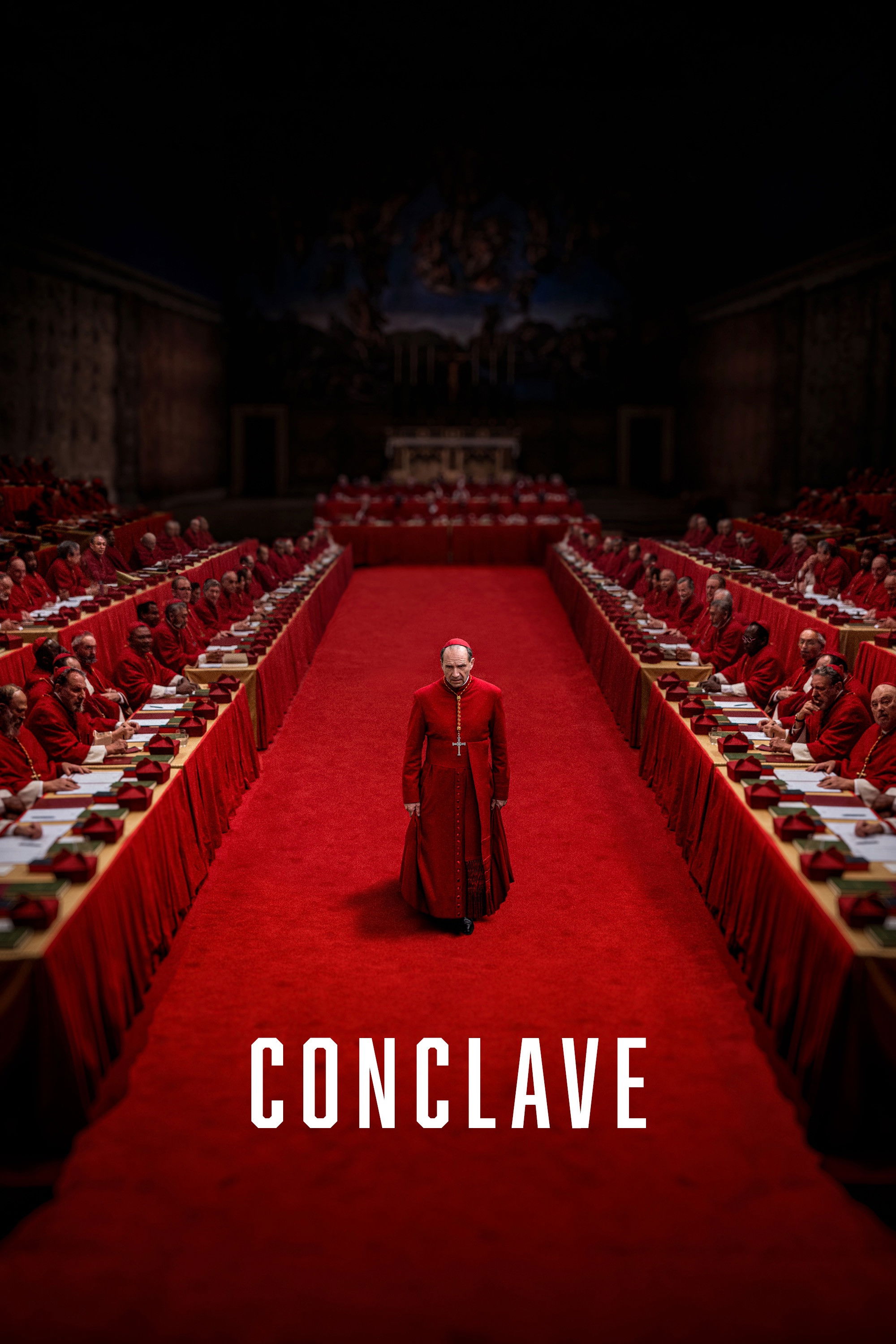
This is a handsome, controlled piece of film-making. Stéphane Fontaine shoots the Vatican as a place of vast spaces and small rooms, scarlet robes against grey stone, and finds real beauty in ritual without ever letting it tip into reverence. Berger keeps the camera patient and the cutting tight, so a story that is mostly men talking in chambers never loses its grip. Volker Bertelmann’s score does a lot of the tension, all nervy strings and percussive pulses that turn the counting of votes into something close to a heist sequence. The film understands that ceremony and suspicion are made of the same material, and it mines the gap between the sacred surface and the very human horse-trading underneath for both unease and a dry, welcome streak of humour.
How it stacks up
The natural shelf for this is alongside the other Harris adaptations, and The Ghost Writer is the closest fit: the same trick of making a confined, talky investigation feel genuinely tense, the same interest in power that prefers not to be seen working. It belongs in the company of Tinker Tailor Soldier Spy too, another film about an institution policing its own secrets through quiet, careful men. Against the broadsheet sweep of something like State of Play, Conclave is more chamber piece than newsroom thriller, but it shares the conviction that procedure, watched closely enough, is drama. What it does that the spy films do not is graft a real interrogation of belief onto the mechanics, so the question of who wins carries an actual moral weight.
Critics versus the rest of us
Critics have taken to it readily, sitting at 93% on Rotten Tomatoes, with most of the praise going to Fiennes, the look of the thing and the audacity of treating a conclave as a whodunnit. Audiences are warm but a touch cooler at 86%, and the IMDb 7.4 suggests the people expecting a faster thriller found it more measured than advertised. That is a fair reading. Conclave is deliberate, and it asks you to find votes and silences exciting, which not everyone will. The late turn the plot takes is divisive, and I can see why, though it is set up honestly enough to earn its place rather than feeling pulled out of the air.
Verdict
What I want from this kind of film is institutional intrigue handled by people who know how to build tension out of talk, and on that count Conclave delivers almost everything I ask of it. Fiennes is excellent, the craft is immaculate, and the central idea, that choosing a pope is a thriller plot waiting to be filmed, is a good one well executed. It stops just short of the very top tier for me because the resolution leans on a contrivance the rest of the film is too disciplined to need, and because for all its polish it is a touch airless. But it is intelligent, gripping and genuinely rewatchable, the sort of film that rewards a second viewing once you know what everyone is hiding. 8⁄10.
Availability: In UK cinemas now, on general release from Black Bear UK.
Update
Added since this review first appeared: Conclave went on to a strong awards run, taking the BAFTA for Best Film and an Academy Award for Peter Straughan’s adapted screenplay, with Fiennes nominated for his lead. Its standing has only firmed up as one of the best-reviewed films of its year, and it found a second, larger audience on streaming, where its tense, talky pleasures travelled well. It is now available on digital and disc, and streams on various platforms depending on region.
BBFC content advice
Rated 15 by the BBFC for brief sexual violence references. The notes below may contain spoilers.
Violence: A ceiling partially caves in following a sudden explosion, resulting in cuts and grazes across characters’ faces. There are references to a terrorist attack claiming the lives of 52 victims and wounding hundreds more.
Sex: Discreet references are made to a secret sexual relationship between a cardinal and a nun which resulted in the birth of a child.
Discrimination: A white cardinal distinctly points to his black peer when asking whether one could imagine an alternative to an Italian pope. He later expresses Islamophobic attitudes in the aftermath of a suicide bombing, however, these views are immediately and clearly condemned. A cardinal denounces his peer’s homophobic views. Discrimination is not condoned by the film as a whole.
Sexual Violence and Sexual Threat: A brief and undetailed verbal reference is made to previous popes ignoring reports of child sexual abuse within the Catholic Church. There is also a reference to the establishment of a convent for victims of genocidal sexual violence.
Theme: There are mild upsetting scenes relating to death and bereavement. Cardinals perform last rites over an elderly man’s corpse.
Alcohol and Smoking: Religious figures are shown smoking cigarettes. There is close-up sight of a pile of discarded cigarette butts on the ground. Infrequent references are made to a man’s alcohol dependency.
Source: British Board of Film Classification (bbfc.co.uk).