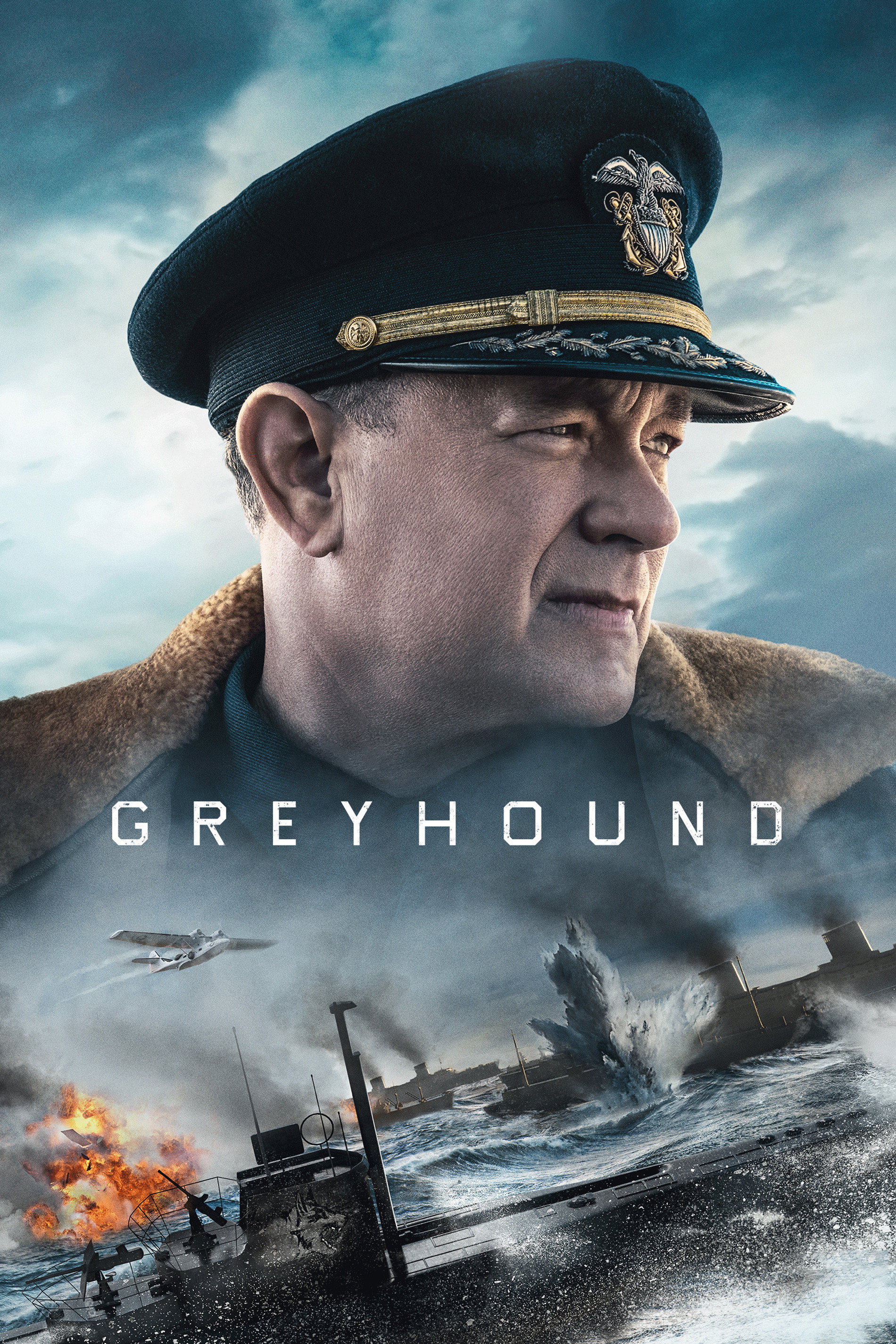

- UK release: July 2020 (Apple TV+)
- Director: Aaron Schneider · Writer: Tom Hanks
- Studio / distributor: Columbia Pictures; Playtone; Apple TV+
- Source: The Good Shepherd by C. S. Forester
- Genre: Second World War naval thriller · Runtime: 91 minutes (BBFC 15)
- Main cast: Tom Hanks (Saving Private Ryan, Captain Phillips) as Commander Ernest Krause; Stephen Graham (This Is England, Boardwalk Empire) as Charlie Cole; Rob Morgan (Mudbound) as Cleveland; Elisabeth Shue (Leaving Las Vegas) as Evelyn
- Rotten Tomatoes: 79% critics / 76% audience · My rating: 8 / 10
Tom Hanks has spent a fair part of his career in uniform, and a fair part of it adapting things himself, so a Hanks-written naval thriller pulled from a C. S. Forester novel was never going to be a hard sell. What is slightly unexpected is the discipline of it. Greyhound runs to ninety-one minutes, refuses almost every chance to cut away from the ship, and treats the destroyer’s bridge as a stage it has no intention of leaving. The pandemic has pushed it off the big screen and onto Apple TV+ rather than into cinemas, which is a shame for the sound design, but the film that arrives is tighter and more single-minded than the streaming release might lead you to expect.
The setup
It is early 1942, and Commander Ernest Krause (Tom Hanks) has his first wartime command: the destroyer USS Keeling, call sign Greyhound, shepherding an Allied convoy across the North Atlantic. For two days in the middle of the crossing the ships will be beyond the reach of air cover, in the stretch the crews call the Black Pit, and that is exactly where a wolf pack of German U-boats is waiting. Krause has never been tested under fire, the merchant ships behind him are slow and vulnerable, and the enemy is mostly an unseen voice and a wake in the dark. The whole film is that running fight: sonar pings, bearings called out, torpedoes in the water, and a man who has not slept trying to out-think something he can barely see.
The cast
This is Hanks’s film almost to the exclusion of everyone else, and he plays Krause as a quiet, devout, methodical professional rather than a barking hero. The performance is built out of small things: a prayer muttered between orders, untouched meals carried away, the careful courtesy he extends even when the bridge is in chaos. It is closer to his measured captain in Captain Phillips than to the rifle-company leader of Saving Private Ryan, and it gives the picture a still centre. Stephen Graham, as executive officer Charlie Cole, supplies the steadying second voice the format needs, and brings the lived-in authority he has been quietly building since This Is England. Rob Morgan, as the mess attendant Cleveland, lands one of the film’s few moments of real human cost. Elisabeth Shue appears only in a brief framing scene ashore, a memory rather than a character, and the film is honest enough not to keep cutting home to her.
The craft
Aaron Schneider, whose Get Low was a much slower and more talkative film, turns out to have a good eye for procedure. The tension is generated almost entirely by the language of naval combat: the relayed sonar contacts, the corrected headings, the gap between an order given and a hit landing. Shelly Johnson’s camera stays tight and disorienting on the bridge, and the digital seas, while occasionally a touch glassy, mostly hold up under the spray. Blake Neely’s score knows when to drop out and let the sound of the ship do the work. There is a real craft in how legible the film keeps a fight that is, by its nature, a confusion of bearings and blips, and the relentless ninety minutes never lets the pulse drop.
How it stacks up
The obvious shadow over any U-boat-era thriller is Das Boot, and Greyhound is wise not to invite the comparison too closely; it is the convoy’s story, not the submarine’s, and it has none of that film’s claustrophobic character study. It sits nearer to Master and Commander, sharing its love of nautical procedure and chain of command, though without the breadth of that film’s world. Christopher Nolan’s Dunkirk is the recent benchmark for stripping a war film down to pure tension with thin characterisation, and Greyhound is playing a similar game on a smaller budget and a single deck. Against any of them it is the leaner, less ambitious picture, but it is also the most efficient.
Critics versus the rest of us
Critics are broadly favourable, sitting around the high seventies, and praising precisely what I did: the lean running time and the procedural grip. The common reservation is that the film is thin on character, that Krause is the only person aboard who registers and even he is more a set of habits than a man. Audiences are a little cooler, which I suspect is the streaming release setting expectations for something bigger. Both notes are fair. There is no real subplot, no arc beyond surviving the crossing, and viewers who want the people behind the procedure will feel the gap.
Verdict
I happen to like exactly this kind of film: tight, technical, procedural, built around competent people doing a difficult job under pressure, with no patience for the subplots a longer cut would have bolted on. The lack of depth that bothers some critics reads to me as restraint. Greyhound knows what it is, does it in ninety-one minutes, and gets off the bridge before it outstays its welcome. It is the sort of thing I will put on again on a wet afternoon precisely because it asks nothing of me beyond attention and rewards it with sustained tension. Not a great war film, but a very well-made small one. 8⁄10.
Availability: Streaming on Apple TV+ from 10 July 2020. Worth the best speakers or headphones you can manage, since the cinema release it was built for did not happen.
Update
Added since this review first appeared: with no theatrical run, Greyhound has lived its whole life on Apple TV+, where it remains. It picked up an Academy Award nomination for Best Sound at the 93rd ceremony, which fits a film that lives or dies on its sonar pings and depth charges. Its reputation has settled roughly where the original reviews left it: admired as a lean, efficient procedural, gently dinged for thin characterisation, and quietly rewatchable for exactly that leanness.
BBFC content advice
Rated 15 by the BBFC for moderate war violence, threat, infrequent strong language. The notes below may contain spoilers.
Violence: There is moderate violence in sea battles between ships and submarines, with intense exchanges of artillery fire, explosions from depth charges and ships being damaged by torpedo strikes. There are no images of casualties or injury, apart from fleeting sight of a bloody bullet wound to a sailor’s face before he is carried away.
Threat and horror: There is moderate threat as Allied ships attempt to avoid torpedoes, and crew members deal with outbreaks of fires.
Language: There is infrequent strong language (‘f**k’), as well as milder bad language including uses of ‘son of a bitch’, ‘damn’ and ‘hell’.
Additional issues: There are occasional uses of the discriminatory term ‘kraut’ by American sailors to describe the German enemy, which reflect the historical period and events in which the film is set. There is occasional smoking which also reflects the historical setting of the film.
Source: British Board of Film Classification (bbfc.co.uk).