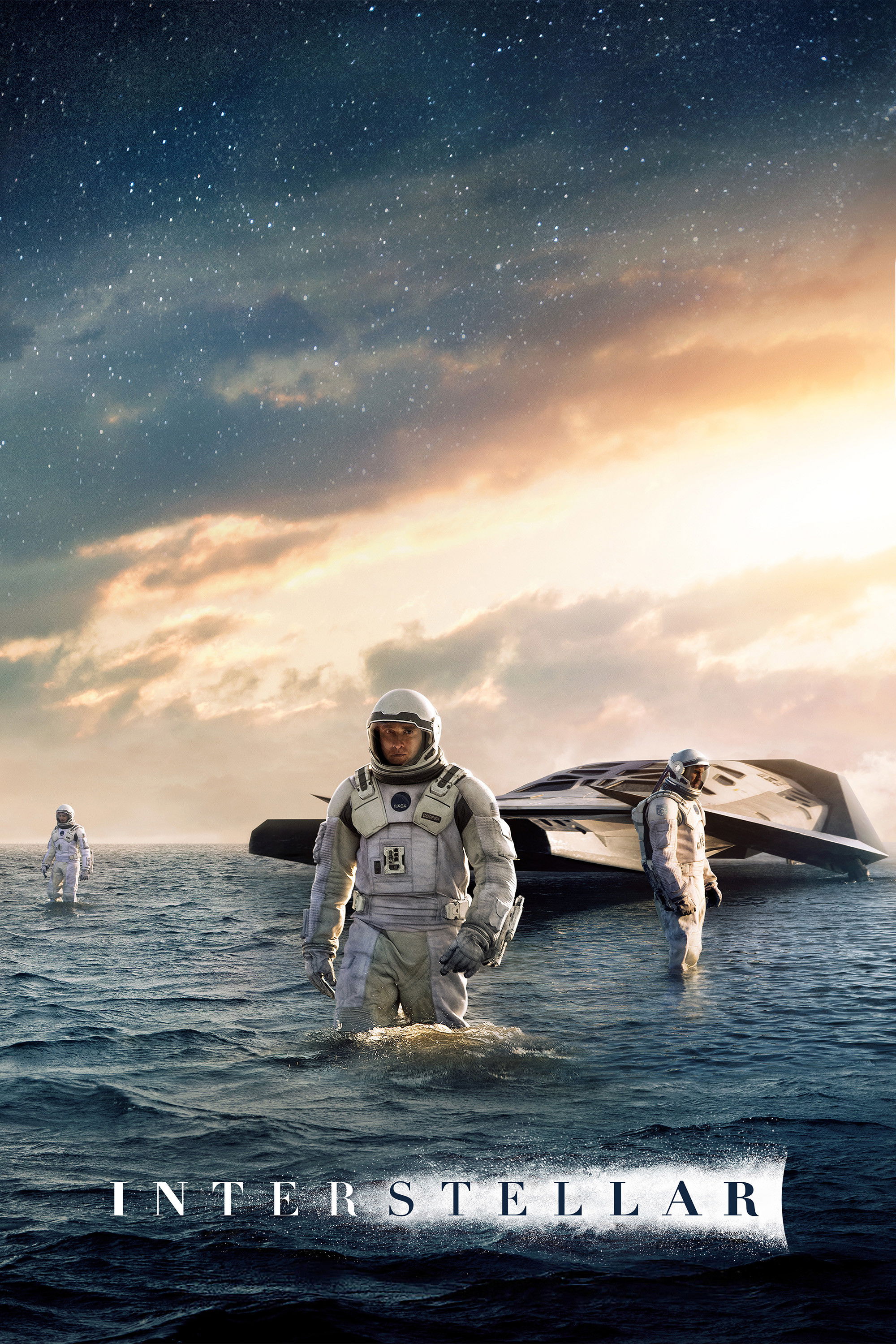

- UK release: November 2014
- Director: Christopher Nolan · Writers: Jonathan Nolan, Christopher Nolan
- Studio / distributor: Paramount; Warner Bros.; Legendary; Syncopy
- Genre: Epic science fiction / space drama · Runtime: 169 minutes (BBFC 12A)
- Main cast: Matthew McConaughey (Dallas Buyers Club, Mud) as Cooper; Anne Hathaway (Rachel Getting Married, Les Misérables) as Amelia Brand; Jessica Chastain (Zero Dark Thirty, The Tree of Life) as Murph; Michael Caine (The Dark Knight, The Prestige) as Professor Brand
- Rotten Tomatoes: 72% critics / 86% audience · My rating: 9 / 10
Christopher Nolan has spent a decade making films that fold in on themselves: the reversed grief of Memento, the nested dreams of Inception, the duelling magicians of The Prestige. Interstellar is the first time he has pointed all that engineering outward, at the actual cosmos, and the first time he has let a film be openly, unguardedly emotional. The result is the biggest swing of his career, a three-hour science fiction epic that wants to be 2001 and a story about a father and a daughter at the same time, and mostly gets away with both.
The setup
Earth is dying. Not in a single cataclysm but slowly, choked by blight and dust, the human race reduced to subsistence farming on a planet that has decided it no longer wants us. Cooper (Matthew McConaughey), a former NASA pilot turned reluctant farmer, stumbles onto the remnant of the space programme and is offered the one job left worth doing: fly through a wormhole that has appeared near Saturn, in search of a new home for humanity among the stars on the far side. The catch is the one no parent could ignore. The mission could take years or decades, relativity does strange things to time, and his young daughter Murph will be waiting on a world with a deadline. The film hangs its enormous scale on that small, painful equation.
The cast
McConaughey is the right actor at the right moment, fresh from a run of work that has remade him from rom-com lead into something rawer and more serious. He gives Cooper a plain-spoken decency and a grief that the film keeps returning to, and a scene built around a backlog of video messages from home is the most devastating thing he has ever done on screen. Anne Hathaway brings spine and a flash of genuine feeling to Amelia Brand, the scientist who has to argue for instinct in a film that otherwise worships equations. Jessica Chastain carries the Earthbound half of the story as the grown Murph, all banked fury and unfinished business, and she has to sell the emotional payoff almost single-handed. Michael Caine, a Nolan regular by now, lends Professor Brand the weary authority the part needs, with a compromise hidden behind it.
The craft
This is a film built to be seen large. Hoyte van Hoytema shoots vast stretches of it on IMAX film, and the imagery earns the format: a wall of water under an alien sky, a black hole rendered with real physics rather than guesswork, the small human ship a speck against indifferent scale. Nolan shot practical wherever he could, and you feel it in the weight of the spacecraft and the dust of the cornfields. Hans Zimmer’s score, built around a church organ, swells and shudders and occasionally drowns the dialogue, a choice that will divide people, though the sound design clearly wants you off balance. Lee Smith’s editing cross-cuts the cosmic and the domestic so that an hour on one planet and a lifetime back home land in the same breath. It is overlong and the exposition comes in heavy slabs, but the ambition never flags.
How it stacks up
The shadow over the whole project is 2001: A Space Odyssey, and Nolan invites the comparison openly, down to a wisecracking robot built as the anti-HAL. He is the warmer film-maker; where Kubrick kept his distance, Nolan wants you to cry. The closer cousin is Contact, another story of wormholes, fathers and faith dressed as physics, and not only because McConaughey appeared in that too. Against last year’s Gravity, which was a tighter, leaner survival thriller, Interstellar is baggier and more reckless, reaching for ideas Gravity never tried to hold. It does not have the clean perfection of those leaner films. It has more on its mind than any of them.
Critics versus the rest of us
Critics are split. The praise lands on the ambition, the visuals and the sheer nerve of it; the complaints land on the dialogue, which can clunk, and on a late turn that asks the audience to accept love as something close to a physical force. Around 72% of critics are on side, while audiences are warmer at 86%, and that gap tells the story. The people willing to go all in on the film’s emotional logic come out moved; the ones who wanted rigorous hard science all the way down feel the film blink at the crucial moment. I land with the audience. The reach exceeds the grasp in places, and I would rather watch a film that swings this hard and misses occasionally than one that plays it safe.
Verdict
I value intelligent science fiction, world-building and a score that gets under your skin, and Interstellar delivers all three at a scale almost nothing else attempts. Yes, it is too long, the dialogue sometimes explains what the images already said, and the final act asks for a leap of faith. None of that dents the experience much. It is a film I have already watched several times and will watch again, the rare blockbuster that treats its audience as clever and is unembarrassed about feeling. See it as big and as loud as you possibly can. 9⁄10.
Availability: On general release in UK cinemas now, including 70mm and IMAX prints that are the way to see it. A DVD and Blu-ray release will follow in the spring.
Update
Added since this review first appeared: Interstellar has settled into a reputation well above its mixed opening notices, regularly cited alongside Gravity and the later Arrival and The Martian as the high-water mark of the 2010s space revival, and it has become a fixture of repertory IMAX and 70mm re-releases, where it routinely sells out. Nolan went on to Dunkirk and Oppenheimer, the latter sweeping the Academy Awards, which has only deepened the regard for this film as the moment his ambition and his emotion finally met. It is now widely available on 4K disc and digital, and streams on various platforms depending on region.
BBFC content advice
Rated 12A by the BBFC for infrequent strong language, moderate threat, violence. The notes below may contain spoilers.
Violence: There are infrequent scenes of moderate violence, including punches and head butts. There is no injury detail.
Threat and horror: Numerous scenes of threat show characters dealing with the dangers of space travel and the harsh environments on different planets.
Language: There is infrequent strong language (‘f**k’), during a heated confrontation, as well as various milder terms, such as ‘son of a bitch’ and ‘shit’.
Theme: The film deals with issues such as loss and separation, including never seeing loved ones again, which may be upsetting to younger viewers.
Alcohol and smoking: Adult characters drink alcohol.
Source: British Board of Film Classification (bbfc.co.uk).