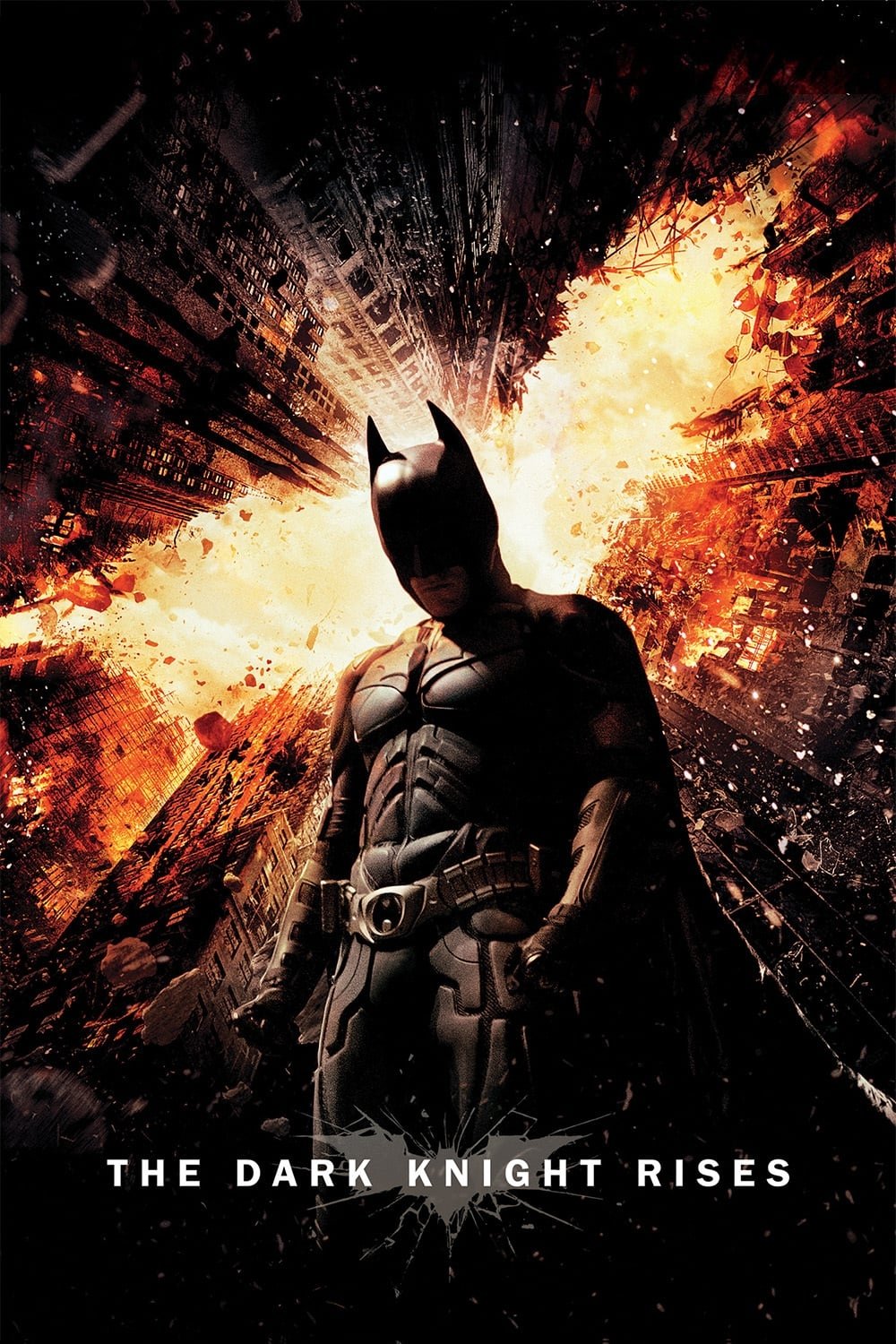
- UK release: July 2012
- Director: Christopher Nolan · Writers: Jonathan Nolan, Christopher Nolan; story by Christopher Nolan and David S. Goyer
- Studio / distributor: Warner Bros.; Legendary Pictures; Syncopy
- Genre: Superhero epic / action thriller · Runtime: 164 minutes (BBFC 12A)
- Main cast: Christian Bale (American Psycho, The Prestige) as Bruce Wayne / Batman; Tom Hardy (Bronson, Inception) as Bane; Anne Hathaway (The Devil Wears Prada) as Selina Kyle; Michael Caine (The Italian Job, The Cider House Rules) as Alfred; Gary Oldman (Tinker Tailor Soldier Spy, The Fifth Element) as Commissioner Gordon; Joseph Gordon-Levitt ((500) Days of Summer, Inception) as John Blake
- Rotten Tomatoes: 87% critics / 90% audience · My rating: 9.5 / 10
Four years ago The Dark Knight did something a comic-book film was not supposed to do: it turned a man in a cape into a study of order and chaos, gave Heath Ledger a Joker for the ages, and left a body count that the city of Gotham, and Batman himself, was always going to have to answer for. Following that is the hardest job in the franchise, and Christopher Nolan has not tried to repeat it. He has instead made the loudest, longest and most openly emotional of the three, a film that wants to be a finale in the full operatic sense, and largely earns the ambition.
The setup
It is eight years on in Gotham, and Batman has not been seen since the night he took the blame for crimes he did not commit. Bruce Wayne (Christian Bale) has shut himself away, a recluse rattling around his own house, while the city congratulates itself on a peace built on a lie. Into that complacency walks Bane (Tom Hardy), a masked mercenary with the strength to break a man and the patience to break a city, and a plan that goes a good deal further than robbery. Drawn back out is a cat burglar, Selina Kyle (Anne Hathaway), with her own agenda and no particular loyalty to either side. Wayne, out of shape and out of practice, has to decide whether the symbol is worth resurrecting, and what it will cost him this time. I will leave the shape of Bane’s scheme where the film leaves it, because the slow reveal is part of the pleasure.
The cast
Bale has always played Wayne as a man at war with himself, and here he is allowed to look genuinely worn out, physically and otherwise, which gives the comeback some weight. Hardy has the harder task, acting through a mask that covers everything but his eyes, his voice piped out in a strange clipped register that you either accept early or spend the film fighting. I accepted it. Bane is not Ledger’s Joker and is not trying to be: where the Joker wanted to watch the world burn for sport, Bane has a thesis, and Hardy gives him a terrible calm. Hathaway is the surprise, light on her feet and quick with a line, never asking to be liked and better for it. The old guard hold the centre, as ever. Michael Caine’s Alfred is given the film’s most wounding scenes, a butler reduced to pleading, and Gary Oldman’s Gordon carries the guilt of the previous film like a stone. Joseph Gordon-Levitt, as a young beat cop who has worked out more than he lets on, quietly turns into the conscience of the thing.
The craft
Nolan and Wally Pfister shoot Gotham as a real, cold, vertical city, and a large amount of the film was photographed in IMAX, which on the right screen is overwhelming in the best way: the opening aerial hijack, an American football stadium folding in on itself, a city sealed off and turned against its own. Practical effects do most of the work, and you feel it; the destruction has heft because so much of it is actually there. Hans Zimmer’s score is relentless, a chanting, building pressure that does not let the audience settle, and Lee Smith’s editing keeps a 164-minute film moving even when the plot is asking a lot of it. The film is too long and the plot creaks in a couple of places, particularly in how easily a city the size of Gotham is cut off from the world. None of it dents the sense of scale, which is the thing Nolan is selling and the thing he delivers.
How it stacks up
Against its own trilogy, this is bigger and broader than Batman Begins and less tightly wound than The Dark Knight, trading that film’s nervy two-hander for something closer to a disaster epic. The reference points Nolan reaches for are not other superhero films at all. There is a great deal of Dickens in here, A Tale of Two Cities read more or less out loud by the end, tumbrils and mobs and a city tearing itself apart, and a strong dose of siege cinema, the occupied-metropolis terror of a Battle of Algiers run through a blockbuster. It is far closer in spirit to a Bond film with a doomsday device than to anything Marvel is making, and it has more on its mind than most of either.
Critics versus the rest of us
Critics are strongly behind it, sitting around 87%, with audiences a notch higher near 90%, and the common reservation is that the plotting is overextended and Bane’s voice an acquired taste. Both of those are fair. The film bites off an enormous amount and chews some of it loudly. The recurring grumble that it is the weakest of the three I half accept and wholly do not care about, because what it does well it does on a scale the other two never attempt: a hero genuinely broken and made to climb back, a finale that pays off three films of accumulated cost, and a closing stretch that lands its emotional punches square. The political subtext that some reviewers worry at, occupy-the-rich one minute and law-and-order the next, reads to me less as a manifesto than as a film grabbing whatever imagery makes the siege feel dangerous.
Verdict
This is the kind of blockbuster I value most: ambitious, built to be watched again, willing to be sincere when it would be safer to be cool. It is not the cleanest film in the trilogy and it does not need to be. It is the one that swings hardest, gives its actors the most to play, and brings a sprawling three-film story to a close that actually feels like a close. I have watched it many times and it holds up every time, the length included. The flaws are real and the spectacle, the performances and the sheer nerve of the ending bury them. 9.5⁄10.
Availability: On general release in UK cinemas now. See it in IMAX if you possibly can; a great deal of the film was shot for that screen and it is a different experience full size.
Update
Added since this review first appeared: The Dark Knight Rises completed what is now generally regarded as the benchmark superhero trilogy, and its operatic, real-world-grounded approach cast a long shadow over the comic-book films that followed. Tom Hardy went on to lead Mad Max: Fury Road (2015), and Anne Hathaway took the Best Supporting Actress Oscar for Les Misérables, released a few months after this. The film is now widely available on disc and digital, with periodic IMAX trilogy re-releases, and streams on the major platforms depending on region.
BBFC content advice
Rated 12A by the BBFC for moderate violence. The notes below may contain spoilers.
Violence: Scenes of violence include fistfights, gunfights, and a brief stabbing. There is limited sight of blood or injury detail throughout, although one sequence dwells on the beating of a man and it is implied that his back is broken.
Threat and horror: There are scenes in which the city is threatened by the central villain, including bombs being planted in tunnels and people being taken hostage.
Language: There is a use of moderate bad language when a woman is called a ‘bitch’. Other language is milder, including uses of ‘bastard’.
Sex: There is some kissing and very mild references to sexual activity.
Injury detail: There is sight of dead bodies in the aftermath of violence but limited sight of blood or injury detail.
Alcohol and smoking: Adult characters drink and smoke.
Source: British Board of Film Classification (bbfc.co.uk).