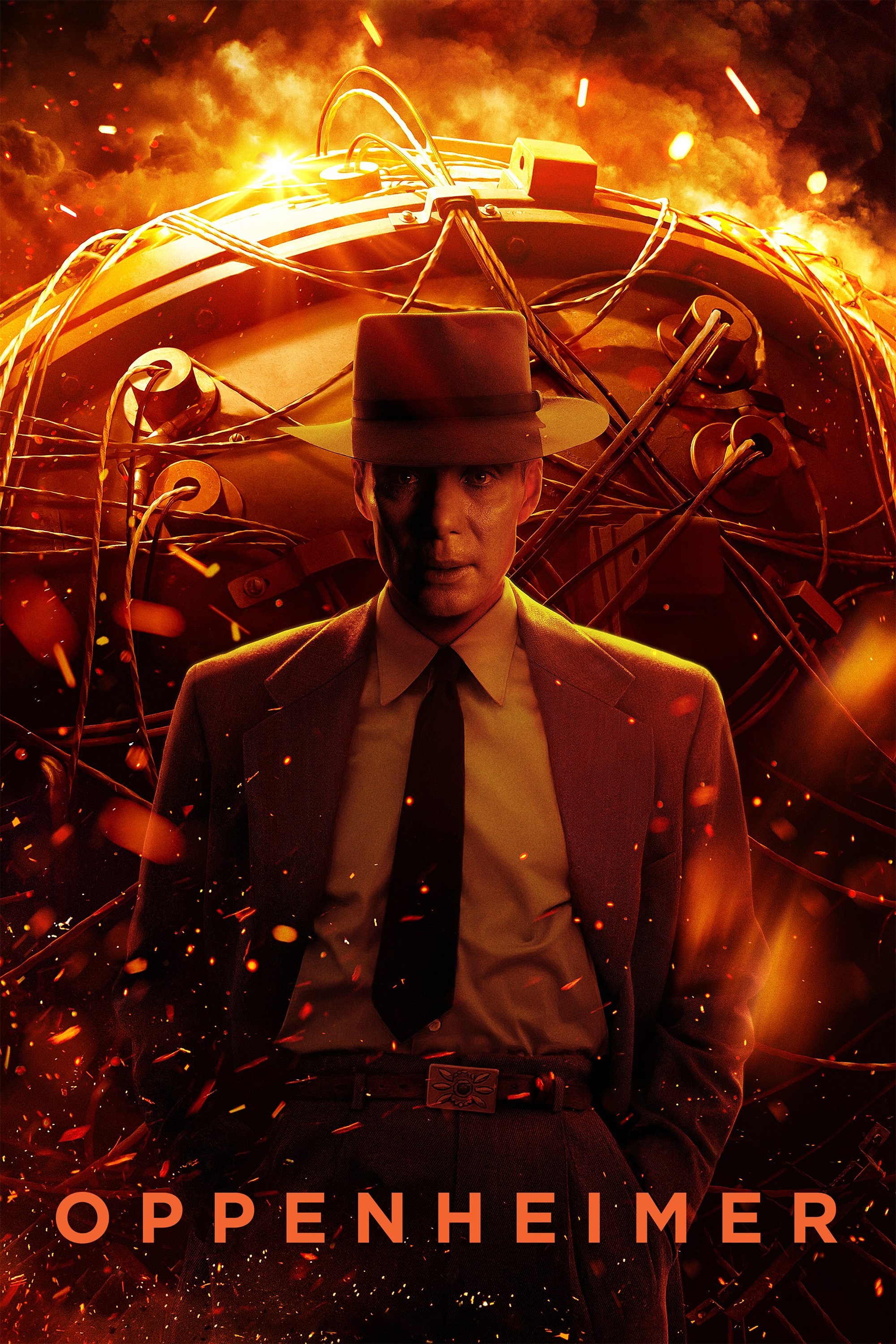

- UK release: July 2023
- Director: Christopher Nolan · Writer: Christopher Nolan
- Studio / distributor: Universal Pictures; Syncopy; Atlas Entertainment
- Genre: Biographical drama / political thriller · Runtime: 180 minutes (BBFC 15)
- Main cast: Cillian Murphy (28 Days Later, Inception) as J. Robert Oppenheimer; Emily Blunt (Sicario, Edge of Tomorrow) as Kitty Oppenheimer; Robert Downey Jr. (Zodiac, Iron Man) as Lewis Strauss; Matt Damon (The Bourne Identity, The Martian) as Leslie Groves
- IMDb: 8.3 / 10 · Rotten Tomatoes: 93% critics / 91% audience · My rating: 8.5 / 10
For twenty years Christopher Nolan has been the director who reaches for the biggest canvas in the room: spinning corridors, capsizing oil tankers, the curvature of time itself. So there is something almost perverse about Oppenheimer, a three-hour film whose largest set pieces are a desert test stand and a wood-panelled hearing room, and whose central drama is a man trying to work out what he has done. It is adapted from Kai Bird and Martin Sherwin’s American Prometheus, and Nolan has clearly read the title closely. This is a film about a man who steals fire and is made to answer for it.
The setup
J. Robert Oppenheimer (Cillian Murphy) is a brilliant, restless theoretical physicist who is handed the job of building an atomic weapon before the Nazis can. He assembles a secret town in the New Mexico desert, drives a sprawling scientific army towards a single morning in July 1945, and succeeds. The film then does the more interesting thing: it follows him past the triumph into the long, airless aftermath, where a closed security hearing and a quietly vengeful Washington insider, Lewis Strauss (Robert Downey Jr.), set out to take apart the reputation of the man who won the war. Nolan runs the two timelines against each other, one in colour and subjective, one in stark black and white, so the bomb and the reckoning detonate at the same time.
The cast
Murphy has spent years on the edges of Nolan’s films, and given the centre he is remarkable: gaunt, watchful, the eyes doing the work the dialogue will not. He plays Oppenheimer as a man permanently slightly ahead of the conversation and slightly behind his own conscience, charismatic and cold in the same breath. Emily Blunt has less screen time than she deserves but turns Kitty into the sharpest, least sentimental person in any room, and her late scene under cross-examination is the film’s hinge. Matt Damon brings welcome bluntness as General Groves, the soldier babysitting a tent full of geniuses. The surprise is Downey Jr., buried under age make-up and pettiness as Strauss, giving the most disciplined performance of his career and reminding you there was a serious actor before the armour.
The craft
Nolan and his cinematographer Hoyte van Hoytema shot much of this on large-format and IMAX film, including, by some accounts, the first sections of black-and-white IMAX ever exposed, and it shows in the texture of faces and the depth of the desert light. The Trinity test, built without computer-generated imagery, is a genuinely frightening sequence precisely because Nolan withholds the noise and lets the silence stretch. Ludwig Goransson’s score is almost continuous, a nervous strung-wire pulse that turns equations and committee meetings into thriller mechanics. Jennifer Lame’s editing keeps three hours of talk moving like a chase. The film is dense, occasionally to a fault, and it asks you to keep pace with names, grudges and clearances, but it never coasts.
How it stacks up
The obvious neighbours are the intelligent prestige dramas about troubled clever men: A Beautiful Mind, The Imitation Game, The Social Network. Oppenheimer is colder and more ambitious than any of them, less interested in redemption than in consequence. Its braided-timeline, on-trial structure owes a clear debt to Oliver Stone’s JFK, and like that film it is really an argument staged as a thriller. Against Nolan’s own work it is the natural companion to Dunkirk: history rendered as pure tension, with the human cost felt rather than explained. What it lacks is the propulsive replay value of Inception or The Dark Knight. This is a film you respect on the first viewing and unpack on the second, not one you put on for comfort.
Critics versus the rest of us
Critics are close to rapturous, sitting around 93%, praising the performances, the sound, the moral seriousness and the sheer nerve of selling a dialogue-driven epic to a summer audience. Audiences, at roughly 91%, have followed in numbers nobody predicted for a three-hour talk about physics and security clearances. The few dissenting notes are fair: the supporting cast is so deep that good actors flash past unnamed, and the second hearing-room hour demands real concentration. I land where most viewers do, with one reservation. The craft is close to flawless and the intelligence is bracing, but it is admired more than it is loved, and weight is not the same thing as rewatchability.
Verdict
This is the best film Nolan has made, and the most grown-up. It takes the most consequential event of the twentieth century and refuses to turn it into spectacle, holding instead on a face working out the cost of a decision that cannot be taken back. Murphy is extraordinary, Downey Jr. is the year’s most unexpected pleasure, and the Trinity sequence alone justifies the largest screen you can find. I keep it just below the very top of my scale only because its seriousness is also its ceiling: I will think about it for a long time, but I will not reach for it as often as the films it sits beside. 8.5⁄10.
Availability: On general release in UK cinemas now, and worth seeing on the biggest IMAX screen you can reach.
Update
Added since this review first appeared: Oppenheimer went on to sweep the 2024 awards season, taking seven Academy Awards including Best Picture, Best Director for Nolan, Best Actor for Cillian Murphy and Best Supporting Actor for Robert Downey Jr. Its unlikely double billing with Barbie on the same July weekend became the “Barbenheimer” phenomenon that drove both films to enormous box office. It is now available on 4K Blu-ray and digital, and streams on Peacock and Sky / NOW in the UK depending on region.
BBFC content advice
Rated 15 by the BBFC for strong language, sex. The notes below may contain spoilers.
Violence: It is briefly implied that an unseen attacker drowns a woman in a bath. There are regular verbal references to deaths by bombing, and the injuries sustained by victims.
Threat and horror: A man experiences nightmarish visions of the end of the world: these include burning skin, charred corpses and sickness. Scientists gingerly prepare an atomic bomb for testing.
Language: There is use of strong language (‘f**k’), as well as other terms such as ‘shit’ and ‘Jesus Christ’.
Sex: There are brief scenes of strong sex which include breast and buttock nudity.
Discrimination: Antisemitism in the context of the 1930s and 40s is an undercurrent of the film. There are undetailed references to the Holocaust. There are references to sexism.
Suicide and self-harm: A woman’s suicide is depicted in terms which throw doubt on that version of the circumstances of her death.
Theme: A woman’s alcoholism, and a man’s haunting guilt, are themes of the film.
Flashing/flickering lights: This work contains flashing images which may affect viewers who are susceptible to photosensitive epilepsy.
Source: British Board of Film Classification (bbfc.co.uk).