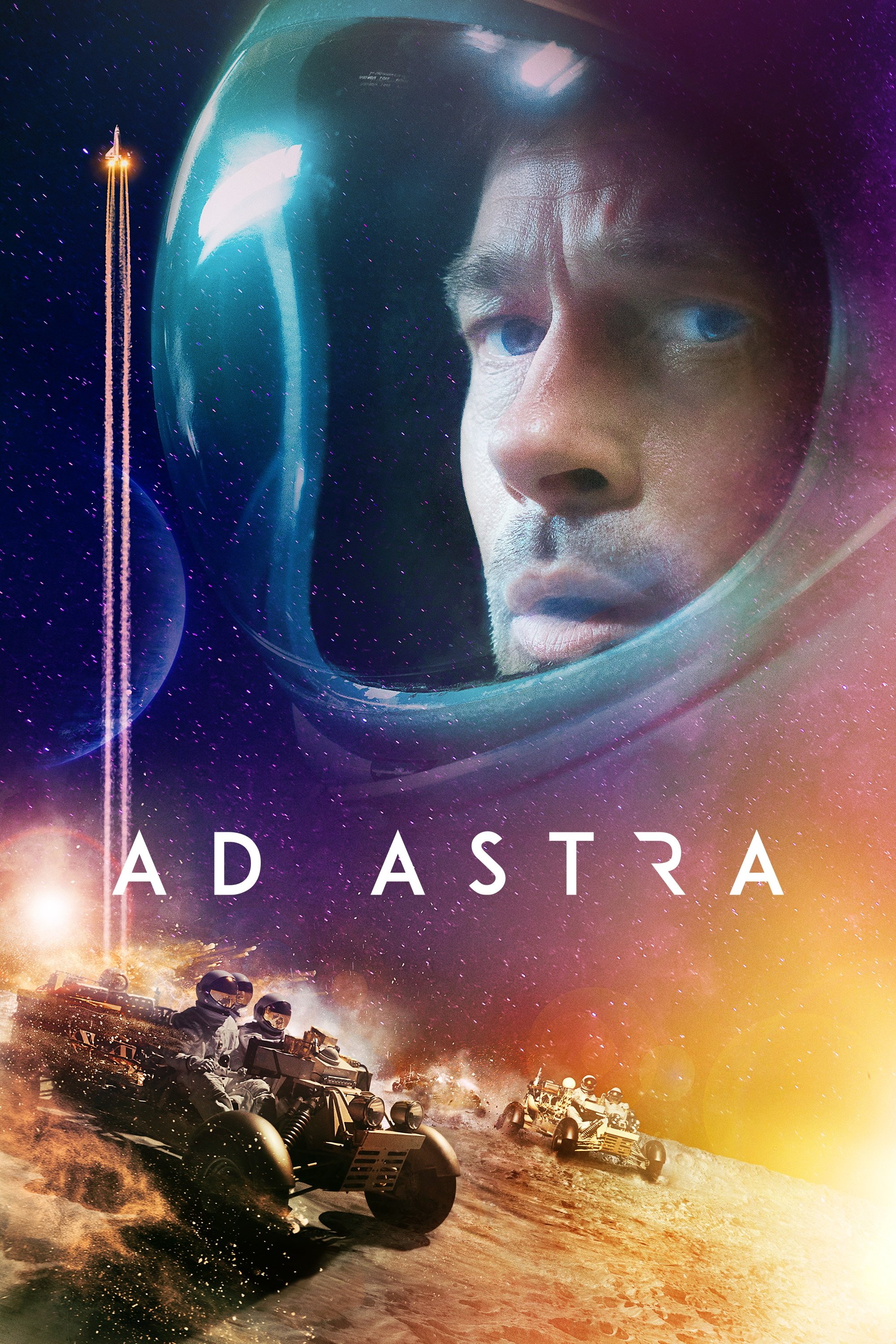

- UK release: September 2019
- Director: James Gray · Writers: James Gray, Ethan Gross
- Studio / distributor: 20th Century Fox; New Regency; Plan B Entertainment
- Genre: Science fiction drama / space odyssey · Runtime: 123 minutes (BBFC 12A)
- Main cast: Brad Pitt (Fight Club, The Tree of Life) as Roy McBride; Tommy Lee Jones (The Fugitive, Men in Black) as H. Clifford McBride; Ruth Negga (Loving) as Helen Lantos; Donald Sutherland (Ordinary People, Klute) as Thomas Pruitt
- IMDb: 6.5 / 10 · Rotten Tomatoes: 83% critics / 40% audience · My rating: 7 / 10
James Gray has spent his career making sober, slightly old-fashioned dramas about fathers, sons and the weight of obligation, mostly set in a New York that looks like it belongs to an earlier decade. Ad Astra is the first time he has pointed that sensibility at the stars, and the surprise is how little he changes to do it. The marketing sells a Brad Pitt action picture set against the rings of Neptune. What turns up is a quiet, interior film about a man who has spent his whole life not feeling things, sent on a mission that gives him no choice but to start.
The setup
Roy McBride (Brad Pitt) is an astronaut so unflappable that his resting heart rate has become a professional legend. He is the kind of man who can survive a fall from the top of a structure that reaches into the upper atmosphere and report his vitals on the way down. When a series of power surges threatens Earth from somewhere out past Neptune, the authorities tell Roy something he has spent thirty years half believing was a lie: his father, the celebrated and presumed-dead Clifford McBride (Tommy Lee Jones), may still be alive at the far edge of the solar system, and may be the source of the catastrophe. Roy is sent out to make contact, a journey that takes him from the Moon to Mars and beyond, and the further he travels the clearer it becomes that the mission and the man are the same problem.
The cast
This is Pitt’s film almost to the exclusion of everyone else, and he carries it with a stillness that is the opposite of movie-star vanity. Much of the performance lives in voiceover and in a face holding itself very deliberately together, and he makes that restraint compelling rather than inert. Tommy Lee Jones, when he finally arrives, brings the granite obsession he can summon better than almost anyone, a man who chose the void over his own family and will not apologise for it. Ruth Negga has only a couple of scenes as a Mars-born administrator with her own buried grief, but she lands them; you wish the script had found more for her. Donald Sutherland appears briefly as an ailing colleague of Roy’s father and lends the early stretch a note of weary history. The film is not really built for an ensemble, and it knows it.
The craft
The reason to see this on the largest screen available is Hoyte van Hoytema’s photography. He shoots the solar system as a series of vast, cold, beautiful spaces, and the set pieces, a lunar rover chase across the grey, a scramble through a derelict research vessel, are staged with real clarity and tension. Max Richter’s score works in long mournful washes that suit the mood without telling you what to feel. Gray’s design instinct is for plausibility over spectacle: the Moon has a strip-mall departure lounge, space travel has been thoroughly monetised, and the future feels lived-in and slightly shabby. The pacing is the gamble. This is a deliberately slow film, and a couple of the incident-filled detours sit awkwardly against its meditative spine, as though the studio asked for action and Gray supplied it under protest.
How it stacks up
The film wears its influences openly. The structure is Apocalypse Now in a spacesuit, a journey upriver toward a charismatic absent figure who has gone his own way past the edge of sanction, with Roy’s voiceover doing the Willard work. The cosmic awe and the cool, clinical surfaces nod to 2001: A Space Odyssey, and the marriage of hard science fiction to a study of grief and isolation recalls Solaris. Against the other recent space films it sits in an interesting spot: it has neither the rousing problem-solving momentum of Interstellar nor the procedural restraint of First Man, and it is more openly a psychodrama than either. Where it parts company with most of them is its answer. The vast expensive journey to the outer solar system turns out to be about whether one closed-off man can let himself feel something, and your patience with the film depends almost entirely on whether you find that ending earned or anticlimactic.
Critics versus the rest of us
The split here is stark and instructive. Critics are largely won over, sitting around 83%, praising the photography, Pitt’s controlled performance and the ambition of making a contemplative art film on a blockbuster budget. Audiences are far cooler, down at 40%, and you can see why: anyone who bought a ticket for a Brad Pitt space-action thriller is within their rights to feel quietly misled. Both sides are responding to the same thing. The film is beautiful, serious and unhurried, and whether that reads as profound or as ponderous is close to a coin toss. I land between the two camps, nearer the critics, but with the audience’s reservation acknowledged.
Verdict
This is a film I admire more than I love, which is precisely the kind of distinction that keeps a score honest. The craft is genuinely first-rate, the central performance is brave and the ideas about masculinity, distance and the cost of mission-above-all are handled with more intelligence than the genre usually allows. It is also slow, emotionally guarded by design, and a little too pleased with its own melancholy to be something I will reach for on a rainy Sunday. Beautiful and thoughtful, then, but not a keeper I will return to often. 7⁄10.
Availability: On general release in UK cinemas now. Worth the largest screen you can find, IMAX if you have one within reach.
Update
Added since this review first appeared: Ad Astra has settled into its reputation as a handsome, divisive one-off, admired by critics and respected rather than embraced by audiences, the kind of mid-budget adult science fiction that the studios were already finding hard to justify. It is now widely available on disc and digital, and streams on the major platforms depending on region, where its slow rhythm arguably plays better at home than it did against blockbuster expectations in a cinema.
BBFC content advice
Rated 12A by the BBFC for infrequent strong language, moderate violence, threat, gory images. The notes below may contain spoilers.
The BBFC’s full per-category Content Advice for this title could not be retrieved at the time of writing (the release page returned an error). The age rating and short consumer advice line above are from the BBFC classification record; the detailed breakdown by category (Violence, Threat and horror, Language, and so on) should be confirmed against the BBFC release page before relying on it.
Source: British Board of Film Classification (bbfc.co.uk).