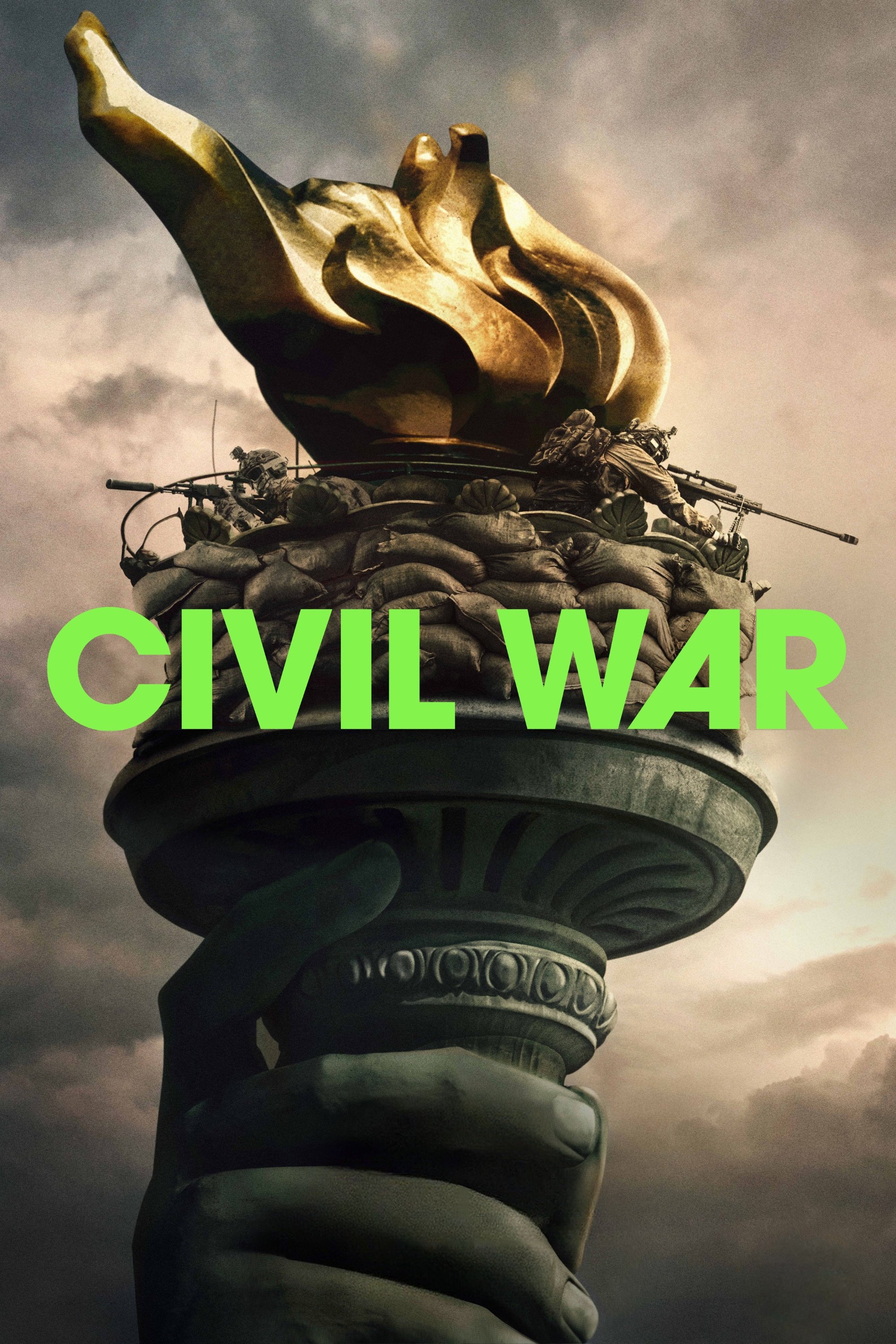

- UK release: April 2024
- Director: Alex Garland · Writer: Alex Garland
- Studio / distributor: A24; DNA Films
- Genre: Dystopian war thriller / road movie · Runtime: 109 minutes (BBFC 15)
- Main cast: Kirsten Dunst (Melancholia, Spider-Man) as Lee; Wagner Moura (Elite Squad, Narcos) as Joel; Cailee Spaeny (Priscilla) as Jessie; Stephen McKinley Henderson (Fences, Dune) as Sammy
- IMDb: 7.0 / 10 · Rotten Tomatoes: 81% critics / 69% audience · My rating: 8 / 10
Alex Garland has spent his directing career picking at things that frighten him in private: the machine that learns to lie in Ex Machina, the biology that rewrites itself in Annihilation, the rot under a pretty English village in Men. Civil War is the first time he has pointed that unease at something as blunt as a country tearing itself apart, and the surprise is how little interest he has in the politics of it. The marketing sells a near-future America at war with itself. The film that arrives is about the people who photograph wars, and what it costs to keep looking through the viewfinder when everyone else has looked away.
The setup
The United States has fractured. A secessionist alliance of Texas and California is closing on Washington, the President is barricaded in a White House that no longer controls much, and the front line has dissolved into a patchwork of militias, holdouts and men with guns who answer to nobody. Into this, four journalists set out by road from New York towards the capital, chasing one last interview with a President who has stopped giving them. Lee, a veteran war photographer, leads. Joel drives and writes. Sammy, older and slower, comes along against everyone’s better judgement. Jessie, barely out of her teens and desperate to do what Lee does, attaches herself to them. Garland keeps the causes of the war vague on purpose, and refuses to tell you who the good side is. What he gives you instead is the road, and a country you half recognise turned into something you do not.
The cast
Kirsten Dunst gives the film its spine. Her Lee is hollowed out, professional to the point of numbness, a woman who has seen too much and survives by feeling as little as possible, and Dunst plays the cost of that rather than the cool of it. It is the best work she has done since Melancholia, and it carries the picture. Wagner Moura, loose and grinning where Dunst is shut down, brings a reporter’s adrenaline junkie energy that curdles as the journey goes on. Cailee Spaeny, fresh off Priscilla, is the audience’s nerve endings, all hunger and shock, and the film tracks how quickly that hunger learns to harden. Stephen McKinley Henderson lends Sammy a weary decency that the others have burned through. Look out too for a single, chilling scene with a soldier who wants to know what kind of American you are; it is the most quietly terrifying thing in the film.
The craft
Rob Hardy’s photography is the reason to see this on a big screen. The road movie passages have an eerie calm, sunlit motorways and abandoned forecourts, broken by violence that arrives without warning and ends just as abruptly. Garland’s masterstroke is the sound. Gunfire is enormous, sudden, physical, and then he cuts to silence and a frozen still frame, a photograph snatched mid-chaos, so that you feel the photographer’s instinct overriding fear in real time. Ben Salisbury and Geoff Barrow’s score is sparing, and the needle-drops are deliberately wrong, pop songs laid over carnage, which is unsettling in exactly the way it intends. At 109 minutes the film is tight, and the final push on Washington is a genuinely white-knuckle sequence.
How it stacks up
The obvious reference point is Children of Men, another near-future Britain-or-America-in-collapse film built around long, immersive, you-are-there set pieces, and Civil War shares that DNA without quite matching Cuaron’s emotional pull. The road-through-ruin structure recalls The Road, though Garland is colder than that. Where it cuts closest is Nightcrawler, another study of a person who has learned to point a lens at suffering and click; Lee is what Lou Bloom might have become with a conscience she is trying to switch off. And the spectacle of an American city under bombardment inevitably summons Apocalypse Now, a comparison the film courts and mostly earns in its last act.
Critics versus the rest of us
Critics have largely come down on Garland’s side, praising the tension, the sound design and the performances, and the Rotten Tomatoes figure sits around 81%. Audiences are cooler, nearer 69%, and the split is easy to read. A good number of viewers wanted the film to take a position, to name the sides and tell them who to root for, and Garland flatly refuses. The ambiguity that critics read as discipline, some audiences read as a cop-out. I land closer to the critics. The refusal to assign blame is the engine of the film, not a dodge: it is a film about how the camera flattens everyone into the same image once the shooting starts.
Verdict
This is grim, controlled, expertly made cinema that knows exactly the film it wants to be. The photography is superb, the sound design is among the best of the year, and Dunst anchors it with a performance that gets under your skin. It loses a point for the very thing it is praised for: the deliberate vagueness keeps the film at arm’s length emotionally, and for all its craft I admired it more than I was moved by it. It is also not a film I will reach for often; the bleakness is the point and it lingers. But as a piece of work it is close to the front of its genre, and the final twenty minutes are as tense as anything I have seen this year. 8⁄10.
Availability: On general release in UK cinemas now, and worth the biggest, loudest screen you can find for the sound alone.
Update
Added since this review first appeared: Garland followed Civil War with Warfare (2025), co-directed with the former Navy SEAL Ray Mendoza, a far more literal and minute-by-minute combat film that works as a companion piece to this one’s photographer’s-eye remove. Civil War has settled into its reputation as A24’s biggest production to date and as the film that confirmed Garland’s interest in dread over plot. It is now streaming on Max in the US and is widely available on UK digital and 4K Blu-ray, the disc worth it for the sound mix.
BBFC content advice
Rated 15 by the BBFC for strong threat, bloody images, violence, language. The notes below may contain spoilers.
Violence: Scenes include gunfights, executions, people being set on fire and implied torture. There are also instances of racist violence.
Threat and horror: Sequences of threat are prolonged and intense, including terrorist bombings, people being shot at, scenes of rioting, and chase scenes. In a protracted scene, people are made to kneel by a mass grave and interrogated.
Language: There is use of strong language (‘fk’, ‘motherfker’) and milder terms including ‘bullshit’, ‘shit’, ‘bastard’, ‘Jesus’, ‘God’, ‘damn’, and use of middle finger gestures.
Injury detail: Strong bloody images and injury detail are visible in the aftermath of violence, including bodies lying in pools of blood and piled in a mass grave, grisly images of corpses in the aftermath of a bombing, and a woman washing blood out of a car after a man has died.
Sex: A man claims the sound of a distant battle is giving him an erection.
Discrimination: A man displays racist attitudes when he questions a group of people about what ‘kind of American’ they are. He executes those he does not deem to be the correct kind.
Drugs: People share cannabis joints.
Sexual violence and sexual threat: A man follows a young woman as she walks alone, and so another woman follows, fearful of what may happen to her friend. However, no sexual violence occurs.
Source: British Board of Film Classification (bbfc.co.uk).