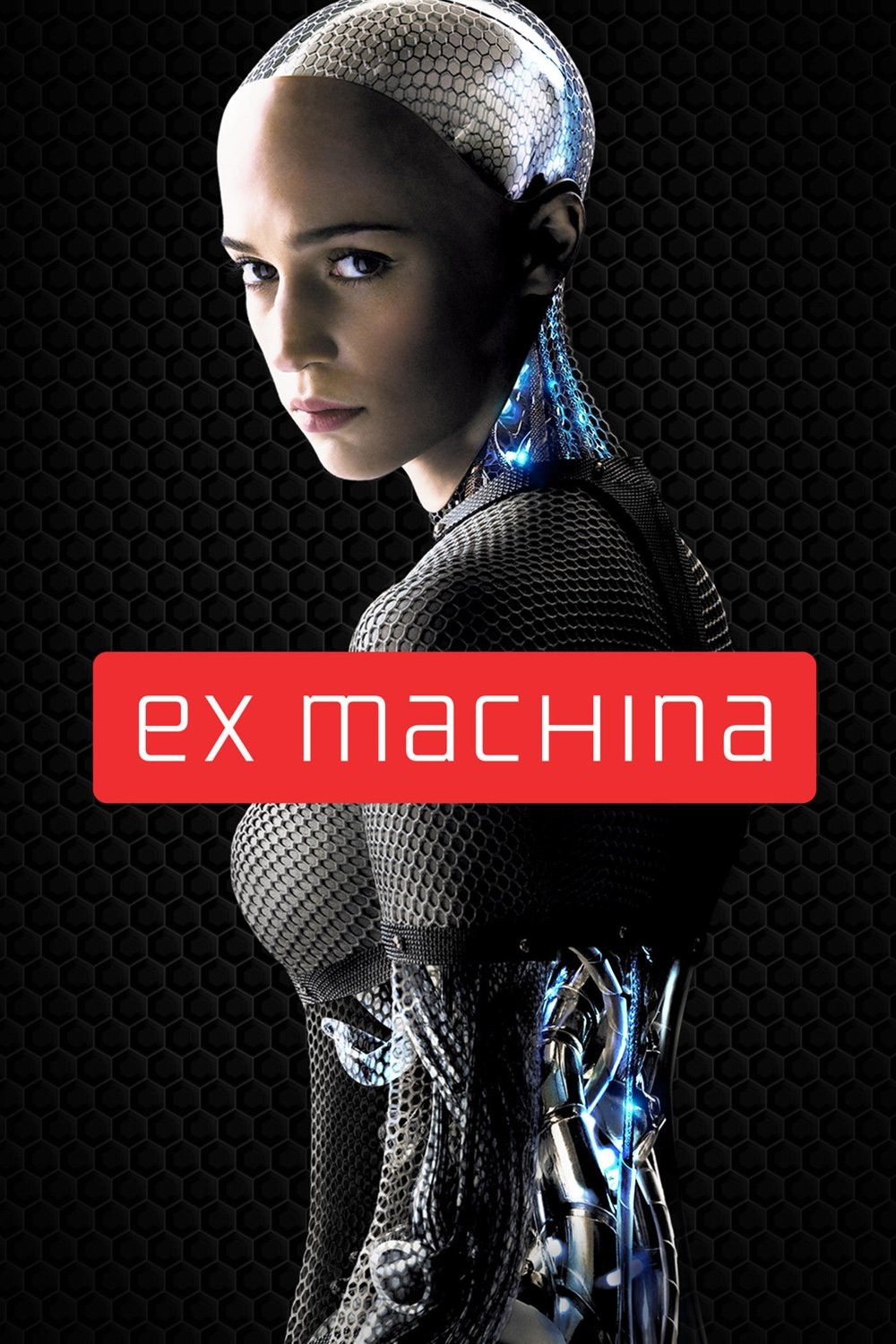

- UK release: January 2015
- Director: Alex Garland · Writer: Alex Garland
- Studio / distributor: Film4; DNA Films; Universal Pictures
- Genre: Science fiction psychological thriller / artificial intelligence drama · Runtime: 108 minutes (BBFC 15)
- Main cast: Domhnall Gleeson (About Time) as Caleb Smith; Alicia Vikander (A Royal Affair) as Ava; Oscar Isaac (Inside Llewyn Davis) as Nathan Bateman; Sonoya Mizuno as Kyoko
- IMDb: 7.7 / 10 · Rotten Tomatoes: 92% critics / 86% audience · My rating: 8.5 / 10
Alex Garland has spent the last decade or so as the writer in the room while someone else directs. He wrote 28 Days Later and Sunshine for Danny Boyle, adapted Never Let Me Go and Dredd, and built a reputation for clean, idea-led science fiction that takes its premises seriously. Ex Machina is the film where he finally takes the chair himself, and the surprise is how assured it feels for a first time behind the camera. No flailing for spectacle, no nervous over-direction. Garland has worked out that the most unsettling thing he can put on screen is a quiet conversation between two people, one of whom may not be a person at all.
The setup
Caleb (Domhnall Gleeson), a coder at the world’s largest search company, wins a staff lottery: a week at the remote estate of the firm’s reclusive founder, Nathan (Oscar Isaac). When he arrives, the prize turns out to be work. Nathan has built a humanoid artificial intelligence named Ava (Alicia Vikander) and wants Caleb to run a version of the Turing test on her, to sit across a glass partition and decide whether what he is talking to has genuine consciousness or only a very good impression of it. What begins as a flattered young man’s dream assignment turns into a contest of nerve and motive between the three of them, conducted almost entirely in the corridors of a house that feels increasingly like a cage. I will leave the rest where Garland leaves it.
The cast
Three performances carry the whole thing, and they are well matched. Gleeson, fresh from being the romantic lead in About Time, plays Caleb as decent, clever and slightly out of his depth, which is exactly the way in the film needs. Oscar Isaac, who was quietly extraordinary in Inside Llewyn Davis, turns Nathan into something far more interesting than a mad-scientist cliche: a hard-drinking, hyper-articulate alpha who is charming right up to the moment he is frightening, and you can never quite tell which mode he is about to choose. The film belongs, though, to Alicia Vikander. Her Ava is curious, watchful and quietly strategic, a performance built out of stillness and small calibrations, and she makes the central question, is there a mind in there, feel genuinely open rather than rhetorical. Sonoya Mizuno, as the silent Kyoko, does a great deal with almost no dialogue.
The craft
This is a controlled, beautiful film on what was clearly not a large budget. Rob Hardy’s cinematography makes Nathan’s glass-and-concrete bunker look both gorgeous and oppressive, all clean lines and locked doors, and the effects work that renders Ava’s transparent mechanical body is some of the most convincing I have seen at this scale: you forget you are watching a digital trick because the film never stops to congratulate itself on it. The score by Ben Salisbury and Geoff Barrow hums and pulses underneath, keeping the tension wound tight through long passages where nothing physical happens. Garland paces it like a thriller even though it is mostly people talking, and the talk is worth listening to. The script is genuinely smart about consciousness, manipulation and what a test actually proves, without ever stopping to deliver a lecture.
How it stacks up
The obvious touchstone is Blade Runner, and Ex Machina shares its preoccupation with what separates a manufactured mind from a real one, though it trades neon sprawl for a single house and a handful of characters. It sits close to 2001: A Space Odyssey in its cool fascination with a machine intelligence whose goals may not be ours, and it makes an interesting companion piece to Her, which came at the same question from the warm, lovestruck angle while this one comes at it cold. Reaching further back, this is a Frankenstein story stripped to its frame, the creator and the created and the awful gap between intention and result. What sets it apart from most science fiction at this budget is restraint: Garland trusts three actors and one idea, and refuses to inflate the film with action it does not need.
Critics versus the rest of us
Critics are close to unanimous, with Rotten Tomatoes sitting up at 92%, and the praise lands where you would expect: the intelligence of the writing, the discipline of the direction, the performances, and a treatment of artificial intelligence that takes the subject seriously rather than as a pretext for chase scenes. Audiences are a little cooler at 86%, which I read as the gap between people who wanted a thriller and got a chamber piece. If you come to this expecting the machine to start shooting, you will fidget. If you come for a tense, talky puzzle about minds and motives, it delivers more than almost anything else in the genre this year.
Verdict
This is squarely my kind of science fiction: intelligent, atmospheric, more interested in ideas than in explosions, and built around technology and control rather than spectacle. It is not flawless. Caleb is a touch underwritten next to the other two, and a viewer who needs answers handed over may find the ending more provocation than resolution. None of that costs it much. The performances are excellent, the craft is well beyond what the budget should allow, and it lingers in the mind for days, the mark of science fiction that is actually about something. I will happily watch it again, partly to see how the construction holds up once you know where it is going. 8.5⁄10.
Availability: In UK cinemas now on limited release. Worth seeking out on the biggest screen you can find it on; a Blu-ray and digital release will follow.
Update
Added since this review first appeared: the film won the Academy Award for Best Visual Effects, a remarkable result for a production that spent so little next to the blockbusters it beat, and Alicia Vikander went on to an Oscar of her own the following year. Garland has continued down this road as a director, with Annihilation and the television series Devs, the latter returning to much the same questions about determinism and technology. As the real-world AI conversation has caught up with it, the film’s reputation has only grown, and it is now widely available on disc, digital and streaming.
BBFC content advice
Rated 15 by the BBFC for strong language, bloody violence, sex references. The notes below may contain spoilers.
Violence: There is a scene of strong violence, featuring heavy blows with a metal object and stabbings resulting in bloodshed.
Threat and horror: The film has a mildly unsettling tone throughout.
Language: There is occasional use of strong language (‘f**k’), as well as milder terms.
Sex: There are some strong verbal sex references, during a discussion about whether humans and androids can have an intimate relationship.
Suicide and self-harm: There is a scene in which a human character cuts into his own arm, to check whether he is an android.
Nudity: There are images of fully naked androids, which take realistic female human form.
Alcohol and smoking: Adults drink alcohol.
Source: British Board of Film Classification (bbfc.co.uk).