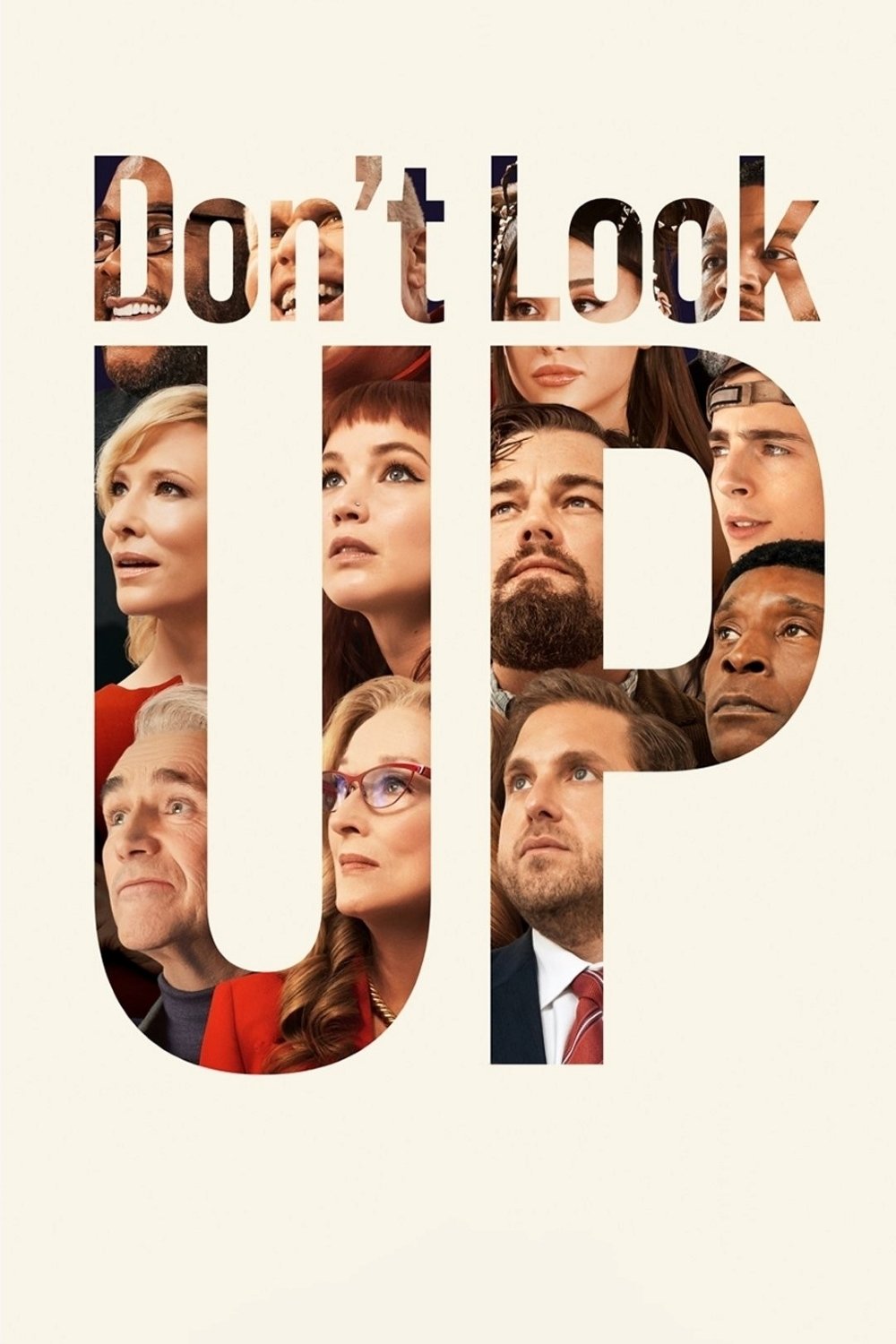
- UK release: December 2021
- Director: Adam McKay · Writer: Adam McKay (story by Adam McKay and David Sirota)
- Studio / distributor: Hyperobject Industries; Bluegrass Films; Netflix
- Genre: Satirical disaster comedy / political science fiction · Runtime: 138 minutes (BBFC 15)
- Main cast: Leonardo DiCaprio (The Revenant, Inception) as Dr Randall Mindy; Jennifer Lawrence (The Hunger Games, Silver Linings Playbook) as Kate Dibiasky; Meryl Streep (The Devil Wears Prada, The Iron Lady) as President Orlean; Jonah Hill (Moneyball, The Wolf of Wall Street) as Jason Orlean
- IMDb: 7.1 / 10 · Rotten Tomatoes: 56% critics / 78% audience · My rating: 7.5 / 10
Adam McKay has spent the last few years turning serious subjects into comic forensics. The Big Short made collateralised debt obligations into a punchline you could follow, and Vice did much the same for Dick Cheney. Don’t Look Up extends that run to the largest target he has taken on, the end of the world, and the apparatus that would rather argue about it than do anything. The premise is almost too neat: a planet-killer is coming, the science is settled, and nobody with any power can be bothered to act. The interesting question is whether a film this furious can also be funny, and for long stretches it manages both.
The setup
Kate Dibiasky (Jennifer Lawrence), a PhD candidate, spots a previously uncatalogued comet. Her supervisor, Dr Randall Mindy (Leonardo DiCaprio), runs the numbers and finds it is roughly nine kilometres across and on a direct collision course with Earth, about six months out. That should be the most important fact on the planet. Instead the two scientists are shuttled from a distracted White House to a breakfast television sofa where bad news rates poorly, and watch the warning of their lives get reframed as a vibe, a meme, and finally a business opportunity. The film tracks what happens to the truth as it passes through people who have every incentive to misread it.
The cast
The casting is the loudest thing in the film and mostly the smartest. DiCaprio plays against his own gravity here, giving Mindy a clammy, anxious decency that curdles as fame finds him, and it is a more interesting performance than the role looks on paper. Lawrence has the harder job and the better part, the one person allowed to react like a human being, and her flat, baffled rage is the film’s anchor. Meryl Streep clearly relishes President Orlean, a populist with the attention span of a news cycle, and Jonah Hill, as her chief-of-staff son, lands a particular kind of smirking entitlement. The supporting bench is deep enough to be distracting, with Cate Blanchett and Mark Rylance both doing precise, chilly work, but the ensemble occasionally tips into stunt casting for its own sake.
The craft
McKay and editor Hank Corwin keep the film jittery on purpose, cutting away to stock footage, social feeds and reaction shots so that no scene sits still long enough to breathe. It is the same restless grammar as The Big Short, and it suits a story about a culture that cannot hold a thought. Nicholas Britell’s score does real work underneath the noise, swelling into genuine dread whenever the film stops mugging, and the late stretch finds a stillness the first two hours keep interrupting. The trouble is tonal consistency. The satire is broad by design, the targets are the size of barns, and a lighter touch would have drawn more blood than the sledgehammer does. When it slows down and trusts the actors, it is far stronger than when it is elbowing you in the ribs.
How it stacks up
The obvious ancestor is Dr Strangelove, the gold standard for laughing at extinction, and Don’t Look Up is nowhere near that controlled. It owes more to Network, with its vision of catastrophe processed into ratings, and to Idiocracy, with its faith that the dumbest possible response is the likeliest one. Against Armageddon it is the anti-blockbuster, the disaster film where nobody competent is allowed to save the day. And it is recognisably McKay’s own The Big Short turned outward: the same fury at institutional denial, the same trick of making the audience the only people in the room who can see the cliff. It is blunter than any of them, but the target is broader too.
Critics versus the rest of us
Critics have split hard, sitting around 56%, with the recurring complaint that the satire is obvious and pleased with itself, preaching to a choir that already agrees. Audiences are warmer, up near 78%, and the gap is telling. The critics are not wrong that the film lacks subtlety. But subtlety was never the assignment. The charge that it is too on-the-nose assumes the nose in question deserves gentler handling, and plenty of viewers, watching the news, evidently disagree. As a Netflix release it has the reach to start arguments at scale, which is precisely what it wants.
Verdict
This is messier and angrier than McKay’s best work, and a sharper edit would have made it land harder. The broad satire caps how often I would return to it, and a couple of the cameos pull focus for no reward. But the central performances are excellent, the dread underneath the comedy is real, and when it lands it lands hard. It is the rare big-cast issue film that is actually about something and is not boring about it. Not a classic, but a good deal better than its reviews, and the kind of film you end up quoting at people. 7.5⁄10.
Availability: Streaming on Netflix from 24 December 2021, after a short UK cinema run from 10 December.
Update
Added since this review first appeared: Don’t Look Up became one of Netflix’s most-watched films on release and drew four Academy Award nominations, including Best Picture and Best Original Screenplay. Its reputation has settled along the same fault line it opened on, beloved by viewers who read it as the only honest film about the climate and denial, dismissed by critics who found it smug. It remains on Netflix, where it has stayed a regularly revisited title.
BBFC content advice
Rated 15 by the BBFC for strong language. The notes below may contain spoilers.
Language: There is use of strong language (‘f**k’). Milder terms include ‘prick’, ‘pussy’, ‘cooch’, ‘skank’, ‘shit’, ‘screw’, ‘bullshit’, ‘asshole’, ‘ass’ and ‘crap’.
Additional issues: There are scenes of moderate fantasy threat. There are brief scenes involving misuse of Xanax and marijuana, as well as passing comic references to MDMA and cocaine. There is a fleeting image of a couple kissing and embracing in bed, with visible breast nudity; another scene features non-sexualised full frontal and rear nudity. There are also moderate comic verbal references to pornography, erections, ‘sexting’ and ‘screwing’, as well as use of ‘f**k’ in the sexual sense. There are infrequent comic scenes of racist behaviour and references to racism, such as when a white man refers to “both kinds” of ‘Indians’: “the ones with the elephants and the ones with bows and arrows”. Other issues include mild violence and very brief images of moderate bloody injury detail.
Source: British Board of Film Classification (bbfc.co.uk).