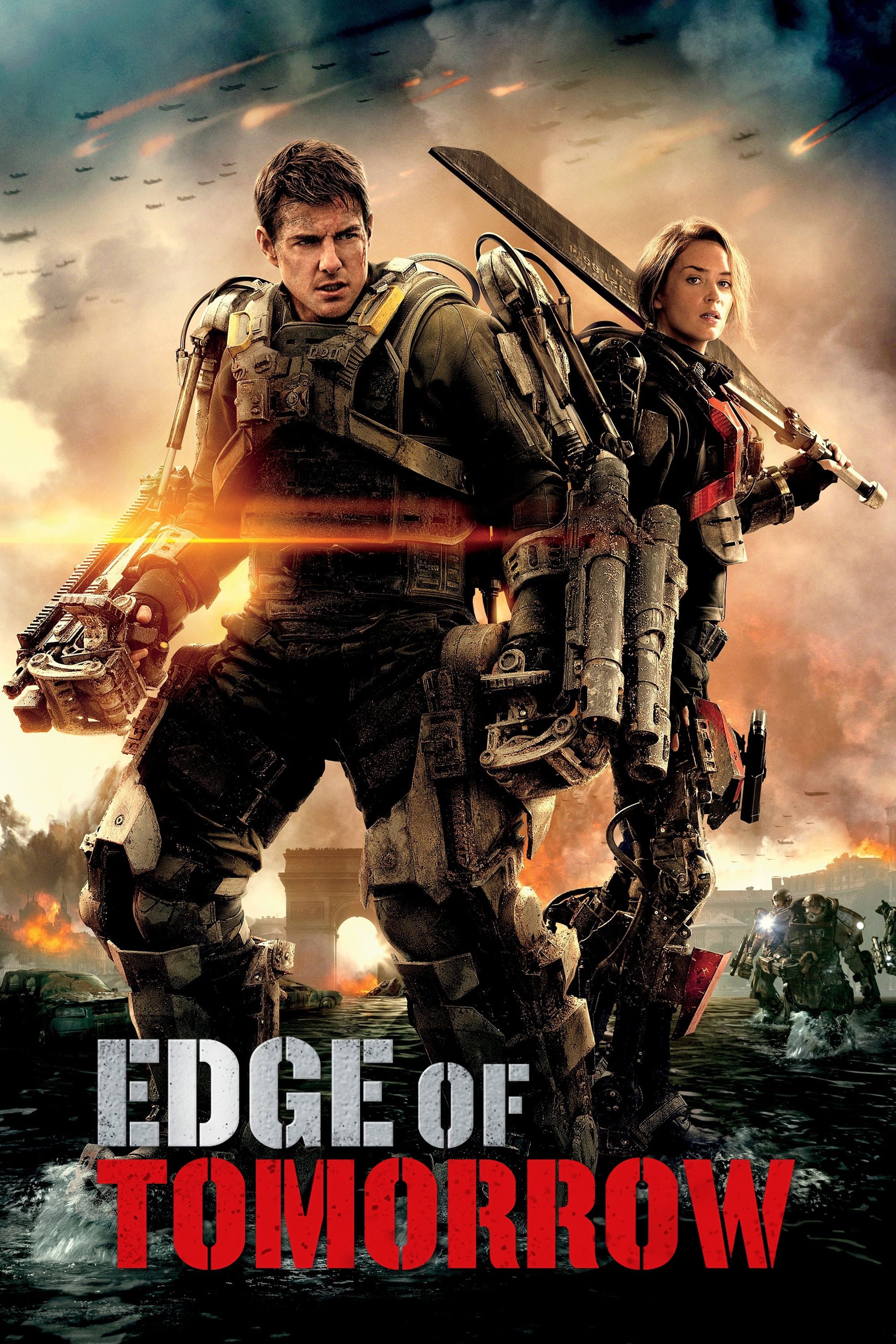

- UK release: May 2014
- Director: Doug Liman · Writers: Christopher McQuarrie, Jez Butterworth and John-Henry Butterworth
- Studio / distributor: Warner Bros.; Village Roadshow
- Source: All You Need Is Kill by Hiroshi Sakurazaka
- Genre: Science fiction action / time-loop war film · Runtime: 113 minutes (BBFC 12A)
- Main cast: Tom Cruise (Top Gun, Mission: Impossible) as Major William Cage; Emily Blunt (The Devil Wears Prada, The Adjustment Bureau) as Rita Vrataski; Bill Paxton (Aliens, Apollo 13) as Master Sergeant Farell; Brendan Gleeson (In Bruges, The Guard) as General Brigham
- IMDb: 7.9 / 10 · Rotten Tomatoes: 91% critics / 90% audience · My rating: 8 / 10
There is a particular kind of summer film that sounds exhausting on paper and turns out to be a delight in the seat, and Edge of Tomorrow is this year’s example. The premise reads like a pitch nobody should have green-lit: Tom Cruise relives the same disastrous beach landing over and over, dying every time, until he gets good at it. Yet Doug Liman, who made his name on the kinetic clarity of The Bourne Identity, has taken a Japanese light novel and a structure borrowed openly from Groundhog Day and built something genuinely smart, fast and funny out of it. The surprise is not the loop. The surprise is how much fun the film has running it.
The setup
Major William Cage is a peacetime PR man for the army, a coward in a uniform who has spent the alien war selling it on television rather than fighting it. When he is bundled onto the front line of a doomed amphibious assault against the Mimics, an enemy that moves like a swarm and thinks like a chess computer, he dies within minutes. Then he wakes up the previous morning, on the same base, facing the same day, with every memory of how it ended intact. Each death resets the clock. The only person who understands what is happening to him is Rita Vrataski, the war’s celebrated poster soldier, who once carried the same curse and knows it is the one weapon humanity has. From there it becomes a grim, repeating apprenticeship: learn the beach, learn the enemy, learn how not to die, and do it again tomorrow.
The cast
Cruise does something here he rarely allows himself, which is to start as a useless, sweaty coward and earn the competence frame by frame. The early loops, where Cage flinches, begs and bolts, are played for proper laughs, and Cruise commits to the indignity of dying badly again and again before the familiar action-star certainty is allowed to surface. It is a clever use of the persona rather than a coast on it. Emily Blunt is the film’s real find. Her Rita is all hardened muscle and impatience, a fighter who treats Cage’s deaths as a training resource rather than a tragedy, and Blunt gives her a flinty authority that never softens into the love interest the genre usually demands. Bill Paxton has a fine time as the drawling master sergeant who greets Cage anew each morning, and Brendan Gleeson supplies the weight of command in a couple of well-judged scenes. The Cruise and Blunt pairing carries the picture, and it carries it on competence and friction rather than romance, which is the right call.
The craft
Liman shoots the action with a legibility that a lot of bigger-budget science fiction has forgotten how to manage. The Mimics are a nasty, whip-fast design, the exo-suits the soldiers wear are heavy and awkward in a way that feels engineered rather than weightless, and the Normandy-by-way-of-Pandora beach assault is staged so you always know where everyone is and what is killing them. The editing is the cleverest department: a loop film lives or dies on how it handles repetition, and the cutting compresses, skips and replays Cage’s days so the joke lands without the structure ever dragging. Christophe Beck’s score keeps the momentum taut. At 113 minutes the film is lean by the standards of the summer, and that discipline is felt in every reel.
How it stacks up
The obvious ancestor is Groundhog Day, and the film knows it; the difference is that the comedy here is welded to a war movie, so each reset carries real stakes rather than romantic farce. Source Code worked a similar loop a few years back with more melancholy and a smaller canvas. For the bug-war satire and the propaganda-poster gloss on military service, the line runs straight back to Starship Troopers, and for the hardware and the dread of an enemy that overwhelms, to Aliens, which makes Paxton’s casting a quiet in-joke. What lifts Edge of Tomorrow above a clever mash-up is that the time-loop is not a gimmick the script forgets about; it shapes the action, the comedy and the way the characters relate, right to the end.
Critics versus the rest of us
Critics are unusually warm, sitting around 91%, with audiences close behind at 90%, and the praise lands where it should: the pace, the humour, the action clarity and the Cruise and Blunt double act. The one shadow over the conversation is commercial rather than critical. Warner Bros. saddled it with a forgettable title and a muddled campaign, and the early box office suggests a lot of people are walking past a film they would enjoy. That is a marketing failure, not a film one. On the evidence in front of me this is one of the most purely entertaining studio science fiction films in some time.
Verdict
This is squarely in my territory: intelligent, rewatchable science fiction that respects the audience, built on a structural idea it actually commits to. It is funny without being silly, fast without being incoherent, and it gives Emily Blunt the kind of role the genre too rarely writes. If I have a reservation it is the final stretch, where the plot machinery has to resolve the loop and loses a little of the wit that powered the middle. It is not quite flawless, but it is the sort of film I will happily start again the moment it ends, and that counts for a great deal with me. 8⁄10.
Availability: On general release in UK cinemas now. Worth the big screen for the beach assault alone.
Update
Added since this review first appeared: the film never did find its audience in cinemas under that title, and Warner Bros. quietly rebranded it Live Die Repeat for the home release, which is the tagline everyone remembered anyway. Word of mouth did the work the marketing could not, and it has since settled into a reputation as one of the most rewatchable science fiction films of its decade and a high point for both Tom Cruise and Emily Blunt in the genre. A long-promised follow-up has been talked about for years without materialising. It is now widely available on disc and digital, and turns up on the major streaming services on rotation.
BBFC content advice
Rated 12A by the BBFC for moderate violence, threat, infrequent strong language. The notes below may contain spoilers.
Violence: There is sight of tentacled aliens being shot, hacked or blown up. Occasional streaks of blood are seen on faces, and a man is seen bleeding after being attacked. However, there is no focus on detail of blood or injury. A man’s face is seen briefly starting to melt after an alien attack but he survives without injury.
Threat and horror: There is plenty of moderate threat, as soldiers face alien attacks, but the focus of the film is on the action and on overcoming the threat.
Language: There is one use of strong language (‘f***k’) and milder terms including ‘bitch’, ‘bastard’ and ‘son of a bitch’.
Additional issues: The film also contains mild sex references and comic buttock nudity.
Source: British Board of Film Classification (bbfc.co.uk).