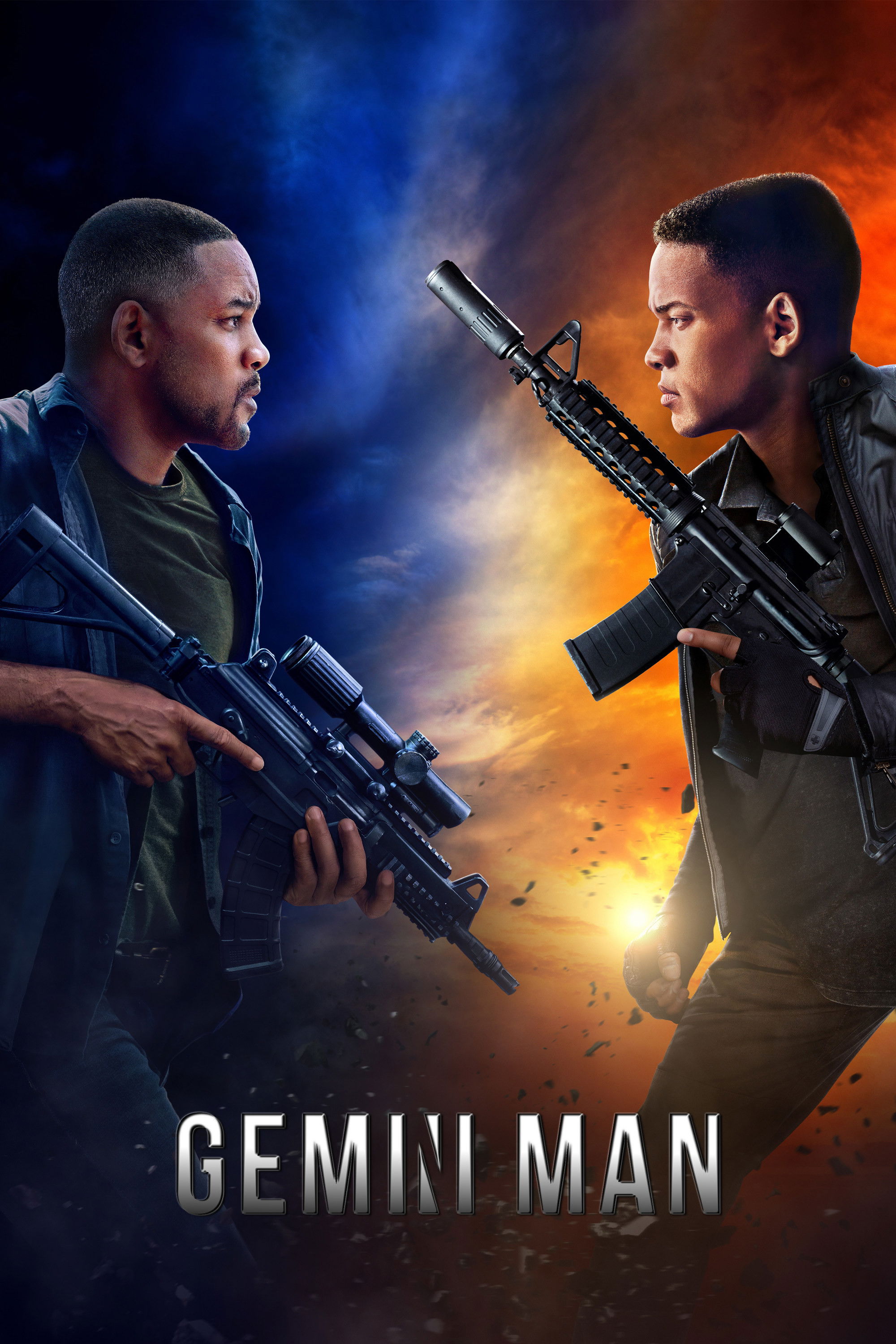

- UK release: October 2019
- Director: Ang Lee · Writers: David Benioff, Billy Ray, Darren Lemke
- Studio / distributor: Paramount Pictures; Skydance Media
- Genre: Science-fiction action thriller / clone-assassin film · Runtime: 117 minutes (BBFC 12A)
- Main cast: Will Smith (Men in Black, Independence Day) as Henry Brogan / Junior; Mary Elizabeth Winstead (10 Cloverfield Lane, Scott Pilgrim vs. the World) as Danny Zakarweski; Clive Owen (Children of Men, The International) as Clay Varris; Benedict Wong (Doctor Strange, The Martian) as Baron
- Rotten Tomatoes: 26% critics / 83% audience · My rating: 7 / 10
Gemini Man has been sitting on a shelf for about twenty years. The pitch, a top assassin hunted by a younger clone of himself, has been passed between studios and stars since the late nineties, always stalling on the same problem: nobody could build a convincing young double of an ageing star. What finally unsticks it is Ang Lee, a director who keeps treating the action film as a laboratory, and the digital tools to grow a twenty-three-year-old Will Smith from scratch. The result is a film whose reason for existing is a technical one, and which knows it.
The setup
Henry Brogan (Will Smith) is a government sniper at the top of his trade and the end of his patience, a man who has decided that fifty-one years and seventy-two kills is enough and he would like to go fishing. Retirement does not take. Henry stumbles onto something he was not meant to know, the agency decides he is a liability, and the operative they send to clean up after him moves and shoots exactly the way Henry does, because he is Henry, grown in a lab and twenty-five years younger. Pursued across continents with only a watchful agent, Danny (Mary Elizabeth Winstead), and an old pilot friend, Baron (Benedict Wong), for company, Henry has to work out who built his replacement and why, while fighting the one opponent who can read his every move.
The cast
Smith is doing double duty and quietly carries the whole thing. As Henry he is older, slower and more tired than the Smith of the Men in Black years, leaning on weariness rather than wisecracks, and it suits him. As Junior, the clone, he is a wholly digital creation, and the trick of the film is that Smith is also acting that role, supplying the body language and the eyes that the effects team paint a younger face onto. The two performances have to feel related and slightly off from each other, and they do. Winstead gives Danny more spine and competence than the genre usually allows the lone woman in the chase, and she and Smith strike up an easy, unforced rapport that never tips into romance. Clive Owen, as the private-military man behind the cloning programme, is handed a thinly drawn villain and plays him with more conviction than the part deserves. Benedict Wong walks off with most of the laughs as the pilot, the one character allowed to enjoy himself.
The craft
This is where the money and the curiosity went. Lee shot the film at a high frame rate and in 3D, chasing the same hyper-clear, almost uncanny smoothness he reached for in Billy Lynn’s Long Halftime Walk, and where the format is available it gives the action a strange, glassy immediacy. A motorcycle chase through Cartagena, with Junior using the bike itself as a weapon, is the standout, and a catacomb fight in the closing stretch has real snap. Dion Beebe’s photography keeps the globe-trotting looking handsome, and Lorne Balfe’s score does its job without lingering in the memory. The de-ageing is the headline, and it is impressive without being invisible: in motion and in daylight Junior is convincing, while a handful of close, still shots betray the slightly waxy look that this technology has not yet shaken off. It is a genuine advance, watched with the awareness that you are watching an experiment.
How it stacks up
The premise invites comparison and mostly suffers from it. Looper did the hunted-by-yourself idea with more wit and a colder edge; Face/Off did the my-enemy-wears-my-face thriller with far more operatic abandon. As a globe-hopping chase with a weary professional at its centre, this wants to be in the conversation with the Bourne films, and it has the geography and the competence but not the paranoid charge. The cleanest comparison is Terminator 2, another film about an unstoppable double sent to erase its original, and the gap there is one of stakes and screenplay rather than spectacle. Gemini Man has the chases; what it lacks is a script with the same drive. The screenplay, worked over by several hands across two decades, lands every beat you expect and almost none that you do not.
Critics versus the rest of us
The critical reception has been rough, sitting around 26%, with the recurring complaint that the story is a relic and the de-ageing a costly distraction. Audiences are notably warmer, up at 83%, and that split tells you who the film is for. The critics are right about the screenplay; it is the least adventurous thing in a film built on adventurous technology. But the reviews undersell how watchable the thing actually is, how well the action plays, and how much Smith carries on charm and craft. This is the familiar gap between a film judged as art and a film enjoyed on a Friday night, and on the second count it does fine.
Verdict
I value intelligent science fiction, technology themes done seriously, and a film willing to try something, and Gemini Man has all three even when the story around them is ordinary. It is a handsome, well-paced, perfectly enjoyable action thriller with one genuinely interesting idea about ageing and identity that it never quite digs into, wrapped around a special effect that is worth seeing for itself. It is not a classic and it will not haunt you, but it is a long way from the failure the scores suggest, and I would happily watch the Cartagena chase again. 7⁄10.
Availability: In UK cinemas now. Worth catching in a screen showing the high-frame-rate 3D presentation if you can find one, where the format experiment is the point of the ticket.
Update
Added since this review first appeared: the high-frame-rate format proved a dead end commercially, and very few people ended up seeing the film the way Lee intended, which blunted the one thing that set it apart. The de-ageing here now reads as an early, visible step toward the much smoother digital youth effects that followed across the next few years. The film has settled into its reputation as an honourable technical misfire rather than a disaster, and it is widely available on disc and the usual digital rental and streaming services.
BBFC content advice
Rated 12A by the BBFC for moderate violence, infrequent strong language. The notes below may contain spoilers.
Violence: There are several gunfights and scenes of hand-to-hand violence, occasionally with bloody detail. A preternaturally powerful clone is repeatedly shot, punched and set on fire. A man throws a woman through a window. A man is shot with a dart containing bee venom, and suffers an allergic reaction.
Language: There is infrequent use of strong language (‘motherf**ker’), as well as milder terms such as ‘shit’, ‘hell’, ‘screw’, ‘piss’, ‘God’, ‘Jesus’ and ‘asshole’.
Additional issues: A man cuts into another’s bicep to extract a microchip. Injuries are tended to, in close-up detail. Threat and sex references are mild. A man smokes a cigar.
Source: British Board of Film Classification (bbfc.co.uk).