
- UK release: November 2013
- Director: Alfonso Cuarón · Writers: Alfonso Cuarón, Jonás Cuarón
- Studio / distributor: Warner Bros.; Esperanto Filmoj; Heyday Films
- Genre: Science fiction survival thriller · Runtime: 91 minutes (BBFC 12A)
- Main cast: Sandra Bullock (Speed, The Blind Side) as Dr Ryan Stone; George Clooney (Ocean’s Eleven, Michael Clayton) as Matt Kowalski; Ed Harris (Apollo 13, The Right Stuff) as the voice of Mission Control
- IMDb: 7.7 / 10 · Rotten Tomatoes: 96% critics / 80% audience · My rating: 8 / 10
It has been seven years since Alfonso Cuarón gave us Children of Men and its long, unbroken takes that put you inside a collapsing world, and you can feel that same patience working through Gravity. He has spent the gap not on another sprawling future-shock but on something almost perversely small: two people, one accident, and the largest empty space anyone has ever tried to film. The marketing sells it as a spectacle, and it is one. What sneaks up on you is how little it leans on plot to keep you pinned to the seat.
The setup
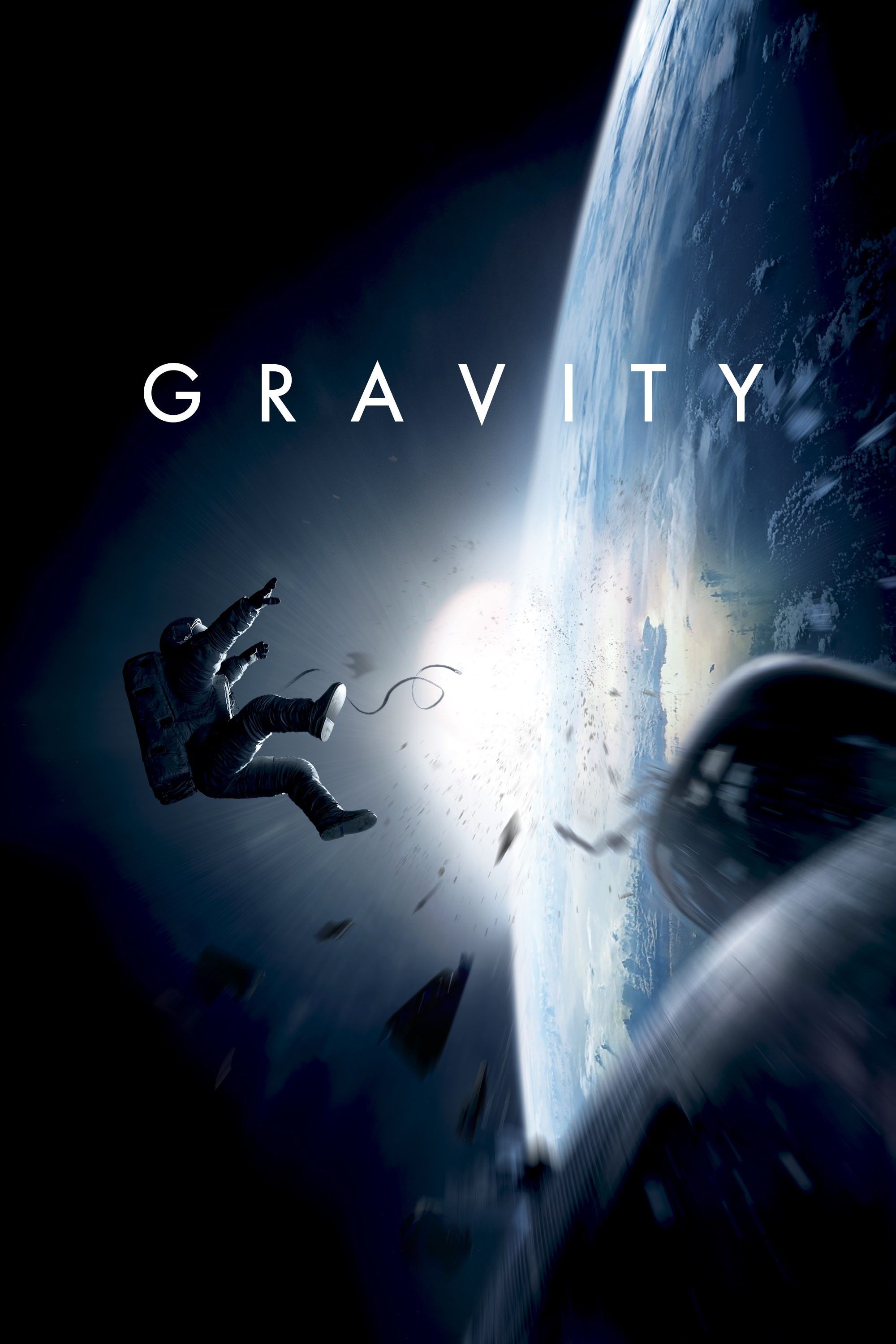
Dr Ryan Stone (Sandra Bullock) is a medical engineer on her first shuttle mission, out on a spacewalk to service a telescope under the easy supervision of veteran astronaut Matt Kowalski (George Clooney), who is enjoying what he keeps reminding everyone is his last flight. A field of high-speed debris from a destroyed satellite tears through the mission without warning, and Stone is left tumbling through orbit with her oxygen dropping, her tether gone, and Earth turning silently below her. The rest is the oldest story there is, dressed in a pressure suit: getting home, with the odds against you and the clock running.
The cast
This is Bullock’s film, almost alone, and she carries it without the safety net most leads are given. Stone spends much of the running time isolated inside a helmet, her face the only thing the camera can read, and Bullock makes the panic, the grief and the grim refusal to stop fighting all legible without ever tipping into hysterics. It is a more controlled, interior performance than Speed or The Blind Side would lead you to expect. Clooney does the thing Clooney does better than anyone, supplying warmth, dry humour and an unflappable cool that gives the early scenes their lightness and the later ones their ache. Ed Harris, heard but never seen as the voice of Houston, is a quiet in-joke for anyone who knows their Apollo 13 and The Right Stuff, and his presence alone lends the radio chatter a borrowed authority.
The craft
Where Gravity earns its reputation is in the making. Emmanuel Lubezki’s camera drifts and circles in apparently unbroken takes, the opening shot running something like a quarter of an hour without a visible cut, and the absence of up or down is used as a weapon rather than a gimmick. There is no sound in vacuum, so Steven Price’s score and the transmitted hum of the suits do the work air normally would, and the silence when the music drops away is genuinely frightening. The 3D, so often a tax on the ticket, is for once built into the grammar of the image: debris does not fly at you so much as the empty volume around the characters becomes real and enormous. Ninety-one minutes turns out to be exactly the right length. The film never sags because it never stops moving.
How it stacks up
The obvious touchstone is Apollo 13, another film that wrings unbearable tension out of procedure and the cold arithmetic of oxygen and re-entry, though Ron Howard had a true story and a crowded Mission Control to lean on where Cuarón has one woman and a void. Reach further back and 2001: A Space Odyssey is the ancestor, in the unhurried beauty of bodies moving through hard vacuum, even if Cuarón is after your pulse rather than your sense of cosmic awe. The closest cousin of all is All Is Lost, Robert Redford’s near-wordless ordeal at sea from this same year: both strip survival cinema down to one person, one failing machine and the indifferent element trying to kill them. Gravity is the more technically astonishing of the pair, if also the more sentimental.
Critics versus the rest of us
Critics have gone close to unanimous, sitting up at 96%, treating the film as proof that a studio blockbuster can still be a genuine formal experiment. Audiences are warmer than lukewarm but noticeably cooler, around 80%, and the gap is easy to read. The complaints are not really about the spectacle, which nobody disputes, but about the thinness behind it: the backstory handed to Stone is a touch too neat, a couple of beats reach for tears the situation had already earned, and the science takes liberties that anyone who has read about orbital mechanics will notice. Those are fair hits. They also matter far less in a dark cinema with the sound turned up than they will on a laptop afterwards.
Verdict
I admire this enormously and I am not quite in love with it, which is roughly where my number lands. As an exercise in tension, immersion and sheer craft it is close to faultless, and Bullock anchors it with a performance that deserves to be remembered when the effects have dated. The reason it stops short of the top tier for me is rewatchability: once you know whether she makes it, a good deal of the white-knuckle charge is spent, and the human story left behind is slighter than the technique around it. This is a film to see once, properly, on the biggest screen and the loudest system you can find, and to be genuinely glad you did. 8⁄10.
Availability: On general release in UK cinemas now, and the rare modern blockbuster where the 3D and IMAX surcharge is money well spent. Catch it on the largest screen you can reach before it leaves.
Update
Added since this review first appeared: Gravity swept the craft categories at the following awards season, taking seven Oscars including Best Director for Cuarón, Lubezki’s cinematography and Price’s score, while Bullock’s nomination went unrewarded. It has since become the standard reference point for the wave of one-person survival pictures that followed, The Martian (2015) among them, though that film answers Gravity’s grim minimalism with humour and hard problem-solving. The spectacle was always built for the cinema, and it loses the most of any recent blockbuster on the move to the small screen, but it streams on the usual platforms depending on region and turns up in 4K for anyone with the kit to do the debris justice.
BBFC content advice
Rated 12A by the BBFC for sustained moderate threat, disturbing images, strong language. The notes below may contain spoilers.
Threat and horror: There are numerous scenes of threat as the surviving astronauts dodge debris from exploding space vehicles, explosions, bursts of flame and high speed buffeting by and bouncing off various space vehicles and crashing spacecraft. There is also a brief scene of a woman close to drowning. While many of these sequences of threat are sustained, they demonstrate an overwhelmingly positive message about the human will and ability to survive.
Disturbing images: Brief but disturbing images of dead bodies in space include a man whose frozen face has a hole in the middle where his nose has broken off.
Language: There is a single use of strong language (‘f***k’) by one of the astronauts expressing frustration and stress which is not directed at anyone. The film also contains some milder bad language, such as ‘shit’ and ‘sonofabitch’.
Source: British Board of Film Classification (bbfc.co.uk).