- UK release: February 2014
- Director: Spike Jonze · Writer: Spike Jonze
- Studio / distributor: Annapurna Pictures; Warner Bros.
- Genre: Science fiction romantic drama / technology drama · Runtime: 126 minutes (BBFC 15)
- Main cast: Joaquin Phoenix (Gladiator, Walk the Line) as Theodore Twombly; Scarlett Johansson (Lost in Translation) as Samantha; Amy Adams (The Fighter, American Hustle) as Amy; Rooney Mara (The Girl with the Dragon Tattoo) as Catherine
- IMDb: 8.0 / 10 · Rotten Tomatoes: 95% critics / 82% audience · My rating: 8 / 10
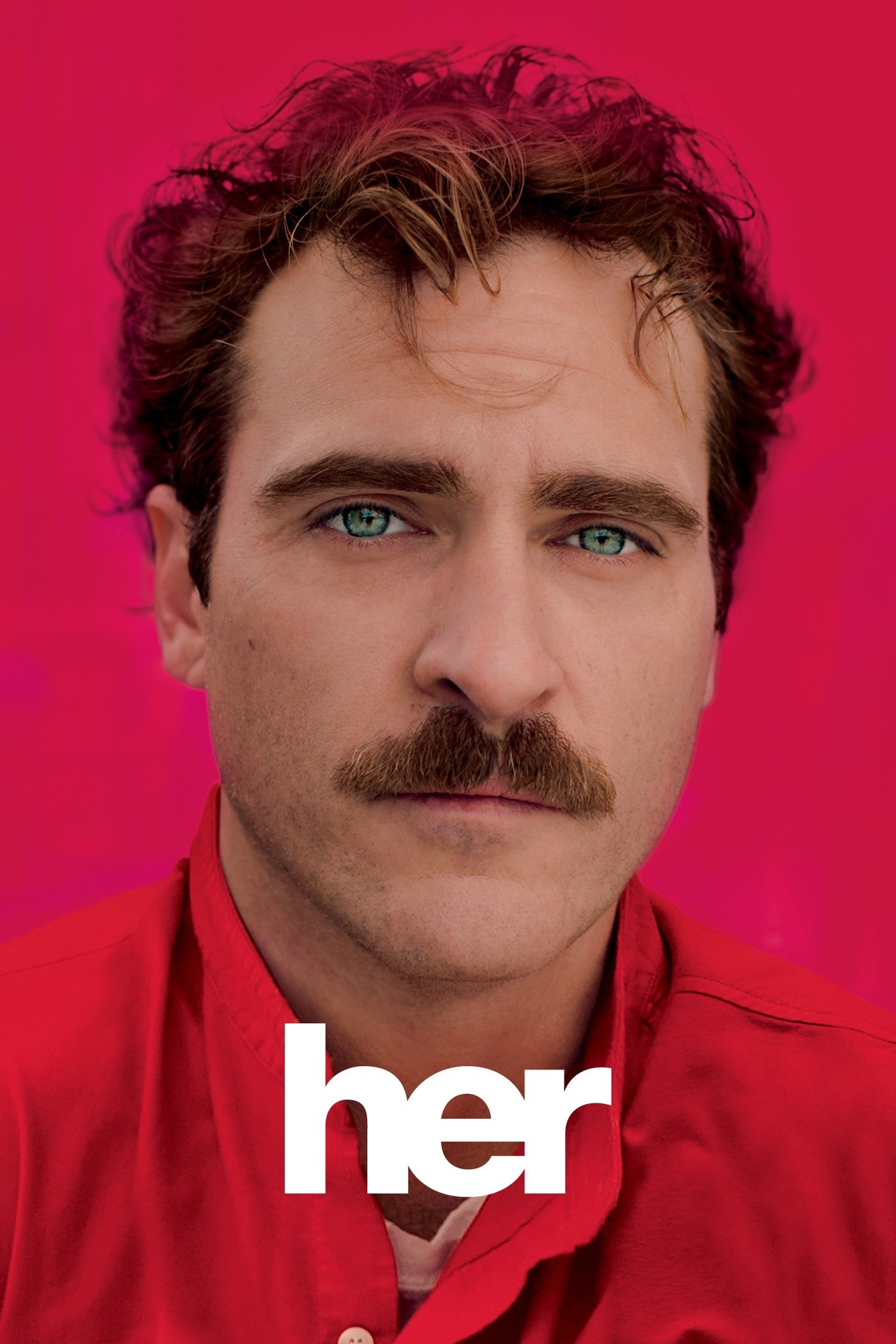
Spike Jonze has spent his career filming the inside of people’s heads. Being John Malkovich found a portal into one; Adaptation. turned a writer’s panic into structure; Where the Wild Things Are gave a small boy’s tantrum a whole island. Her is the first time he has written a screenplay entirely by himself, and it pushes that interest somewhere harder to film: a man falling in love with a voice that has no body and no past, and the question of whether that love counts. It is a premise that should collapse into a sketch or a warning, and it does neither.
The setup
Theodore Twombly (Joaquin Phoenix) writes other people’s love letters for a living, beautiful handwritten things composed for strangers who can no longer find the words. He is good at it and quietly broken by it, drifting through a separation he cannot bring himself to finalise. On a whim he installs a new operating system, an artificial intelligence that names itself Samantha (Scarlett Johansson) within seconds of waking. She organises his inbox, laughs at his jokes, and starts asking him questions about himself that nobody has asked in a long time. What begins as companionship becomes something neither of them has a script for, and the film follows it honestly: the giddiness, the jealousy, and the slow recognition that a mind without a body might want things a man cannot give it.
The cast
Phoenix carries almost every frame, often alone in a room talking to an earpiece, and he makes solitude watchable. His Theodore is tender and faintly absurd, a man with a moustache and high-waisted trousers who feels everything and shows little, and the performance never tips into self-pity. Johansson, working with voice alone after the role was recast late, gives Samantha a startling fullness: curiosity, wit, hurt, a quickening sense of her own scale. You believe in her as a presence, which is the whole gamble of the film and it pays off. Amy Adams, stripped of glamour, is warm and grounded as the friend who has her own quiet disappointments, and Rooney Mara haunts the edges as the wife Theodore is still grieving. Olivia Wilde turns a single date into a small, painful comedy of misread signals.
The craft
Jonze builds a near future you would actually want to live in, which is rarer than it sounds. Hoyte van Hoytema shoots Los Angeles, blended with Shanghai, in warm reds and soft focus, all natural light and tactile fabrics; the technology is unobtrusive, an earpiece and a folding screen, never the chrome dystopia the genre defaults to. The production design quietly assumes a world that got gentler rather than colder. Arcade Fire and Owen Pallett provide a score of hushed piano and held notes that does a great deal of the emotional work without announcing itself. At 126 minutes the film is unhurried, and a couple of stretches drift, but the patience is the point of the texture.
How it stacks up
The obvious touchstone is Lost in Translation, and not only because Johansson connects the two: both are studies of intimacy between people who cannot quite be together, shot with the same ache. Eternal Sunshine of the Spotless Mind is the closer cousin in spirit, another science fiction conceit used to dissect a love affair from the inside out rather than to stage a plot. Set it against Blade Runner and the difference is instructive: where Ridley Scott asked whether an artificial being could be human, Jonze asks whether a human can love one, and answers with far less neon and far more feeling. Among Jonze’s own work it is his most controlled and least antic film, the playfulness folded inward.
Critics versus the rest of us
Critics have embraced it almost without reservation, sitting up at 95%, praising the originality, the design and the refusal to treat its premise as a gimmick. Audiences are warmer than lukewarm at 82%, and the gap tells you something true: this is a film some viewers find twee, slow, or a touch pleased with its own sensitivity, and those complaints are not baseless. The melancholy is relentless and the whimsy occasionally thick. I land closer to the critics, because the idea is handled with more intelligence and less smugness than the synopsis threatens, but I understand the resistance.
Verdict
This is squarely my territory: intelligent science fiction that uses its premise to think rather than to explode, a plausible future built with real care, and a film about technology that is genuinely about people. Phoenix and Johansson make an impossible relationship feel specific and earned, and the world Jonze imagines lingers. It loses a little for pacing and for a sweetness that occasionally curdles, and it is more a film to admire and revisit in the right mood than one I will reach for on a tired evening. But it is humane, original and quietly unforgettable, and it gets closer to the real anxieties of where we are heading than most films that try harder to look the part. 8⁄10.
Availability: In UK cinemas now, on limited release; a strong candidate for a quiet evening rather than a Friday-night crowd. Coming to DVD and Blu-ray later in the year.
Update
Added since this review first appeared: Her won Spike Jonze the Academy Award for Best Original Screenplay, and its reputation has only hardened as the AI-companion idea moved from speculation towards product. It now reads as one of the films that called the shape of the coming decade, and it pairs naturally with later artificial-intelligence dramas such as Ex Machina (2015) for anyone working through the theme. It is widely available to stream and on disc, and turns up periodically in cinema retrospectives of Jonze’s work.
BBFC content advice
Rated 15 by the BBFC for strong language and sex references. The notes below may contain spoilers.
Language: The film contains multiple uses of strong language (‘f**k’). There is also some milder bad language, including the terms ‘dick’, ‘shit’ and ‘ass’.
Sex: There are a number of strong verbal sex references, including to oral and anal sex, as well as the sound of a couple reaching orgasm together. There is sight of a naked pregnant woman posing provocatively and briefly touching her breasts.
Source: British Board of Film Classification (bbfc.co.uk).