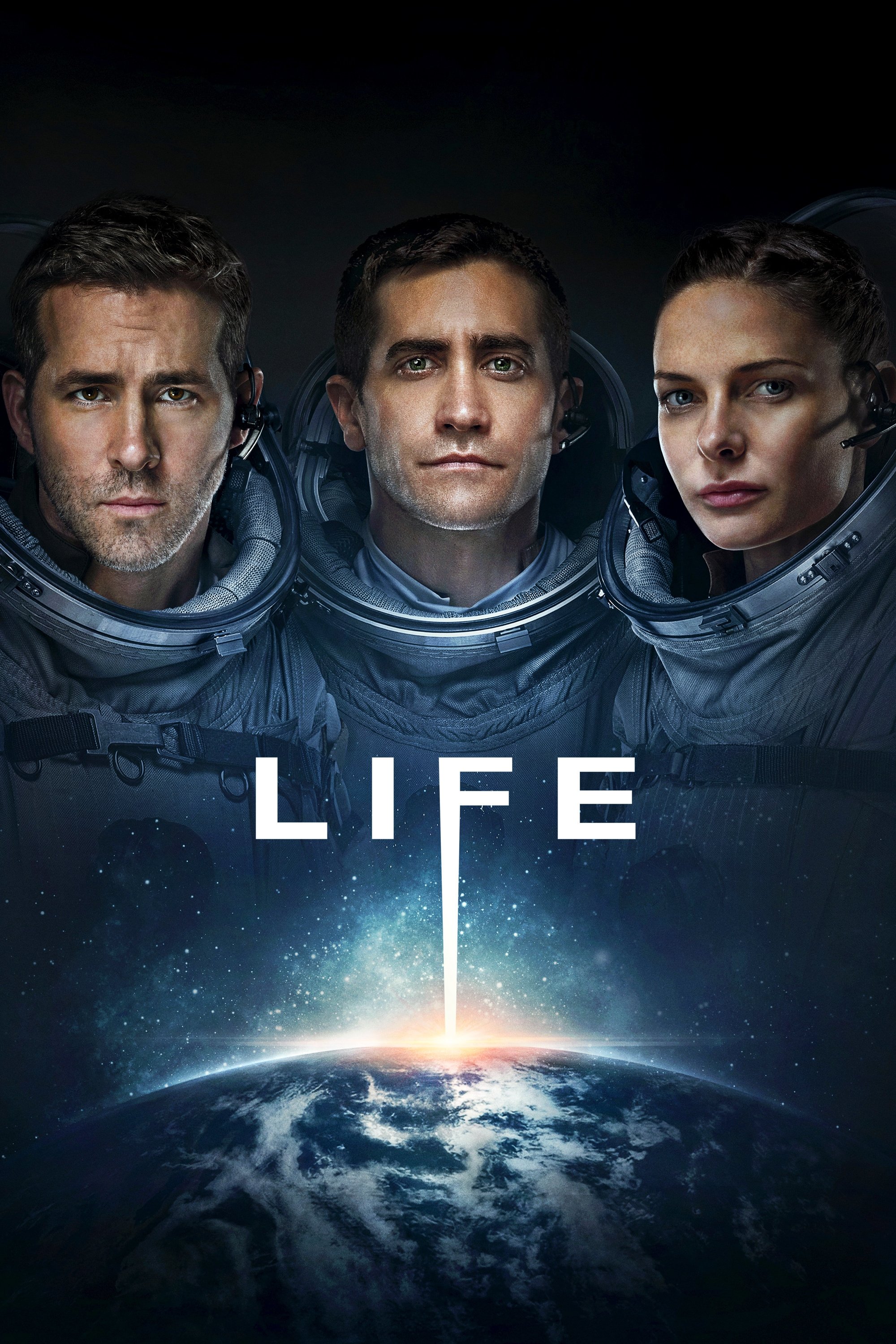

- UK release: March 2017
- Director: Daniel Espinosa · Writers: Rhett Reese, Paul Wernick
- Studio / distributor: Columbia Pictures; Skydance Media; Phantom Four; LStar Capital
- Genre: Science fiction horror / space-survival thriller · Runtime: 104 minutes (BBFC 15)
- Main cast: Jake Gyllenhaal (Nightcrawler, Source Code) as Dr David Jordan; Rebecca Ferguson (Mission: Impossible - Rogue Nation) as Dr Miranda North; Ryan Reynolds (Buried, Deadpool) as Rory Adams; Hiroyuki Sanada (The Last Samurai) as Sho Murakami
- IMDb: 6.6 / 10 · Rotten Tomatoes: 67% critics / 54% audience · My rating: 7.5 / 10
There is a particular kind of space-horror film that knows exactly which shelf it has been pulled from and decides to be very good at the job anyway. Life is that film. It comes from Daniel Espinosa, who made the slick, paranoid Safe House, and from Rhett Reese and Paul Wernick, the writers of Deadpool, which is the last lineage you would guess from anything on screen. What they have built is lean, mean and openly indebted to a film from 1979 that everyone in the cinema will be thinking of within ten minutes. The interesting question is whether knowing that ruins it. It does not.
The setup
A six-strong crew aboard the International Space Station intercepts a probe returning from Mars carrying soil samples, and in one of those samples a single dormant cell stirs back into life. It is the first confirmed proof that we are not alone, and for a giddy while the crew treat it as the discovery of the century: a small, translucent, beautiful thing that the watching world names Calvin. Then it grows, and it learns, and it works out that the warm bodies sharing its pressurised box are the most useful resource it has. What follows is a contained survival thriller played out across the station’s modules, where every airlock and quarantine protocol that should keep the crew safe becomes one more thing the organism turns against them.
It is a clean, ruthless premise, and the film is honest enough not to pad it. There is no subplot down on Earth, no romance bolted to the side. Just six people, one organism, and a slowly shrinking amount of breathable air.
The cast
The ensemble is the film’s strongest asset, and it is cast with more weight than the material strictly needs. Jake Gyllenhaal, fresh from the live-wire intensity of Nightcrawler, plays the station’s doctor as a man who has spent so long in orbit he would rather not go back down, and that quiet detachment gives the film its melancholy centre. Rebecca Ferguson, who stole Rogue Nation out from under a franchise, is the disease-control officer whose insistence on protocol reads at first as caution and later as the only clear thinking in the room. Ryan Reynolds supplies the wisecracks, and the script is canny about how it uses that easy charm. Hiroyuki Sanada gives the crew its emotional stakes as a new father watching events from the wrong side of the planet, and the underused Ariyon Bakare carries the film’s worst luck as the biologist who reaches into the box first. Nobody is slumming; everybody plays it straight, and the threat lands harder because of it.
The craft
Espinosa and cinematographer Seamus McGarvey shoot the station as one continuous, weightless space, and the long floating takes that drift from module to module are genuinely impressive, recalling the unbroken opening of Gravity without ever quite matching its grandeur. Zero gravity is used intelligently rather than decoratively: blood pools in spheres, the creature moves through the air in ways nothing on a planet could, and the absence of up and down keeps you faintly disoriented throughout. Jon Ekstrand’s score does the patient, dread-building work, and the sound design makes a virtue of the station’s hums and alarms. Calvin itself is a clever piece of creature design, a starfish-cum-octopus that is delicate one moment and horribly strong the next, and the film is restrained enough to keep it credible rather than turning it into a monster-movie mascot. The whole thing is handsome, controlled and properly tense.
How it stacks up
The comparison the film cannot escape is Alien, and Life does not try. Crew picks up organism; organism picks off crew; protocol fails; the survivors improvise. Ridley Scott did it first and did it better, with a working-class crew and a sense of grubby industrial dread that this cleaner, more clinical film never reaches for. Life also borrows the claustrophobia of Event Horizon and the sun-blind awe of Sunshine, and it has none of the intelligence-of-the-universe ideas that made Danny Boyle’s film linger. Where it earns its place is in execution and pace. It is tighter than Event Horizon, more coherent than Sunshine, and far less interested in jump-scares than the run of recent space-set thrillers. If The Thing is the gold standard for an organism that is smarter than the people trying to kill it, Life is at least playing the same game, even if it never quite reaches that level of paranoid invention.
Critics versus the rest of us
Critics have landed mixed-to-warm, around two-thirds positive, with the recurring note that the film is well made but unoriginal, a polished cover version of a song you already own. Audiences have been a touch cooler, which I suspect comes down to expectation: a poster fronted by Gyllenhaal, Ferguson and Reynolds promises a four-quadrant blockbuster, and what arrives is a tight, nasty, R-rated survival picture that is not especially interested in sending everyone home happy. I think the critics have it about right and the audience score undersells it. The lack of originality is real and the film never transcends its sources, but competence at this level is not nothing.
Verdict
This is not the intelligent, idea-driven science fiction I love most, and it knows it is wearing another film’s coat. What it offers instead is craft, tension and a cast taking thin material seriously, plus a creature that stays scary because the film refuses to overexpose it. It is gripping in the moment and holds together far better than most of its recent rivals, even if it is unlikely to be the one I reach for on a second viewing. Judged as what it sets out to be, a tight, well-built space-survival thriller, it clears the bar comfortably. 7.5⁄10.
Availability: On general release in UK cinemas now, in standard and IMAX, with a DVD and Blu-ray release to follow later in the year.
Update
Added since this review first appeared: a persistent fan theory tried to fold Life into the Venom universe, on the strength of its writers and a shared studio, which the makers have politely declined to confirm; treat it as internet folklore rather than canon. The film has settled into its reputation as a competent, slightly anonymous Alien riff that is better than its standing suggests, the sort of thing that plays very well when it turns up unannounced on a streaming service. It is now widely available on disc and digital, and rotates through the usual subscription platforms depending on region.
BBFC content advice
Rated 15 by the BBFC for strong horror, gory images, language. The notes below may contain spoilers.
The BBFC release page for Life could not be retrieved at the time of writing (the bbfc.co.uk listing returned a server error), so the full category-by-category Content Advice is not reproduced here. The 15 certificate and the short consumer advice line above are confirmed from the BBFC classification record; per the Board’s summary the film features an extraterrestrial organism that attaches itself to and pursues the crew, strong language and strong, gory horror.
Source: British Board of Film Classification (bbfc.co.uk).