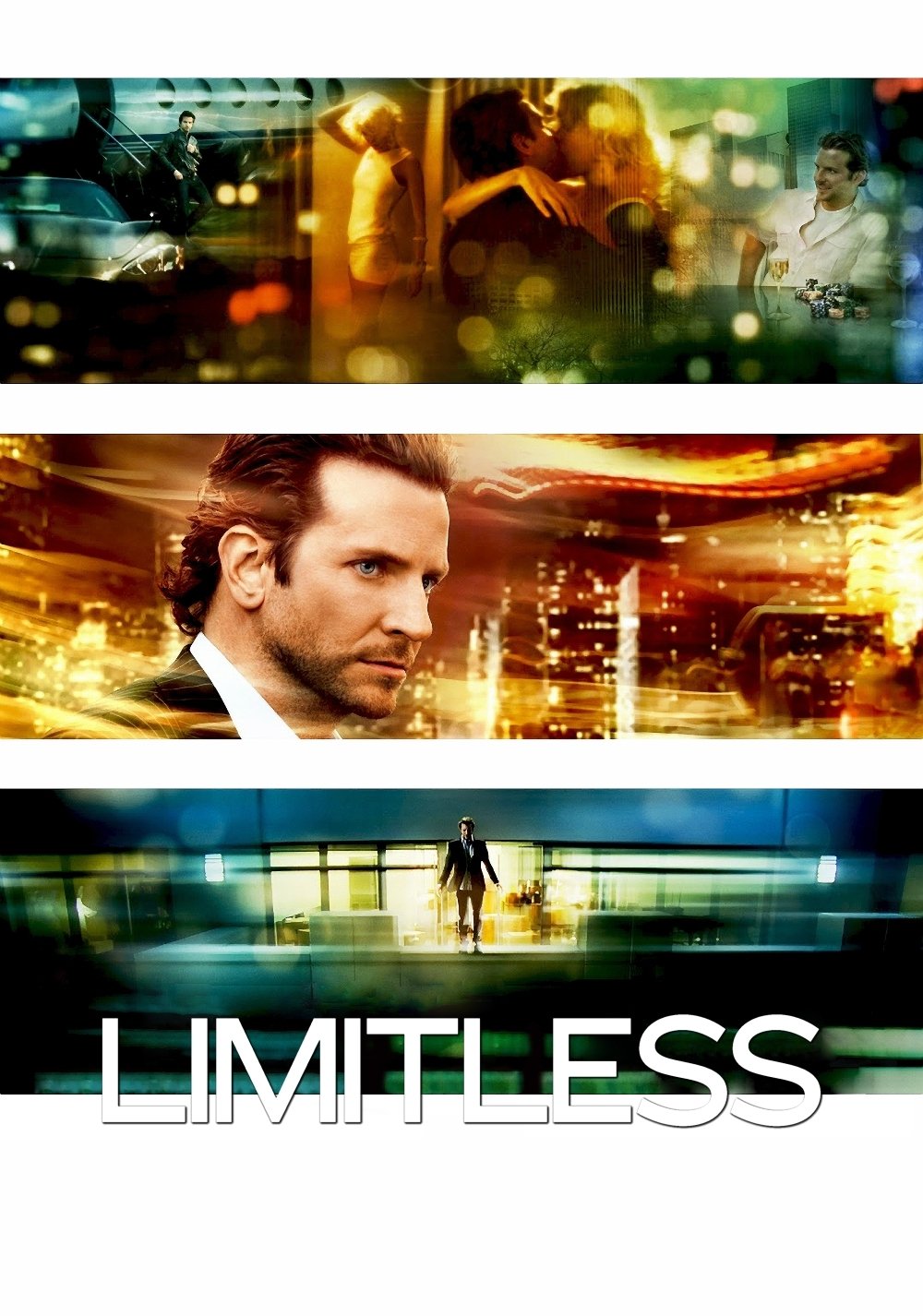

- UK release: March 2011
- Director: Neil Burger · Writer: Leslie Dixon
- Studio / distributor: Relativity Media; Rogue; Momentum Pictures (UK)
- Genre: Science fiction thriller / techno-thriller · Runtime: 105 minutes (BBFC 15)
- Main cast: Bradley Cooper (The Hangover, The A-Team) as Eddie Morra; Robert De Niro (Taxi Driver, Heat) as Carl Van Loon; Abbie Cornish (Bright Star, Stop-Loss) as Lindy; Anna Friel (Land of the Lost) as Melissa; Andrew Howard as Gennady
- Rotten Tomatoes: 69% critics / 74% audience · My rating: 8 / 10
There is a particular fantasy that any writer who has ever stared at a blank page knows intimately: the one where the fog lifts, the sentences arrive in order, and the brain finally does what you always suspected it could. Limitless takes that daydream, drops it into a pill, and asks what a man would do if it actually worked. Neil Burger, who made the elegant period sleight-of-hand of The Illusionist, swaps the candlelight for a glassy, over-caffeinated Manhattan, and the result is the rare high-concept thriller that is as interested in showing off as it is in scaring you.
The setup
Eddie Morra (Bradley Cooper) is a struggling novelist in the worst sense: long hair, unpaid rent, a contract he has not delivered a word against, and a girlfriend who has just run out of patience. An old acquaintance hands him a clear tablet called NZT, which, the pitch goes, lets you use all of your brain instead of the sliver you currently run on. One dose and Eddie is fluent, magnetic and several moves ahead of everyone in the room. He finishes the book, learns languages over a weekend, and turns a few thousand dollars into a fortune on the markets, which is exactly when the wrong sort of people start to notice. The supply is finite, the side effects are not advertised, and the higher Eddie climbs, the further there is to fall.
The cast
This is the film that argues Bradley Cooper can carry a picture on his own, and he wins the argument. He has to play two men, the rumpled failure and the sharpened operator, and the pleasure is in watching the second one switch on behind the eyes. He keeps Eddie likeable even when he is plainly cheating at life, which the film needs, because there is not much else to root for. Robert De Niro arrives late as Carl Van Loon, a finance titan who has spent decades earning his edge and does not much like a man who bought his overnight; it is a contained, watchful performance, and the scenes where the two circle each other are the closest the film comes to real weight. Abbie Cornish brings scepticism and a flicker of conscience as Lindy, and Anna Friel makes a brief, bruised impression as the woman NZT got to first. They exist mostly to show us the cost, but they do it well.
The craft
Burger and cinematographer Jo Willems work hard to put the drug on screen rather than just describe it. When Eddie is clear, the city turns saturated and golden and the camera barrels through it in dizzying infinite-zoom shots that race down whole streets without a cut; when he is crashing, the colour drains and the edits stutter. It could be a gimmick and now and then it is, but it gives the film a genuine point of view and a restless forward momentum. Paul Leonard-Morgan’s pulsing electronic score keeps the adrenaline up. At 105 minutes the thing never sags, and Burger has the good sense to play several of the nastier beats for dark wit rather than grimness. The look is glossy, knowing and rewatchable, which counts for a lot in a film built on a single clever idea.
How it stacks up
The obvious cousins are the money-and-hubris pictures, Wall Street above all, with Eddie as a Bud Fox who skipped the apprenticeship and swallowed his ambition instead. The smarter comparison is Charly, the old Cliff Robertson film about a man briefly made brilliant who can feel the gift slipping away, because Limitless shares that anxiety underneath the swagger. It is more fun and less searching than either. Burger is plainly less interested in the philosophy of enhancement than in the wish-fulfilment of it, and the film is at its weakest when it gestures at consequences it does not really want to dwell on. As a glossy techno-thriller with a killer hook it more than holds its own; as a serious inquiry into what we would become with the brakes off, it changes the subject.
Critics versus the rest of us
Critics are mixed-positive, parked around 69%, and the recurring complaint is fair: a premise this rich deserves a braver, stranger film, and Limitless keeps choosing the slick option over the searching one. Audiences are warmer at 74%, and I am with them. The line that it wastes its idea is true and also slightly beside the point, because the idea is so enjoyable to watch in motion. You can dock it for the depth it leaves on the table while still grinning through most of it.
Verdict
What I want from a film like this is a strong central conceit, a lead who can sell it, momentum and a glossy texture that survives a second viewing, and Limitless delivers on all four. It does not have the nerve to follow its premise all the way to the dark place it keeps glancing at, and that ceiling is the only thing keeping it off the top shelf. But it is sharp, quick, funny and genuinely entertaining, with a star performance that finally puts Cooper front and centre, and it is the kind of thriller you will happily put on again. 8⁄10.
Availability: On general release in UK cinemas now, with a DVD and Blu-ray release to follow later in the year.
Update
Added since this review first appeared: NZT outlived the film. Limitless was spun into a one-season CBS television series in 2015, with Jake McDorman as a new user of the drug and Bradley Cooper reprising Eddie Morra as a recurring senator, a thread the film leaves dangling in its final scene. The wish-fulfilment-pill subgenre also kept going, most directly with Luc Besson’s Lucy (2014), which took a similar “unlock the whole brain” hook in a more cosmic, less grounded direction. The film has settled into its reputation as a slick, very rewatchable thriller that is fonder of its premise than it is curious about it. It now streams across the usual subscription and rental platforms depending on region.
BBFC content advice
Rated 15 by the BBFC for strong bloody violence. The notes below may contain spoilers.
Violence: There are frequent scenes of strong violence including sight of the hero stabbing a man in the eye with a syringe. A character is also forced to drink the blood of a man he has killed. There are also strong, realistic images of injury detail when a man is seen lying dead on the ground after having been shot in the head and chest.
The BBFC release page lists its detail under a single Violence heading; no separate Drugs, Language or Sex breakdown was published for this title at the cinema classification.
Source: British Board of Film Classification (bbfc.co.uk).