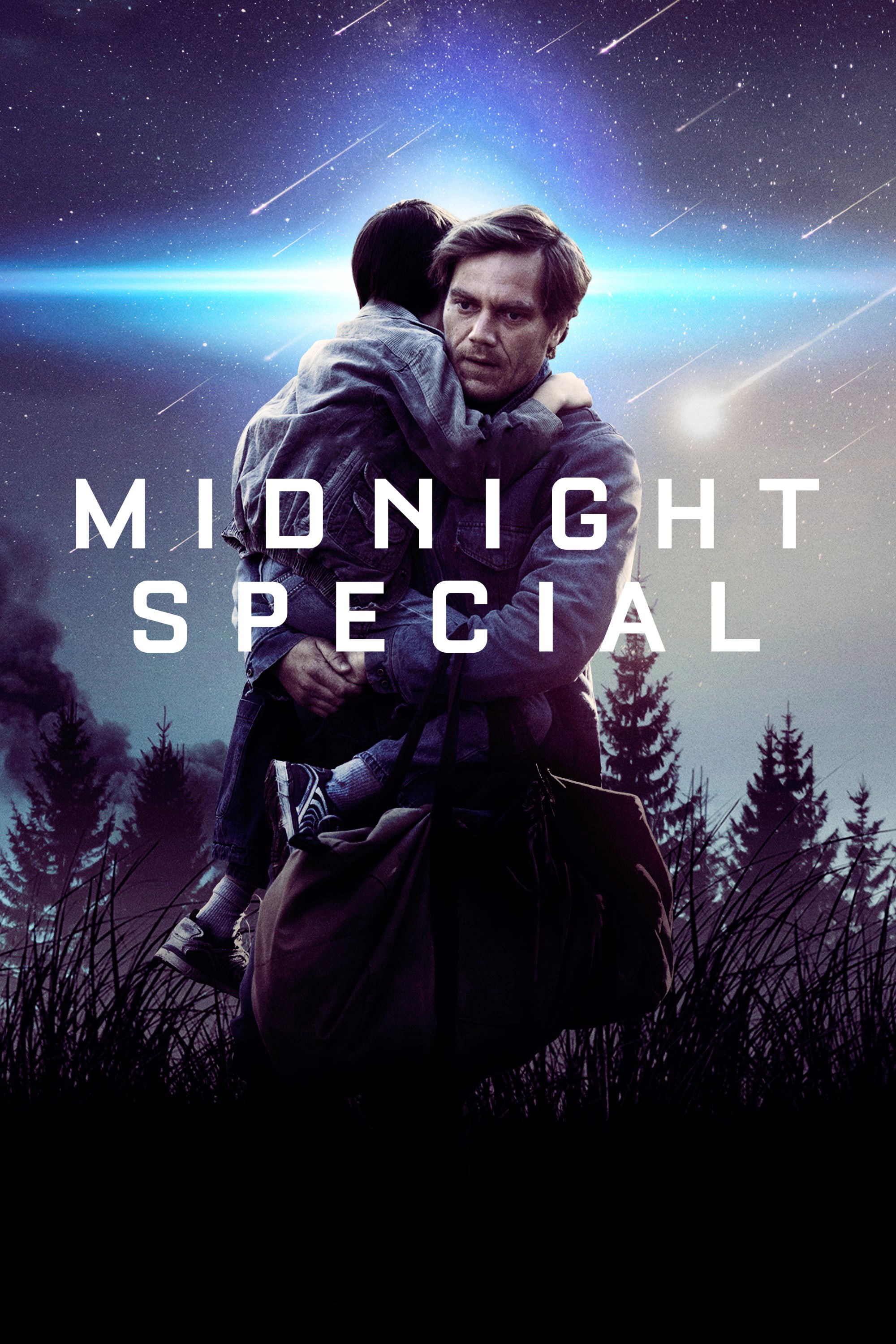

- UK release: April 2016
- Director: Jeff Nichols · Writer: Jeff Nichols
- Studio / distributor: Warner Bros.; Faliro House; Tri-State Pictures
- Genre: Science-fiction mystery / chase thriller · Runtime: 112 minutes (BBFC 12A)
- Main cast: Michael Shannon (Take Shelter, Man of Steel) as Roy Tomlin; Jaeden Lieberher (St. Vincent) as Alton Meyer; Joel Edgerton (Warrior, The Gift) as Lucas; Kirsten Dunst (Melancholia, Spider-Man) as Sarah Tomlin
- IMDb: 6.6 / 10 · Rotten Tomatoes: 84% critics / 67% audience · My rating: 8 / 10
Jeff Nichols has spent three films working a particular seam: ordinary men in the American South, plainly photographed, quietly coming apart. Take Shelter gave us a husband building a storm bunker against a vision he cannot explain; Mud sent two boys to help a fugitive on a river island. Midnight Special takes that same grounded dread and aims it, for the first time, at the sky. This is Nichols making a science-fiction film without telling you he is making one, and the surprise of it is how completely he keeps his nerve.
The setup
Roy Tomlin (Michael Shannon) is driving through the night with his eight-year-old son Alton (Jaeden Lieberher), the boy’s eyes shielded behind swimming goggles, the windows of the motel taped over with cardboard. Roy has taken Alton from a Texas religious community that built its scripture around the boy’s strange utterances, and the federal government wants him too, because whatever Alton can do has started leaking into satellite feeds and radio bands. Helped by his old friend Lucas (Joel Edgerton), a state trooper who has thrown his career away to come along, Roy is racing toward a place and a date that only Alton seems to understand. What the boy is, and what is waiting at the end of the road, the film parcels out a piece at a time, and never quite all at once.
The cast
Shannon is the centre of gravity, and he plays Roy with his usual coiled stillness, a man whose love for his son has hardened into pure function: drive, protect, do not stop to ask the questions he is terrified to answer. It is a performance built on what he refuses to show. Lieberher, asked to be uncanny and fragile at the same time, holds the screen without ever tipping into the precocious-child register that sinks lesser versions of this story. Edgerton brings a watchful, decent solidity as the friend who has decided to believe before he understands, and Kirsten Dunst, as Alton’s mother Sarah, arrives later and lends the chase its emotional ache, the grief of a parent measuring how little time is left. Adam Driver, as the NSA analyst piecing the mystery together from the other side, is the one character allowed to share the audience’s curiosity, and he plays it with a nerdish delight that cuts the tension nicely.
The craft
Nichols and his regular cinematographer Adam Stone shoot most of this at night, in motels and on back roads, and the restraint is the whole strategy. The effects are sparing and arrive late, so that when the film finally shows its hand the images land with real weight rather than wearing you down by the hour. David Wingo’s score hums with low electronic unease, closer to a thriller than a wonder-film for most of the running time. There is a deliberate withholding here that will frustrate some viewers: Nichols trusts you to sit with not-knowing, to read a glance or a half-finished sentence and carry the gap yourself. The pacing is taut, the geography of the chase always legible, and the dread is generated almost entirely by people behaving as if something enormous is at stake without ever over-explaining what.
How it stacks up
The lineage is obvious and Nichols knows it. This is a film raised on Close Encounters of the Third Kind and Starman, on the Spielberg and Carpenter register of ordinary Americans brushing up against something vast and benign. It shares blood with E.T. in its government pursuit and its child at the centre, and with the recent Super 8 in its small-town, analogue-era texture. But the closest comparison is Nichols’ own Take Shelter: the same actor, the same married couple under unbearable strain, the same question of whether a man losing the world’s trust is mad or right. Where those films leaned on spectacle or on a single domestic dread, Midnight Special keeps both plates spinning, a road thriller and a father’s quiet agony, and it earns the comparison rather than borrowing the goodwill.
Critics versus the rest of us
Critics have taken to it warmly, sitting around 84%, drawn to the restraint, the atmosphere, and the first-contact mood handled without bombast. Audiences are cooler, nearer 67%, and the gap is easy to read: the people who wanted answers and a third-act payoff to match the build-up have come away short-changed, because the film deliberately gives you less explanation than the set-up seems to promise. That is a fair grievance if you arrive wanting a puzzle solved on screen. It is not my grievance. The withholding is the texture I came for, and I would rather a film leave a door ajar than spend twenty minutes nailing it shut.
Verdict
This sits squarely in territory I am fond of: intelligent, restrained science fiction that respects the audience, built on a real emotional engine rather than on light shows. The atmosphere is excellent, Shannon and Edgerton are a pleasure to watch, and the film is short, tense, and confident enough to under-explain. It loses a little in the final stretch, where the careful withholding gives way to imagery that cannot quite match the dread that preceded it, and that keeps it just shy of the top tier. But it is a smart, soulful chase film I will happily watch again, and the most assured thing Nichols has made. 8⁄10.
Availability: In UK cinemas now, on limited release. One to catch on the big screen for the night-time photography while you can; a DVD and Blu-ray release will follow.
Update
Added since this review first appeared: Jeff Nichols followed this the same year with Loving (2016), again with Joel Edgerton, swapping science fiction for civil-rights drama but keeping the same plain, patient eye. Midnight Special has settled into a reputation as a cult favourite, the film cited whenever people argue that modest, character-led science fiction can still be made inside a studio. It is now widely available on disc and digital, and streams on the major platforms depending on region.
BBFC content advice
Rated 12A by the BBFC for moderate violence, threat. The notes below may contain spoilers.
Violence: During a shoot-out one man is shot in the stomach and another in the shoulder. Blood is seen on clothing but there is no emphasis on injuries. In another scene a man is struck across the head with a brass lamp.
Threat and horror: Moments of moderate threat include car crash scenes and a sequence in which a mysterious force causes a house to shake violently.
Language: Other issues include infrequent mild bad language, including uses of ‘asshole’ and ‘shit’.
Source: British Board of Film Classification (bbfc.co.uk).