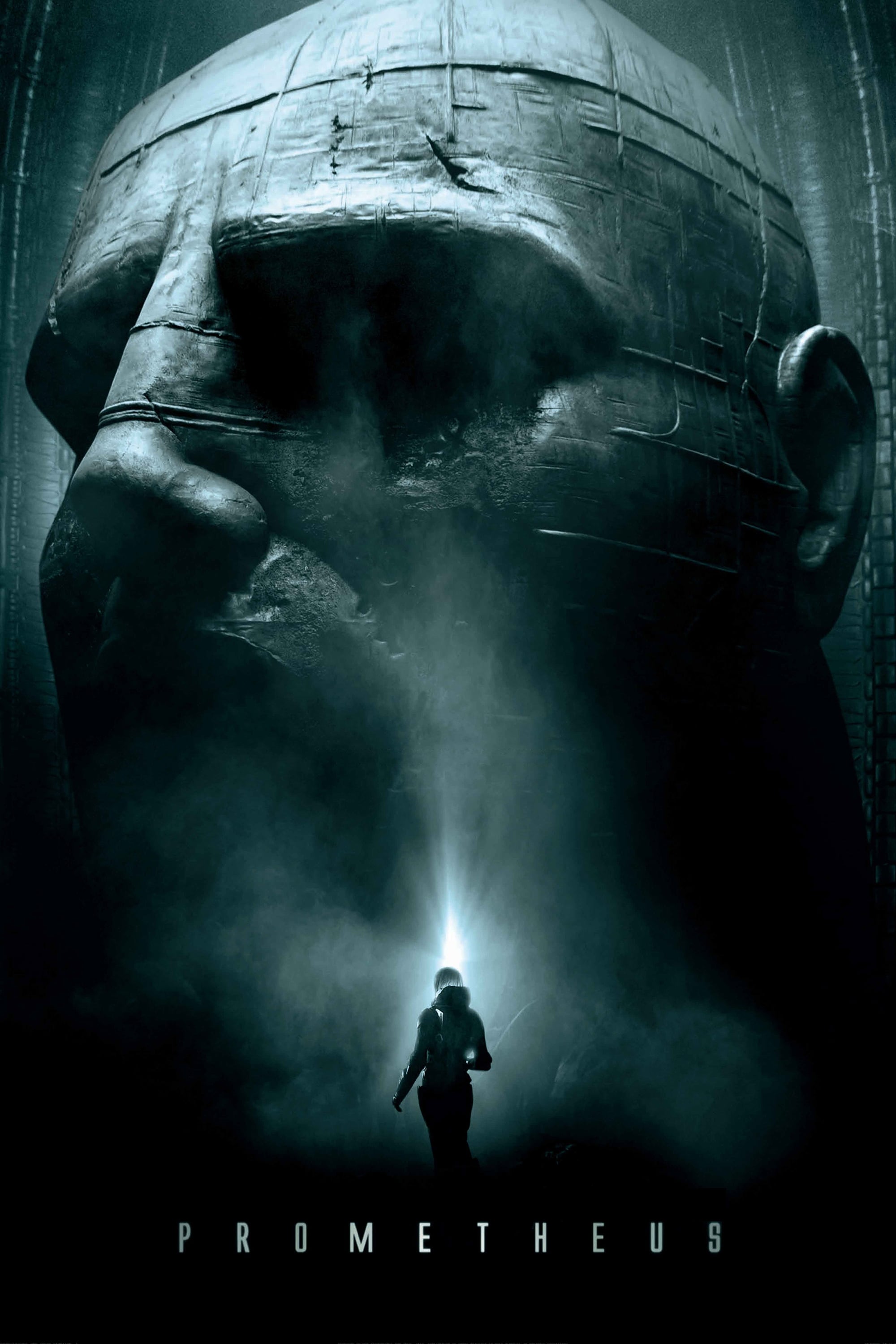

- UK release: June 2012
- Director: Ridley Scott · Writers: Jon Spaihts, Damon Lindelof
- Studio / distributor: 20th Century Fox; Scott Free Productions; Brandywine Productions
- Genre: Science fiction / cosmic mystery · Runtime: 124 minutes (BBFC 15)
- Main cast: Noomi Rapace (The Girl with the Dragon Tattoo) as Elizabeth Shaw; Michael Fassbender (X-Men: First Class, Inglourious Basterds) as David; Charlize Theron (Monster, The Italian Job) as Meredith Vickers; Idris Elba (Luther) as Janek; Guy Pearce (Memento, L.A. Confidential) as Peter Weyland
- Rotten Tomatoes: 73% critics / 68% audience · My rating: 7.5 / 10
Thirty three years after Alien, Ridley Scott has come home. He spent the decades in between making everything except science fiction, and the genre he helped define got along without him by copying him. So there is a lot riding on Prometheus, which started life as a straight prequel and then, somewhere in development, grew ambitions. Scott is no longer interested in a creature stalking a corridor. He wants to ask who made us, and why, and whether we would want to meet them. That is a far bigger swing than the original ever attempted, and the film is at once more beautiful and more exasperating for taking it.
The setup
A pair of archaeologists, Elizabeth Shaw (Noomi Rapace) and Charlie Holloway, find the same constellation pointed to by cultures that never met, and read it as an invitation. The Weyland Corporation funds an expedition to follow the map to a distant moon, and the scientific vessel Prometheus sets down on a grey, dead world that turns out to be neither as empty nor as welcoming as the star charts promised. What the crew uncovers about the beings they came looking for raises far worse questions than the ones they arrived with. I will leave the discoveries where the film leaves them, because the unpeeling is most of the pleasure.
The cast
Rapace, fresh from the Swedish Dragon Tattoo films, makes Shaw the warm centre of a cold story: a scientist who also wears a cross, and whose faith and curiosity pull against each other rather than cancelling out. The film belongs, though, to Michael Fassbender’s David, the synthetic crew member who pads around the sleeping ship modelling himself on Peter O’Toole in Lawrence of Arabia. Fassbender plays him as courteous, childlike and quietly sinister all at once, a machine learning what it wants by watching the people who own him. Charlize Theron’s Meredith Vickers brings corporate frost as the company minder who trusts no one, Idris Elba’s Janek lends the captain’s chair an unfussy, blue-collar authority, and Guy Pearce turns up under heavy age make-up as the dying magnate Weyland. The humans are a notch underwritten, and a couple of the supposed experts make decisions no scientist would, but the two non-quite-human leads more than carry it.
The craft
This is one of the best-looking science fiction films in years. Dariusz Wolski shoots the Icelandic and Scottish landscapes as a genuinely alien frontier, all volcanic black rock and freezing waterfalls, and the production design extends Giger’s old biomechanical grammar without simply xeroxing it. The opening, a wide unhurried fly-over of an empty Earth, tells you straight away that Scott is reaching past the haunted-house thrills of the first film towards something closer to 2001. The 3D is used with restraint, for depth rather than poke-you-in-the-eye gimmickry, and there is one surgical-pod sequence, tense and bloody and almost unbearable, that ranks with anything Scott has ever staged. Marc Streitenfeld’s score and the cold grandeur of the design do a lot to paper over the moments where the plot stops making sense.
How it stacks up
The shadow it stands in is its own. Alien was a perfect, lean machine, a monster movie with the manners of an art film, and nothing here matches that economy. Where Prometheus reaches instead is towards Blade Runner, Scott’s other great science fiction film, in its preoccupation with artificial people and what they owe their makers, and towards Kubrick’s 2001 in its yearning to treat the cosmos as a question rather than a shooting gallery. It does not get within touching distance of either, but the ambition is the right ambition. Set against the run of empty franchise spectacle that has filled the gap since Scott last worked in the genre, a flawed film that genuinely wants to think is a welcome thing.
Critics versus the rest of us
The reception is split right down the middle, and you can see why. Critics are sitting around 73%, audiences a little lower at 68%, and the same fault line runs through both camps: dazzling to look at, maddening to follow. The praise lands on the visuals, the scale and Fassbender. The complaints land on a script that sets up enormous questions and then mislays half of them, and on characters who behave foolishly so the plot can lurch forward. Both readings are correct at the same time, which is the peculiar thing about this film. It is a more interesting failure than most films are a success.
Verdict
I came out divided and stayed that way, and on this film that is closer to a compliment than it sounds. The logic holes are real, the mythology is left dangling, and at least two characters die of plot convenience rather than anything they did. But the look is sumptuous, the ideas are larger than the genre usually risks, Fassbender’s David is one of the most fascinating screen creations of the year, and I have already found myself wanting to go back and argue with it. A clean, satisfying film would not nag at me like this one does. It does not earn the place beside Alien it clearly wants, but it is ambitious, gorgeous and genuinely strange, and I would rather rewatch a fascinating mess than a tidy blank. 7.5⁄10.
Availability: On general release in UK cinemas now, in 2D, 3D and IMAX. Worth the largest screen you can find.
Update
Added since this review first appeared: Scott returned to this corner of the universe with Alien: Covenant (2017), which answered some of the questions left hanging here, gave Fassbender’s David an even larger role, and folded the strand back towards the creature that started everything. Opinion on Prometheus has stayed split in much the way it was at release, though its standing has if anything risen among those who value ambition over tidiness. It is now widely available on disc and digital and streams on Disney+ depending on your region.
BBFC content advice
Rated 15 by the BBFC for strong violence, gore, threat and horror. The notes below may contain spoilers.
Violence: Scenes of strong violence feature heavy blows and bloody detail. For example, in one scene a character’s arm is broken, revealing blood and bone, and in another scene a character’s head is smashed against the floor, resulting in a large spurt of blood.
Threat and horror: There is a sense of threat towards the central characters that is both frequent and sustained.
Injury detail: There are also some scenes featuring gory detail, both when dead bodies are seen and when people are injured.
Additional issues: There is also infrequent use of strong language (‘f**k’), and one implied use of strong language, when a remark is broken up by static. There are several undetailed verbal sex references and a brief scene in which a couple start to have sex, without any nudity or other detail.
Source: British Board of Film Classification (bbfc.co.uk).