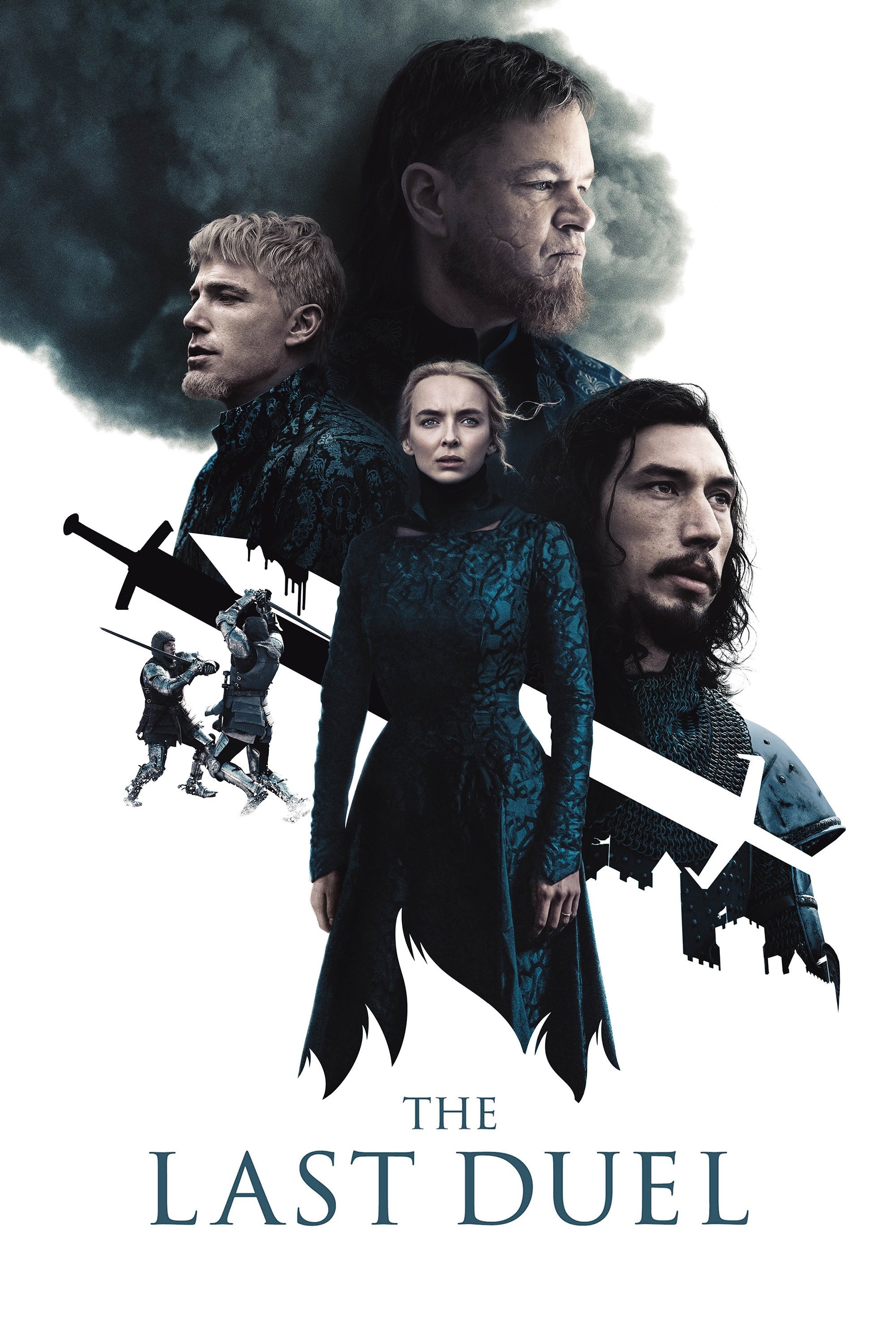
- UK release: October 2021
- Director: Ridley Scott · Writers: Nicole Holofcener, Ben Affleck, Matt Damon
- Studio / distributor: 20th Century Studios; Scott Free Productions
- Genre: Historical drama / medieval legal thriller · Runtime: 153 minutes (BBFC 18)
- Main cast: Jodie Comer (Killing Eve) as Marguerite de Carrouges; Matt Damon (The Martian, The Bourne Identity) as Jean de Carrouges; Adam Driver (Marriage Story, Star Wars: The Last Jedi) as Jacques Le Gris; Ben Affleck (Argo, The Town) as Count Pierre d’Alençon
- Rotten Tomatoes: 85% critics / 81% audience · My rating: 8 / 10
At eighty-three, Ridley Scott has earned the right to coast, and instead he has made the angriest film of his late career. The Last Duel takes the structure everyone reaches for when they describe this sort of story, Rashomon, the same crime told from three points of view, and uses it for something sharper than a parlour trick about the unknowability of truth. Scott built his reputation on men in armour swinging swords at each other; here he spends two and a half hours showing you exactly how little their version of events is worth.
The setup
France, 1386. The knight Jean de Carrouges returns from war to find his standing in ruins and his friendship with the squire Jacques Le Gris turned to rivalry under their shared patron, Count Pierre d’Alençon. Then Carrouges’s wife, Marguerite, accuses Le Gris of raping her while her husband was away. Le Gris denies it. With no witnesses and no court willing to settle the matter, Carrouges petitions the king for trial by combat: a duel to the death in which God is presumed to side with the man telling the truth, and in which, by the law of the day, Marguerite will be burned alive if her husband loses. The film hands the same months to three narrators in turn, each chapter headed “the truth according to” its teller, and lets you watch the same rooms and the same words shift under the weight of who is remembering them.
The cast
The triptych structure is unkind to actors, since each of them has to play two or three subtly different versions of one person, and the cast is up to it. Matt Damon, buried under a scarred face and a foul temper, gives Carrouges a wounded pride that curdles into something close to vanity by his own telling. Adam Driver makes Le Gris plausibly charming and quietly monstrous in the same breath, which is the whole difficulty of the part. Ben Affleck, blond and openly enjoying himself as the dissolute Count, supplies the film’s only real wit. But the picture belongs to Jodie Comer. Marguerite is held at the edge of the men’s chapters and then handed the third one outright, and Comer carries the shift from object to witness without a wasted gesture. Hers is the version the film believes, and she earns that trust frame by frame.
The craft
Scott shoots medieval France as cold, muddy and unglamorous, all grey stone and breath fogging in the air, with none of the burnished warmth of Gladiator. Dariusz Wolski’s photography keeps the world plausible rather than pretty. The triptych is handled with real discipline: the repeated scenes are blocked almost identically, so that a softened line of dialogue or a held glance does the work, and you find yourself watching for the differences like evidence. Harry Gregson-Williams’s score stays low and dread-filled rather than swelling. The title duel, when it finally arrives, is brutal, clumsy and exhausting in the right way, two frightened men in heavy steel hacking at each other in the mud while a crowd watches a woman’s life hang on the outcome. Scott stages it as horror, not spectacle, and that judgement is the film’s making.
How it stacks up
The obvious reference is Rashomon, and The Last Duel knows it, but Kurosawa left the truth genuinely suspended while Scott does not: the third account is plainly the real one, and the film is the better for taking a side. Against Scott’s own historical work it sits closest to Kingdom of Heaven in setting, though it is colder and more interior, with none of that film’s crusader sweep. The nearer cousin is something like a courtroom drama in chainmail, a study of how an institution processes a woman’s word and finds it worth less than a man’s wounded honour. For all the armour, the duel is the smaller subject. The trial around it is the larger one.
Critics versus the rest of us
Critics have come down firmly in favour, sitting around 85%, with most of the praise going to the structure, the seriousness of the third chapter and Comer’s performance. Audiences are a notch behind at 81%, and the film has been a conspicuous flop in cinemas, which says more about selling a grim medieval drama to a post-pandemic multiplex than about the work itself. The complaint worth taking seriously is the runtime: at two and a half hours the repetition can feel like a point being made twice before it is made a third time. I felt the length and did not much mind it, because the structure needs the patience to pay off.
Verdict
This is a hard film to love and an easy one to admire. It is grim by design, it asks a lot of your afternoon, and the central event is staged precisely so that you cannot enjoy it. None of that is a flaw; it is the film working as intended. Comer is extraordinary, the structure is more than a gimmick, and Scott has made the rare late-period epic with a real argument inside it. What it gives up is rewatchability, since I am in no hurry to sit through that third chapter again, and that is what keeps the number where it is rather than higher. A serious, exact, unexpectedly furious piece of work that deserved a far better reception than it got. 8⁄10.
Availability: In UK cinemas now. One for the big screen if you can stand the subject; a film to brace yourself for, not to wander into.
Update
Added since this review first appeared: the box-office failure stuck, and the film has become the case study people reach for when arguing that grown-up cinema struggled to pull audiences back into multiplexes after the pandemic. Its reputation has only risen since, with Comer’s performance in particular singled out as one of the year’s best and the screenplay’s structure aging well. It is now on disc and digital, and streams on Disney+ in the UK.
BBFC content advice
Rated 18 by the BBFC for sexual violence, strong bloody violence. The notes below may contain spoilers.
Violence: There are scenes of strong bloody violence in which people battle with bladed weapons, including stabbings and decapitations. There are also scenes of domestic violence in which men inflict violence on women.
Sexual violence and sexual threat: There is a protracted scene of sexual violence in which a man rapes a woman, seen from the perspective of the perpetrator and victim. The sequence is preceded by growing sexual threat, in which the woman is chased and overpowered.
Language: There is infrequent use of both very strong language (‘c**t’) and strong language (‘f**k’).
Sex: Scenes of sex include thrusting and implied masturbation, as well as full frontal nudity. There are occasional verbal sex references.
Nudity: There is sexualised nudity, including during an orgy.
Theme: A theme of the narrative is the prejudicial treatment of women within the historical setting.
Drugs: A substance is smoked, which may be a drug.
Alcohol and smoking: Adult characters drink alcohol.
Source: British Board of Film Classification (bbfc.co.uk).