
- UK premiere: June 2014 (Edinburgh International Film Festival; a 2013 production)
- Director: Bong Joon-ho · Writers: Bong Joon-ho, Kelly Masterson
- Studio / distributor: Moho Film; Opus Pictures; CJ Entertainment
- Genre: Dystopian science-fiction action thriller · Runtime: 126 minutes (BBFC 15)
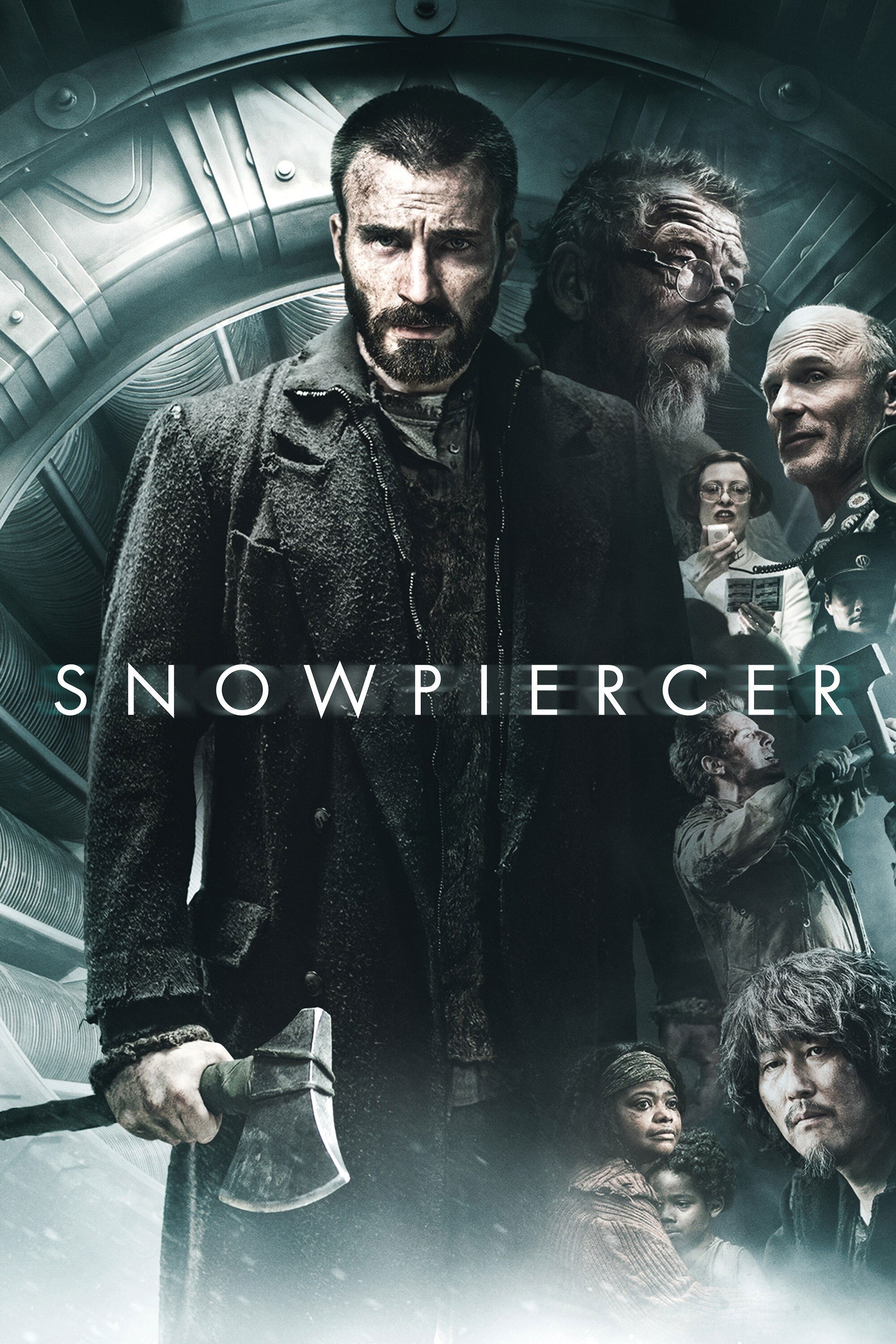
- Main cast: Chris Evans (Captain America: The First Avenger, The Avengers) as Curtis Everett; Song Kang-ho (Memories of Murder, The Host) as Namgoong Minsoo; Tilda Swinton (Michael Clayton) as Minister Mason; John Hurt (Alien, Tinker Tailor Soldier Spy) as Gilliam; Jamie Bell (Billy Elliot, The Adventures of Tintin) as Edgar; Octavia Spencer (The Help) as Tanya
- Rotten Tomatoes: 94% critics / 72% audience · My rating: 8 / 10
Bong Joon-ho is the South Korean director who made the monster movie The Host feel like a family drama and a political cartoon at the same time, and Snowpiercer is his first film in English, his biggest budget, and the one a lot of people outside Korea will meet him through. It is adapted from a French graphic novel, shot in the Czech Republic with an international cast, and it carries that strange pedigree lightly. What it does not carry lightly is its premise, which it states with a bluntness that should not work and somehow does: the last people on Earth live on a train, and the train will never stop.
The setup
A botched attempt to reverse global warming has frozen the planet solid, and the only survivors are aboard the Snowpiercer, a vast self-sustaining train that loops the dead world on an endless circuit. Society has reassembled itself along the carriages, with the wretched packed into the tail and the privileged living in comfort somewhere up front, fed and policed by an order that treats the back of the train as livestock. Curtis (Chris Evans), a reluctant leader among the tail passengers, decides the only way to change anything is to go forward, car by car, fighting through to the engine and the man who runs it. The geography of the film is the plot: one door at a time, with no idea what is behind the next one.
The cast
Evans is cast against the clean-cut heroism that made his name, and he leans into it. Curtis is guilt-ridden, hesitant, carrying something he does not want to say, and Evans plays the weight rather than the leadership. Song Kang-ho, the only actor here speaking through an interpreter device for much of the film, gives the security expert Namgoong Minsoo a wry, addled unpredictability that keeps you guessing about whose side he is on. John Hurt brings his usual frayed gravity to the tail’s elder statesman, and Jamie Bell and Octavia Spencer give the uprising its loyalty and its personal stakes. The performance everyone will talk about is Tilda Swinton’s Minister Mason, a buck-toothed, Yorkshire-accented bureaucrat of pure grotesque comedy, delivering speeches about everyone keeping to their preordained place with the conviction of a woman who has never once doubted it. She is hideous and very funny, and she tilts the whole film towards satire whenever she appears.
The craft
The single-direction structure could have been monotonous and instead it is the source of the film’s momentum and its surprises. Each carriage is its own self-contained world with its own rules, lighting and mood, so the journey forward keeps resetting the tone: a pitched battle in near-darkness, then a classroom, then a greenhouse, then something stranger still. Hong Kyung-pyo’s photography makes the cramped sets feel both claustrophobic and oddly expansive, and Marco Beltrami’s score knows when to go quiet and let the train’s own rhythm carry a scene. Bong’s control of tone is the real achievement. He swings from brutal action to deadpan absurdity to genuine horror without the seams showing, and an extended axe fight staged around a tunnel and a flickering new year is as good a single sequence as the genre has produced lately.
How it stacks up
The obvious touchstone is Children of Men, another grimy, intelligent dystopia that trusts its world to do the talking, and Snowpiercer shares that film’s refusal to over-explain. In its appetite for class allegory dressed as a bureaucratic nightmare it is closer to Brazil, and its forward-grinding corridor combat will remind anyone who has seen it of The Raid, though Bong is after something more political than pure sensation. Set against Bong’s own work it is broader and more cartoonish than Memories of Murder, with the same gift he showed in The Host for sliding between registers that should not coexist. The willingness to be weird, to follow an idea past the point of plausibility because the idea is interesting, is what separates it from the run of grey post-apocalyptic films.
Critics versus the rest of us
Critics are close to unanimous, sitting up around 94%, praising the design, the nerve and the politics. Audiences are warmer than lukewarm but markedly cooler, nearer 72%, and the gap is easy to read: this is a film that asks you to accept a frankly preposterous central conceit and a couple of swerves into the surreal, and viewers who want their science fiction to hold together as engineering will balk. The distribution has not helped, with the film snagged on a long argument over cuts that has kept it out of cinemas in some markets and slowed its reputation. I land with the critics here, but for reasons of taste rather than deference: I will forgive a great deal of implausibility for a world this committed to itself.
Verdict
A train that never stops is a silly idea, and Snowpiercer knows it, and builds something fierce and strange on top of it anyway. The structure gives it relentless drive, the carriages give it variety, Swinton gives it teeth, and Bong gives it a tonal confidence that very few directors working at this scale possess. It is not flawless. The metaphor occasionally announces itself too loudly, and the final act leans harder on speeches than on momentum. None of that stops it being one of the most distinctive genre films in a good while, and one I expect to revisit, partly to catch what is behind doors I was too busy to look at the first time. 8⁄10.
Availability: Screening at the Edinburgh International Film Festival now, ahead of a wider UK release once the distribution wrangle is settled. Worth seeking out on the biggest screen you can find it on.
Update
Added since this review first appeared: the distribution tangle that kept Snowpiercer out of UK cinemas dragged on for years, and the film never got the proper theatrical run it deserved here. It finally reached British audiences through digital platforms in October 2018, with a Film4 broadcast and a handful of repertory screenings following in early 2020. It later inspired a television series of the same name, which ran from 2020; having enjoyed its first season, I scored the show 7⁄10, a notch below the film, and the two are best judged separately. Bong Joon-ho, meanwhile, went on to win Best Picture for Parasite, which makes this English-language calling card look even more like the work of a major director hitting his stride. It now streams on the usual platforms in the UK, subject to the usual regional shuffling.
BBFC content advice
Rated 15 by the BBFC for strong bloody violence, language. The notes below may contain spoilers.
Violence: A rebel stabs a soldier in the chest and cuts upward, with bloody detail. A man is stabbed through the hand, with close-up focus. There are regular fights with axes, guns and makeshift weapons.
Language: There is use of strong language (‘fk’, ‘motherfker’) as well as other terms such as ‘bitch’ and ‘Jesus’.
Additional issues: It is implied that characters misuse a fictional drug. A character tearfully admits to having eaten human babies.
Source: British Board of Film Classification (bbfc.co.uk).