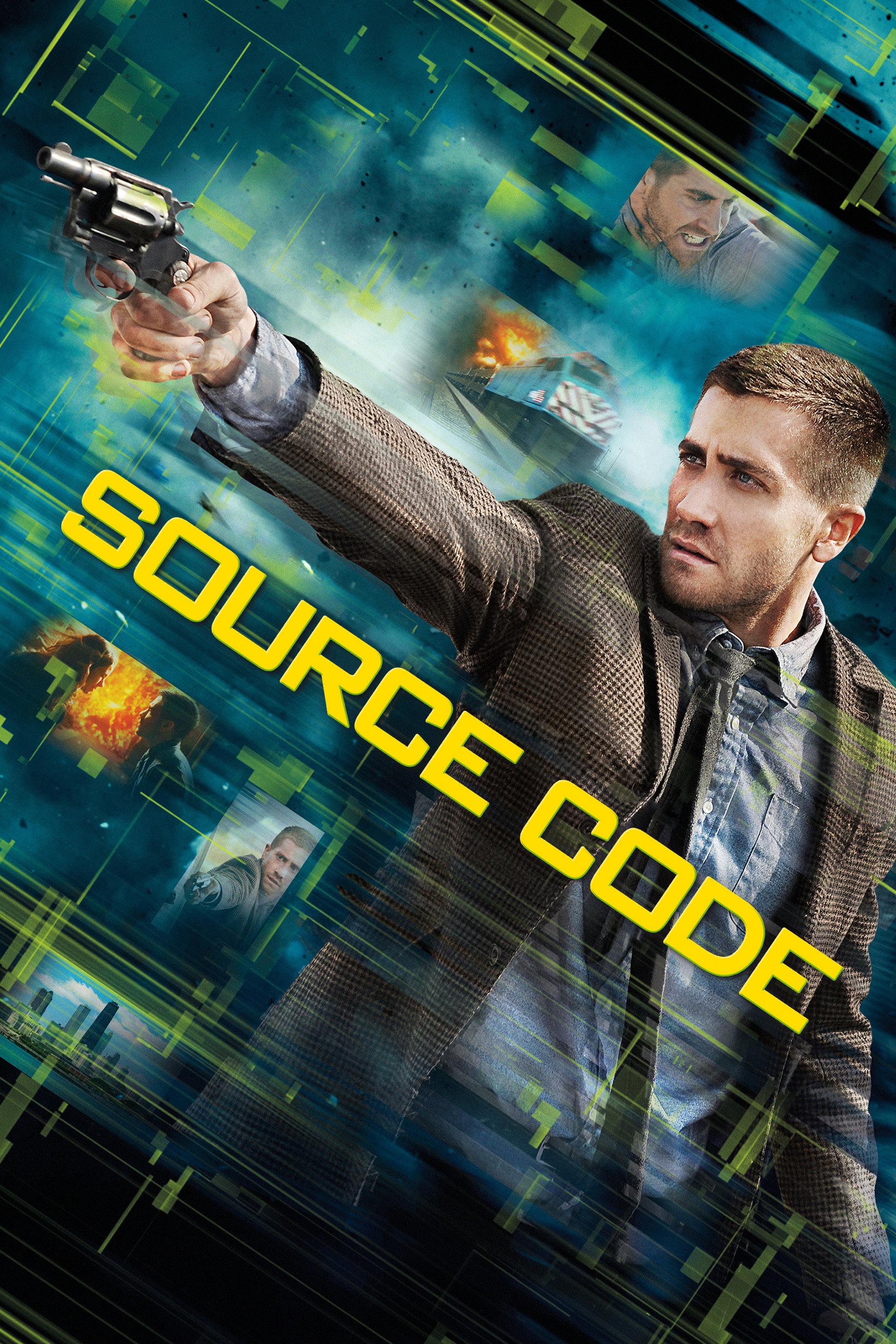

- UK release: April 2011
- Director: Duncan Jones · Writer: Ben Ripley
- Studio / distributor: Summit Entertainment; The Mark Gordon Company; Vendôme Pictures
- Genre: Science fiction thriller / time-loop mystery · Runtime: 93 minutes (BBFC 12A)
- Main cast: Jake Gyllenhaal (Donnie Darko, Brokeback Mountain) as Colter Stevens; Michelle Monaghan (Mission: Impossible III, Gone Baby Gone) as Christina Warren; Vera Farmiga (Up in the Air, The Departed) as Colleen Goodwin; Jeffrey Wright (Casino Royale, Syriana) as Dr Rutledge
- Rotten Tomatoes: 92% critics / 82% audience · My rating: 8 / 10
Two years ago Duncan Jones turned up out of nowhere with Moon, a one-man, one-set science fiction film made for the loose change other directors lose down the back of the sofa, and it was one of the smartest things the genre had produced in a decade. The obvious worry with a follow-up was the second-album problem: a bigger budget, a recognisable lead, a studio behind it, and the danger that the very things that made Moon sing would get smoothed away. Source Code arrives carrying all of that, and the encouraging news is that Jones has spent the extra money on momentum rather than spectacle.
The setup
Captain Colter Stevens (Jake Gyllenhaal) wakes on a Chicago commuter train, sitting opposite a woman who is talking to him as though they know each other, and with no idea how he got there. He is not Colter Stevens to anyone on board; the face in the window is a stranger’s. Eight minutes later the train explodes. Then he wakes again, in a metal capsule, being told by a brisk officer on a screen that he is part of a programme that can drop him into those last eight minutes over and over until he finds the bomber. The film keeps two clocks running at once: the loop on the train, where he is chasing a name, and the cold room outside it, where he is trying to work out what has actually been done to him. I will leave the second clock for you to discover, because the pleasure is in watching the rules reveal themselves.
The cast
This is the most relaxed and likeable Gyllenhaal has been in a while. He plays Colter as a soldier first, methodical and clipped, then lets the confusion and the grief leak through as the repetitions mount, so that by the later runs you feel the cost of being asked to die on a schedule. Michelle Monaghan has the harder job: Christina has to be worth saving on an eight-minute acquaintance, and she finds an easy, lived-in warmth that does the work the script does not have time to. Vera Farmiga, mostly confined to a monitor, turns Goodwin from a procedural mouthpiece into the conscience of the thing, a flicker of doubt behind the protocol. Jeffrey Wright gives Dr Rutledge the clipped certainty of a man who has stopped asking whether he should because he is too pleased that he can.
The craft
What impresses is the economy. Ben Ripley’s screenplay is a precision instrument: it sets up its loop, teaches you the rules, then breaks and bends them at exactly the rate that keeps you leaning forward. Jones shoots the repeated eight minutes so that each pass feels different, finding new angles and details rather than simply replaying the tape, which is the trap this kind of film usually falls into. At ninety-three minutes there is no fat on it. Chris Bacon’s score keeps the pulse up without nagging, and the train itself, all hard light and aluminium and indifferent strangers, becomes a place you come to know the way the hero does. It is a film that respects your time and your intelligence, and that is rarer than it should be.
How it stacks up
The shorthand everyone reaches for is Groundhog Day with a bomb, and the loop structure does owe something to it, and a little to the body-swap conceit of old Quantum Leap. But the closer relative is Tony Scott’s Deja Vu, another thriller that dresses grief up as a technical problem and sends a man back to save a woman he has only just met. Against its own director’s work, this is the warmer, more conventional film: Moon was a chilly meditation on identity and corporate cruelty, while Source Code is a thriller that happens to have ideas, rather than the other way round. That is not a complaint. It tells you Jones can do propulsion as well as melancholy, and it suggests he is a real filmmaker and not a one-set fluke.
Critics versus the rest of us
Critics have taken to it warmly, sitting around 92%, with the praise landing on its pace, its tidy premise and an emotional payoff that earns its keep. Audiences are a notch cooler at 82%, and you can guess why: the more you poke at the science, the more the logic frays, and the ending asks you to accept a fairly generous reading of what the programme can actually do. If you need your time-travel airtight, the last reel will irritate you. I think that is the wrong thing to bring to it. The film is honest about being a thriller with a heart, and it keeps its promises on both counts.
Verdict
This is exactly the sort of film I want more of: intelligent science fiction that trusts the audience, runs lean, and leaves you with something to chew on rather than just something to clean up. It is not flawless. The mechanics do not survive close interrogation, and the resolution reaches for a sentiment it has not entirely banked. But it is tense, humane and clever, the kind of thing I will happily put on again to watch the gears turn, and it confirms that Moon was no accident. 8⁄10.
Availability: On general release in UK cinemas now. Worth catching on a big screen while the train still has its surprises.
Update
Added since this review first appeared: Duncan Jones went on to make the long-gestating video-game adaptation Warcraft (2016) and the Netflix thriller Mute (2018), and Source Code has settled in as the high point of his run with Moon, the two compact, idea-led films he made before the bigger machines closed in. The time-loop subgenre it sits in has since had its definitive action entry in Edge of Tomorrow (2014), which runs the same die-and-repeat structure at a larger scale. Source Code is now widely available on disc and digital, and turns up regularly on the streaming services depending on your region.
BBFC content advice
Rated 12A by the BBFC for one use of strong language and moderate threat. The notes below may contain spoilers.
Threat: There are several scenes of moderate threat when guns are pointed at people in order to make them reveal information.
Language: There is a single use of strong language (‘f**k’), as well as uses of milder terms such as ‘shit’, ‘bullshit’, ‘asshole’ and ‘dick’.
Additional issues: There is a brief image of a man whose upper torso is encased in a clear plastic shell, exposing his organs.
Source: British Board of Film Classification (bbfc.co.uk). The BBFC release page would not render its full content-advice breakdown to automated retrieval; the categories above are quoted from the BBFC listing as surfaced in search and may not be the complete set of headings.