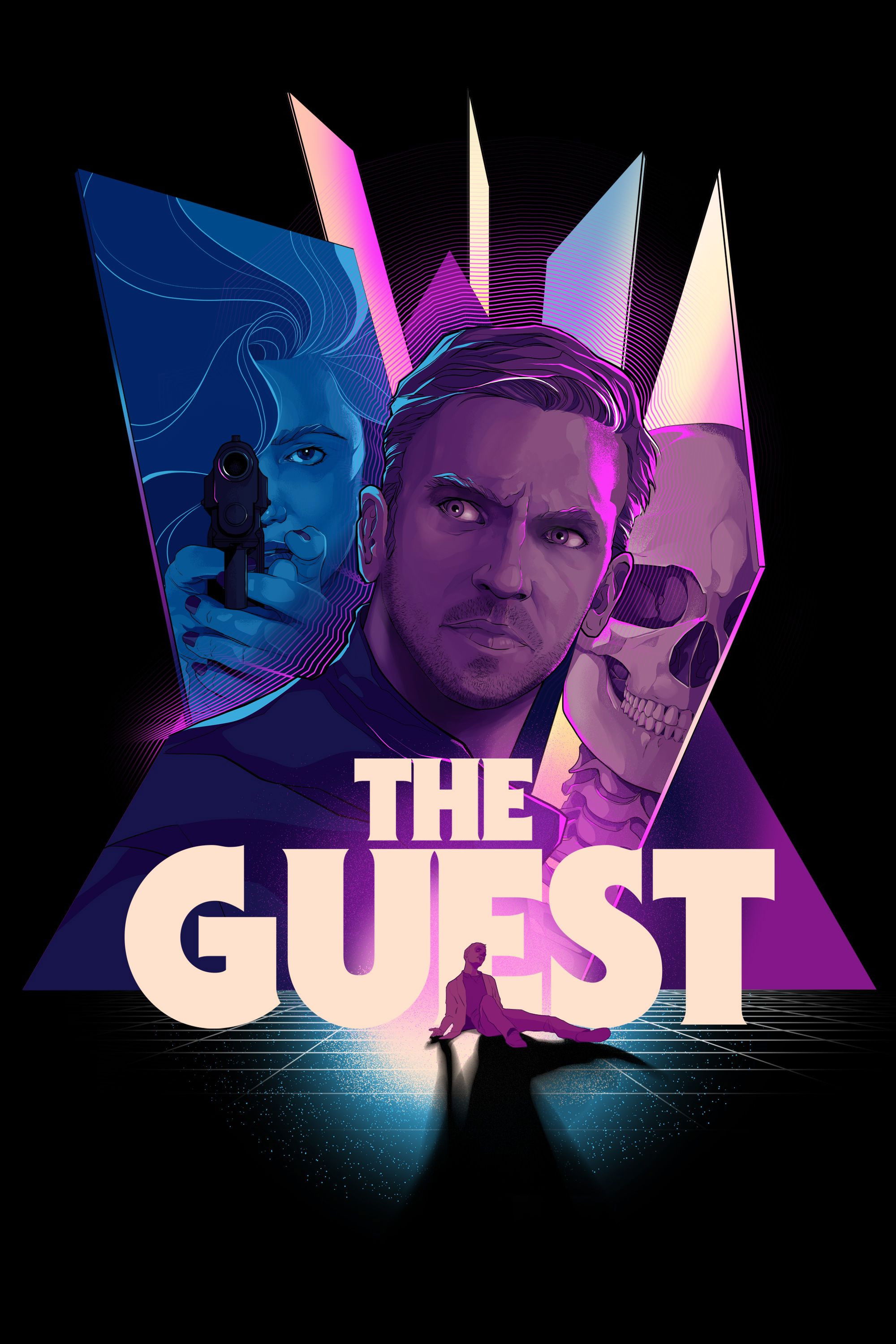

- UK release: September 2014
- Director: Adam Wingard · Writer: Simon Barrett
- Studio / distributor: Snoot Entertainment, HanWay Films; Icon (UK)
- Genre: Action thriller / suspense · Runtime: 100 minutes (BBFC 15)
- Main cast: Dan Stevens (Downton Abbey, The Fifth Estate) as David Collins; Maika Monroe (Labor Day) as Anna Peterson; Brendan Meyer as Luke Peterson; Lance Reddick (The Wire) as Major Carver; Leland Orser (Se7en, Taken) as Spencer Peterson
- IMDb: 6.7 / 10 · Rotten Tomatoes: 91% critics / 69% audience · My rating: 8 / 10
Adam Wingard and Simon Barrett spent the last few years carving out a reputation in low-budget horror, with You’re Next the calling card that got them noticed. The Guest is the pair stepping sideways out of the haunted house and into something leaner and stranger: a thriller built on the architecture of an eighties B-movie, scored like a John Carpenter picture, and anchored by a piece of casting that nobody saw coming. Dan Stevens, until very recently the well-mannered heir of Downton Abbey, turns up here as the most unsettling house guest in years.
The setup
A young man called David (Dan Stevens) arrives at the Peterson family home, all blue eyes and southern courtesy, explaining that he served alongside their son Caleb, killed in action, and promised to look in on them. The grieving parents take him in. He is helpful, charming, and good with the kids: he sorts out a problem for the bullied younger son Luke, charms the mother, and earns the trust of nearly everyone. Only the daughter, Anna (Maika Monroe), keeps a wary eye on him. The film holds its nerve and lets the politeness curdle slowly, until the question stops being whether David is exactly who he says he is and becomes what he intends to do about the people who start asking.
The cast
The film lives or dies on its lead, and Stevens is the reason it lives. He plays David as a smiling surface with something cold idling underneath, switching from warmth to violence without ever raising his voice, and the casting joke pays off in full: an actor we associate with drawing-room decency turning out to be the most dangerous thing in the room. Maika Monroe gives Anna the right mix of suspicion and resourcefulness, a final-girl figure with a brain rather than a scream, and Brendan Meyer makes Luke’s hero worship of David genuinely uncomfortable. Lance Reddick brings his usual clipped authority to the man chasing David down, and Leland Orser and Sheila Kelley sell the parents’ willingness to believe a comforting lie. Nobody is overacting. The film trusts the situation to do the work.
The craft
Wingard directs with real control of tone, sliding between deadpan comedy, dread and sudden bursts of action without the gears grinding. Robby Baumgartner’s photography leans into neon reds and blues and the autumnal Halloween palette, and the production design pushes the whole thing into a slightly heightened, retro-American register. The standout craft element is Steve Moore’s score, a pulsing analogue synth soundtrack that does as much as any scene to set the mood, alongside a sharply chosen selection of darkwave and post-punk tracks. The action, when it arrives, is clean and brutal, building to a final-act set piece in a school’s Halloween maze that turns strobing light and fog into a genuine playground for the camera. At a hundred minutes the film never sags.
How it stacks up
The reference points are worn openly and well. There is a lot of The Terminator in David, an unstoppable, blank-faced thing in human shape walking through a small American town, and a lot of Carpenter’s Halloween in the suburban autumn setting and the relentlessness. The synth score and the cool, glassy style owe an obvious debt to Drive, though The Guest is funnier and pulpier than Refn’s film, less interested in art and more in delivering a good time. Where it differs from the run of modern thrillers is its refusal to take itself too seriously; it is a homage that has the confidence to crack a smile while it tightens the screws.
Critics versus the rest of us
Critics have taken to it warmly, sitting around 91%, with most of the praise landing on Stevens and on the film’s stylish, knowing command of its genre. Audiences are cooler, closer to 69%, and the split is easy to read: a film this tonally slippery, that asks you to laugh and flinch in the same scene and keeps its central mystery deliberately vague, is not built to please everyone who wandered in expecting a straight thriller. If you want every motivation explained, the back half will frustrate you. If you are happy to ride the style and the menace, it delivers.
Verdict
This is exactly the kind of film I enjoy more than its modest profile suggests I should. It is tight, atmospheric, very well cast, and built on a foundation of genre love that never tips into empty pastiche, and the Steve Moore score alone makes it worth a second visit. Stevens gives a star-making turn that recalibrates everything you thought you knew about him. It is not aiming for profundity and does not pretend to; it wants to be lean, stylish and rewatchable, and on all three counts it succeeds. A small film that punches well above its weight. 8⁄10.
Availability: In selected UK cinemas now, with a DVD and Blu-ray release to follow before the end of the year.
Update
Added since this review first appeared: The Guest has settled into a firm cult favourite, the kind of title that turns up on best-of-the-decade genre lists and gets revived for Halloween-season repertory screenings. It proved a springboard for everyone involved. Maika Monroe went straight on to It Follows, cementing her as a modern scream-queen, while Dan Stevens used it as the start of a deliberate run away from period drama. Adam Wingard and Simon Barrett went on to bigger studio work. Steve Moore’s synth score has had its own afterlife on vinyl among soundtrack collectors. It streams on the usual platforms depending on region and is well worth tracking down on Blu-ray for the sound alone.
BBFC content advice
Rated 15 by the BBFC for strong bloody violence, strong language, drug use, sexualised nudity. The notes below may contain spoilers.
Violence: Strong bloody violence includes a number of shootings and several knife attacks, including people stabbed in the chest and lying in pools of blood.
Language: Frequent strong language, including ‘fk’ and ‘motherfker’.
Drugs: Several scenes of cannabis use, smoked from a pipe and in joint form.
Nudity: Sexualised breast nudity in a scene in which a couple lie on a bed, kissing.
Source: British Board of Film Classification (bbfc.co.uk).