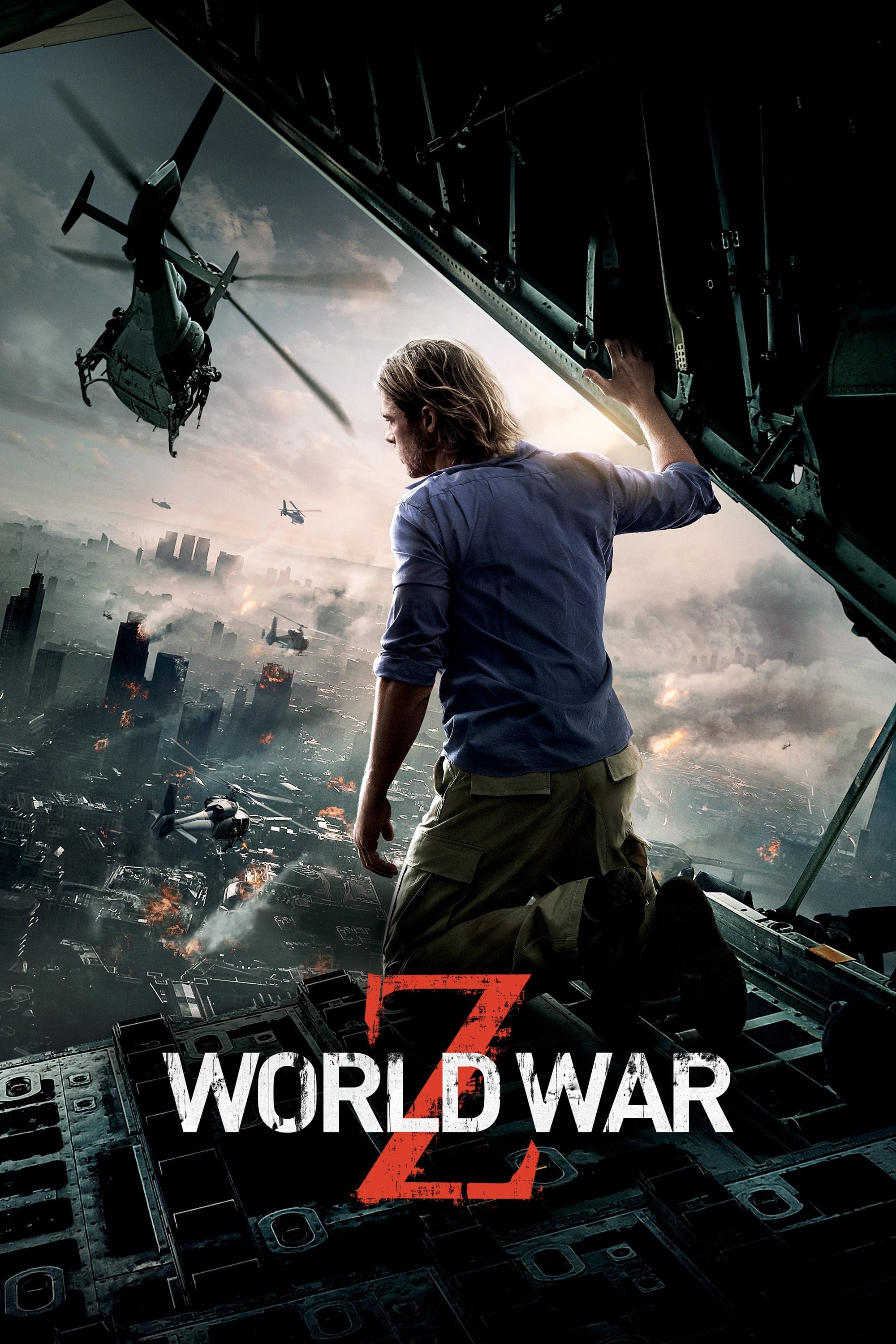
- UK release: June 2013
- Director: Marc Forster · Writers: Matthew Michael Carnahan, Drew Goddard, Damon Lindelof
- Studio / distributor: Paramount Pictures; Skydance; Plan B
- Genre: Pandemic action thriller / zombie disaster · Runtime: 116 minutes (BBFC 15)
- Main cast: Brad Pitt (Fight Club, Se7en) as Gerry Lane; Mireille Enos (Gangster Squad) as Karin Lane; Daniella Kertesz as Segen; David Morse (The Green Mile, 12 Monkeys) as the ex-CIA agent
- IMDb: 7.0 / 10 · Rotten Tomatoes: 66% critics / 72% audience · My rating: 8 / 10
By the time World War Z reaches a UK screen, its reputation has arrived ahead of it, and not the good kind. A reported $200m budget, an entire third act torn up and reshot, a writers’ room shuffled through Matthew Michael Carnahan, then Drew Goddard and Damon Lindelof, the kind of production gossip that usually announces a corpse on the slab. Max Brooks’s source novel, a faux oral history that interviewed survivors of a war already won, was about the worst possible book to turn into a single-hero summer tentpole. So the surprise is not that the film is compromised. The surprise is how well the wreckage runs.
The setup
Gerry Lane (Brad Pitt), a former United Nations investigator who has hung up the dangerous work for school runs and pancakes, is stuck in Philadelphia traffic with his family when the city comes apart around them. The infection moves in seconds: a bite, a count of ten or twelve, and the victim is up and sprinting at the next warm body. With his wife and daughters owed a berth on a navy carrier offshore, Gerry is pulled back into service and sent chasing the outbreak across the globe, from a fortified Jerusalem to a quiet research facility, hunting for where the thing began and the weakness that might stop it. It is a procedural laid over a panic, a man trying to think while everything tells him to run.
The cast
This is Pitt’s film to carry, and he carries it by underplaying. Gerry is competent rather than heroic, a watcher who reads a room and a horizon, and Pitt gives him a husband’s tiredness rather than an action star’s swagger. It is a smart calibration for a film with no time for character arcs. Mireille Enos, all coiled worry as Karin, anchors the family stakes from the far end of a satellite phone, and the device of that fragile connection does more emotional work than the script has any right to expect. Daniella Kertesz is a real find as Segen, an Israeli soldier who becomes Gerry’s near-silent partner in the back half, and David Morse turns one unsettling scene as a caged ex-CIA man into the film’s creepiest few minutes. Nobody is asked to do much beyond survive, and everyone does exactly enough.
The craft
Marc Forster is an odd hire for this, a director best known for Monster’s Ball and Finding Neverland whose one big action credit, Quantum of Solace, was knocked for incoherent cutting. Here the scale suits him better. The set pieces are built around mass rather than gore: the dead pour like liquid, climbing over one another into a living ramp, and the famous shot of them cresting the Jerusalem wall in a chittering wave is the most genuinely frightening image a blockbuster has produced in a while. Ben Seresin shoots it cool and grey, Marco Beltrami’s score works the dread, and the editing keeps the geography legible even when the screen is a churning mob. Crucially, the picture knows when to go quiet. The final stretch shrinks from continents to corridors, a tense crawl through a near-silent lab, and the restraint plays better than another city falling would have.
How it stacks up
Place it among its neighbours and the shape comes clear. It has the cool institutional dread of Contagion, the same interest in protocol and the people trying to hold a system together, without that film’s discipline. It owes its sprinting infected to 28 Days Later, which rewrote the rules a decade ago and made the slow shambler look quaint, though Boyle’s film was angrier and more intimate. And it sits across from I Am Legend as the other big-studio attempt to make the apocalypse a star vehicle, trading that film’s lonely melancholy for restless globe-trotting. What it discards is the book entirely, the geopolitics, the polyphony, the bleak of a world remade. Brooks fans have every right to feel robbed. As a thriller cut loose from its source, it moves.
Critics versus the rest of us
The critics have landed around two thirds positive, and the consensus reads roughly as mine does: a troubled production that came out leaner and more effective than anyone dared predict, stronger as propulsive cinema than as adaptation. Audiences are a notch warmer, which fits a film engineered to keep a Friday-night crowd’s pulse up. The recurring complaint, that the PG-friendly bloodlessness drains the menace, I find overstated. The threat here is being overrun, not dismembered, and the film is scarier for keeping its camera on the swarm rather than the wounds.
Verdict
I came to this expecting a salvage job and got a properly tense disaster picture instead. It is not the book and it is not deep, the characters are thin and the seams of the reshoot show if you look, but it is paced like a sprint, frightening in the right places, and built around a couple of images I will not forget in a hurry. It earns its rewatch on momentum and craft, which is more than most of its budget-bracket rivals manage. Better than its backstage horror stories promised, and better than its scores suggest. 8⁄10.
Availability: On general release in UK cinemas now, including 3D and IMAX screens.
Update
Added since this review first appeared: the sequel that the open ending so plainly teed up never arrived. A follow-up spent years in development with David Fincher attached to direct Pitt, and was cancelled in 2019, leaving this a one-off despite its franchise ambitions. The wave-of-zombies premise found its definitive small-screen answer in The Last of Us (2023), which had the room for the human texture this film had to cut. World War Z has settled into its reputation as the better-than-it-should-be entry in the modern outbreak cycle, and the unrated cut, which restores some of the gore the cinema version held back, is the one to seek out. It streams on Paramount+ and is widely available on disc and digital.
BBFC content advice
Rated 15 by the BBFC for sustained threat, strong violence. The notes below may contain spoilers.
Violence: Most of the violence takes place off-screen and the film contains very little blood. However, some scenes leave a strong impression, including one in which the main character hacks a female soldier’s hand off in order to stop the zombie disease spreading through her body.
Threat and horror: There is sustained threat throughout, with swathes of fast-moving zombies attacking from the very beginning. Zombies fly at humans and attack, almost immediately transforming those bitten into fellow zombies, with some close-ups on their glassy eyes and on black veins spreading across their faces.
Language: There is some moderate bad language, including uses of ‘bitch’ and ‘prick’.
Source: British Board of Film Classification (bbfc.co.uk).