
- UK release: October 2024
- Director: Chris Sanders · Writer: Chris Sanders (from the novel by Peter Brown)
- Studio / distributor: DreamWorks Animation; Universal Pictures
- Genre: Animated science fiction adventure / family drama · Runtime: 102 minutes (BBFC U)
- Main cast: Lupita Nyong’o (12 Years a Slave, Black Panther) as Roz; Pedro Pascal (The Mandalorian) as Fink; Kit Connor (Rocketman) as Brightbill; Catherine O’Hara (Beetlejuice, Home Alone) as Pinktail
- IMDb: 8.2 / 10 · Rotten Tomatoes: 97% critics / 98% audience · My rating: 8 / 10
Chris Sanders has spent two decades making animated films about the bond between a wild creature and someone who was never meant to care for it. He co-directed Lilo & Stitch, where the wild creature was an escaped alien weapon, and How to Train Your Dragon, where it had wings. The Wild Robot runs the same current the other way round: this time the wild island is the given, and the thing that has to learn to belong is the machine. DreamWorks has bet a lot on it, including a deliberate, painterly look that walks away from the studio’s usual glossy house style, and the bet comes off.
The setup
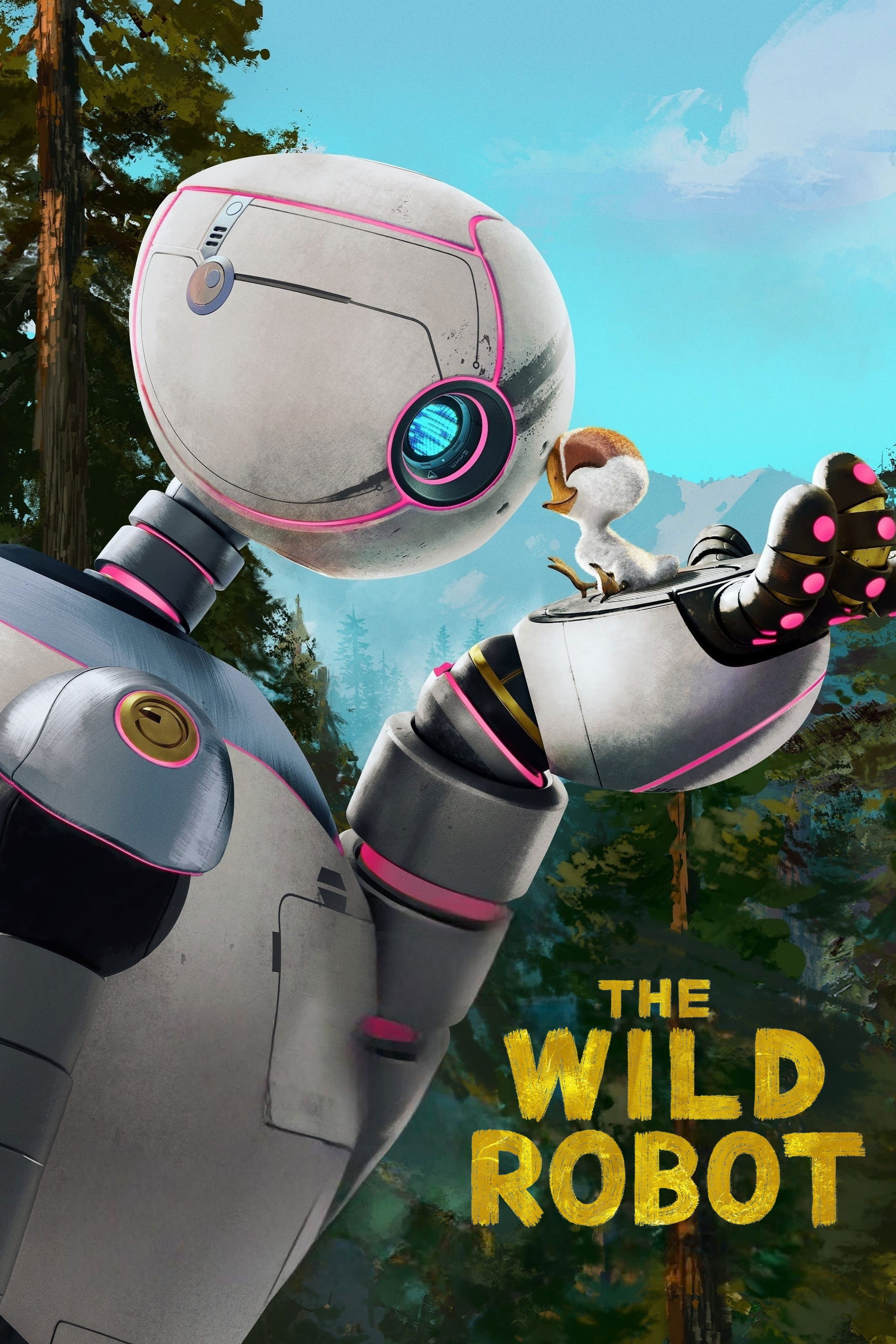
A cargo ship goes down in a storm and washes a single service unit, model ROZZUM 7134, onto the shore of an uninhabited island. Roz (Lupita Nyong’o) wakes up programmed to complete tasks for human owners who are not there, and finds herself surrounded by animals who treat her, reasonably enough, as a monster. Trying to make sense of a place with no instructions, she ends up responsible for an orphaned gosling, Brightbill, and sets herself the task of raising him: feed him, teach him to swim, teach him to fly, all before the flock leaves for winter. A wily fox, Fink (Pedro Pascal), attaches himself to the project, half scavenger and half reluctant uncle. The deadline is the migration, and the question underneath it is whether a robot built to serve can learn to love something and then let it go.
The cast
Voice work in animation usually gets praised for the wrong things, but the casting here is genuinely doing the heavy lifting. Nyong’o starts Roz as flat synthesised customer-service politeness and lets warmth seep in by degrees, so that you can hear the programming loosening rather than snapping. It is a controlled, intelligent performance that never begs for sympathy. Pascal gives Fink a quick, self-deprecating patter that keeps the film from drowning in its own sincerity, and the double act between cautious machine and chancer fox carries the middle stretch. Kit Connor makes Brightbill the runt of the flock, prickly and unsure, and Catherine O’Hara brings her usual warm comic timing to a harassed opossum mother with a burrow full of children. The ensemble of island animals is deep enough that the world feels populated rather than decorated.
The craft
This is the best-looking film DreamWorks has put out. The studio has talked about wanting the frames to feel hand-painted, like a Monet you could walk into, and the result is soft-edged, impressionistic forests and skies that hold real light. It is a deliberate retreat from photoreal fur and toward something more illustrated, and it pays off in atmosphere: the seasons turn, the weather has weight, and a winter storm sequence has genuine scale and threat for a U certificate. Kris Bowers’s score does a lot of quiet work, swelling at the flying scenes without tipping into syrup. Sanders keeps the pacing brisk for a film this emotional, trusting images over explanation, and at 102 minutes it never sags. The science fiction stays light but coherent: Roz’s logic, her task-completion drive, the way her programming bends rather than breaks, all hang together.
How it stacks up
The obvious anchor is WALL-E, another near-silent service robot who develops an inner life in a world humans have left behind, and The Wild Robot shares its faith that a machine learning to feel can carry a whole film. The nature-survival texture and the parent-and-fledgling structure recall The Iron Giant, still the high-water mark for the gentle-machine story, and the wildlife-among-the-trees warmth has something of Sanders’s own How to Train Your Dragon. Against those it holds its own. It is not quite as formally daring as WALL-E’s wordless first act, and it reaches for the tear ducts more openly than The Iron Giant does, but it has a confidence and a visual identity that put it clearly above most of what passes for family animation now.
Critics versus the rest of us
The reception is close to unanimous, which is rare. Critics are sitting around 97%, audiences a hair higher at 98%, and IMDb users are giving it 8.2, the sort of agreement that usually means a film has cleared the bar without dividing anyone. The praise is for the look, the emotion and the way it handles big ideas about belonging and letting go without talking down to children. I am with the consensus on most of it, with one small reservation: the film occasionally signposts its emotional beats a touch too firmly, and the final act tidies its conflicts a little faster than they were earned. That stops it short of the very top tier, but only just.
Verdict
This is a confident, beautiful, properly moving film that knows exactly what it is doing and does it with taste. The voice work is excellent, the world has atmosphere and weather and weight, and the central idea of a machine learning care is the kind of intelligent, gentle science fiction I will always turn out for. It earns its tears honestly rather than manufacturing them, and it is one of the few recent animations I would happily sit through again. A shade more restraint at the close and it would be a 9. As it stands it is a clear, warm recommendation. 8⁄10.
Availability: On general release in UK cinemas now, including IMAX. Worth the big screen for the painterly landscapes and the migration sequences.
Update
Added since this review first appeared: the film went on to be one of the most acclaimed animations of its year and was widely treated as DreamWorks’s strongest work in some time, with a sequel adapting the later books in Peter Brown’s trilogy confirmed to follow. It is now available to rent and buy digitally and on disc, and streams on Sky and NOW in the UK, with the high-resolution home release showing off the hand-painted look well on a good screen.
BBFC content advice
Rated U by the BBFC for very mild threat, violence, language, rude humour. The notes below may contain spoilers.
Violence: Animals and robots battle, including use of laser guns and explosions.
Threat and horror: Scenes of threat include robots and animals falling from heights, being chased, evading fires, and battling the natural world, such as predatory animals, storms and winter weather. In some scenes characters are shot at with laser guns and a robot is threatened with having its memory wiped.
Language: There is use of very mild bad language (‘jerk’, ‘butt’).
Rude humour: A skunk emits green gas, and a beaver refers to ‘excrement’ when implying a rude term.
Injury detail: A robot leaks green fluid when its leg is injured.
Theme: A goose is bullied for being different to other geese, and a robot and fox struggle to be accepted by other animals. Characters say moving goodbyes and at points fear their loved ones have died. However, the film focuses on love and friendship, and there are reassuring outcomes.
Flashing/flickering lights: This work contains flashing images which may affect viewers who are susceptible to photosensitive epilepsy.
Source: British Board of Film Classification (bbfc.co.uk).