
- UK release: July 2017
- Director: Matt Reeves · Writers: Mark Bomback, Matt Reeves
- Studio / distributor: 20th Century Fox; Chernin Entertainment
- Genre: Science fiction war drama / franchise epic · Runtime: 140 minutes (BBFC 12A)
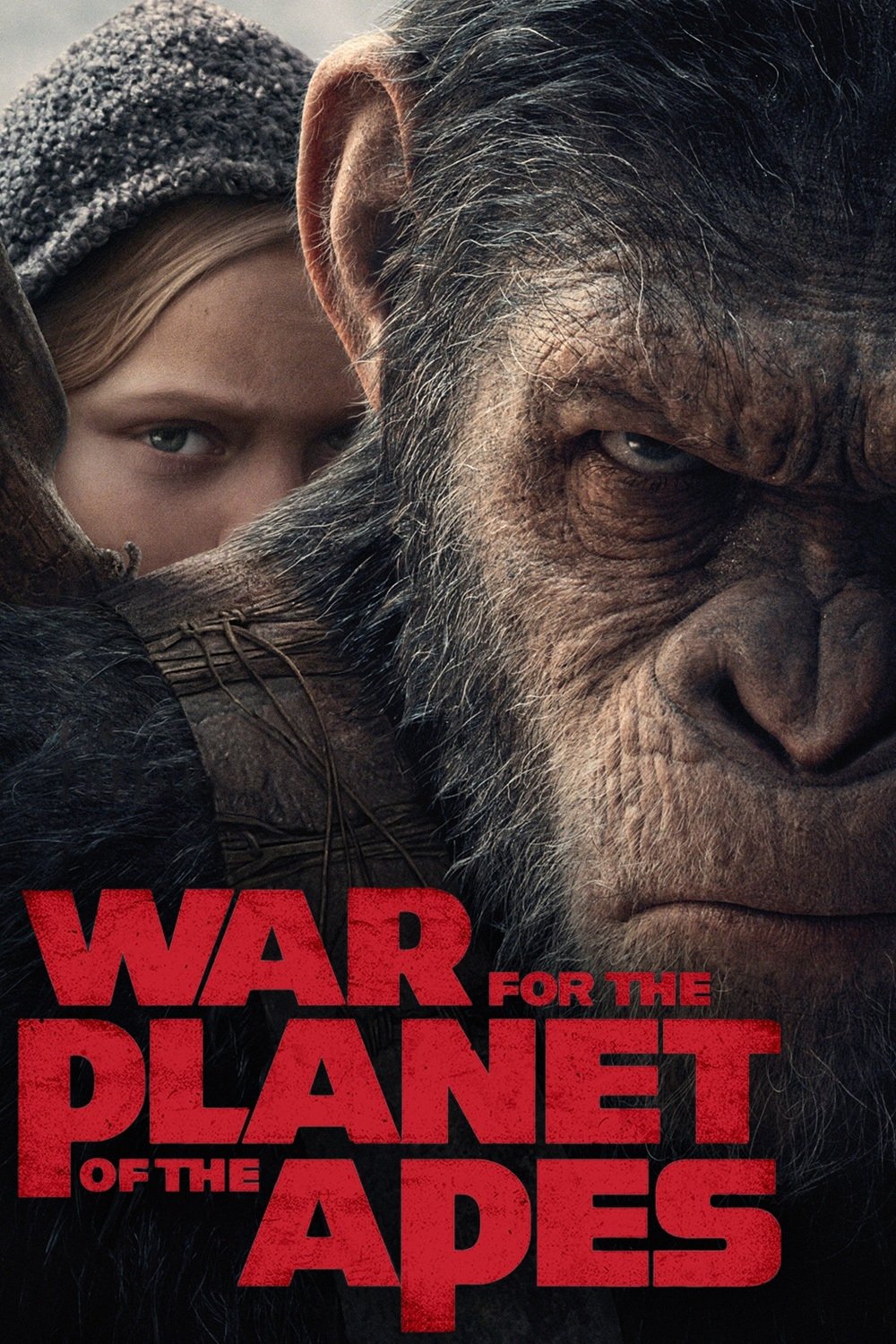
- Main cast: Andy Serkis (The Lord of the Rings, King Kong) as Caesar; Woody Harrelson (Natural Born Killers, No Country for Old Men) as the Colonel; Karin Konoval (Rise of the Planet of the Apes, Dawn of the Planet of the Apes) as Maurice; Steve Zahn (Out of Sight) as Bad Ape
- IMDb: 7.4 / 10 · Rotten Tomatoes: 94% critics / 84% audience · My rating: 8 / 10
Two films ago, the idea of a Planet of the Apes prequel built around a motion-captured chimpanzee sounded like the kind of thing a studio greenlights when it has run out of other ideas. Rise turned out to be sharper than anyone expected, and Dawn was better still, a sober study of how a fragile peace breaks. So Matt Reeves arrives at the third film with something rare in a blockbuster trilogy: trust. The surprise of War is how little it behaves like the climax the title promises. The big set-piece battles are mostly behind us. What Reeves wants is something slower, sadder and more deliberate, and for the most part he gets it.
The setup
Years into the war between apes and the human survivors of the Simian Flu, Caesar (Andy Serkis) wants only to lead his people somewhere safe and be left alone. A military faction led by a ruthless officer known as the Colonel (Woody Harrelson) will not allow it. When the war reaches Caesar personally, in the worst way it could, the leader who has spent two films resisting his own worst instincts sets off after the man responsible, and the film turns from a war story into a tighter, colder one about grief and the cost of revenge.
That journey takes Caesar and a small band of companions across a frozen landscape towards the Colonel’s mountain stronghold, where the human war effort has curdled into something uglier than survival. To say much more is to spoil the back half, but the shape of the thing should be clear: this is an exodus film with a wronged leader at its centre, more Apocalypse Now and The Great Escape than monkeys-with-machine-guns.
The cast
Andy Serkis has been carrying these films through performance capture since Rise, and War is where the gamble pays off completely. Caesar barely speaks, mostly signs, and yet there is a whole interior life on that digital face: weariness, rage held on a leash, the moment the leash slips. It is a real lead performance, and the technology has finally caught up enough to disappear behind it. If a digital character can hold a film of this weight on grief alone, the argument about whether this counts as acting is settled.
Woody Harrelson gives the Colonel a clipped, shaven-headed menace that nods openly at Brando in Apocalypse Now, a true believer who has talked himself into atrocity. It is a big performance that mostly stays the right side of pantomime. Around them, Karin Konoval’s orangutan Maurice is the soul of the ape community, gentle and grave, while Steve Zahn’s Bad Ape, a twitchy zoo escapee, supplies the only real comic relief and lands more of it than you would expect. The mute human girl the apes take in gives the bleakness somewhere soft to rest.
The craft
Reeves directs this with the confidence of a man who knows exactly how serious he is allowed to be. Michael Seresin’s photography turns snow and forest and fortress into something close to a Western, all clean horizons and small figures against vast cold. Michael Giacchino’s score is mournful and restrained, leaning on the action far less than the trilogy’s reputation might suggest. And the visual effects work from Weta is the best the series has produced: fur, breath in cold air, the play of feeling across an ape’s eyes, all of it photoreal enough that you stop clocking it as effects and simply watch the characters. The pacing is deliberate, sometimes very deliberate, and the middle section in the prison camp tests your patience before it pays off. This is a 140-minute film that feels every minute of its length, by design rather than by accident.
How it stacks up
Against its own trilogy, War is the most ambitious and the least fun. Dawn had a propulsive tragedy to it, a peace you could feel slipping; War trades momentum for mood, and asks more of the viewer in return. The franchise reference points it reaches for are bold: the camp sequences borrow from prison-break and prisoner-of-war cinema, the Colonel’s compound from Apocalypse Now, the larger arc from biblical exodus, with Caesar as a Moses who will glimpse the promised land more than he will walk in it. That it carries those comparisons without collapsing under them is the measure of how far this odd little series has come.
Critics versus the rest of us
Critics are close to rapturous, sitting around 94%, praising Serkis, Reeves’s seriousness, and the effects work, several of them calling it the best of the three. Audiences are warmer than for most blockbusters but a notch cooler at 84%, and the gap tells you something true. This is a summer tentpole that does not especially want to entertain you in the summer-tentpole way. The marketing sells a war; the film delivers a wake. Some of that audience went in for spectacle and came out having sat through a two-hour meditation on grief and atonement, and not everyone signed up for that. I am closer to the critics here, with one reservation that keeps me off the top mark.
Verdict
This is a genuinely impressive piece of work: the rare blockbuster trilogy that ends on its most serious and most accomplished note, anchored by a digital performance that quietly rewrites what the technology can do. The craft is faultless and the ambition is real. What holds my number at eight rather than nine is rewatchability. War is admirable, often moving, and heavy enough that I am in no hurry to live through it again, where I would happily revisit Dawn tomorrow. Judged as the sombre finale it sets out to be, it succeeds almost completely, and it has earned the seriousness it asks for. 8⁄10.
Availability: On general release in UK cinemas now, in 2D and IMAX. The biggest screen you can find does the snowbound vistas and the close work on Caesar’s face justice.
Update
Added since this review first appeared: this proved the closing chapter of Reeves’s reboot trilogy, and the franchise eventually returned without him in a later, separate continuation set generations on. Caesar’s arc has settled into its reputation as the high point of modern blockbuster performance capture, and Serkis’s work here is routinely cited as the case study. The film is widely available on disc and digital, and streams on Disney+ depending on region.
BBFC content advice
Rated 12A by the BBFC for moderate violence, injury detail. The notes below may contain spoilers.
Violence: There are scenes of moderate violence in which evolved apes fight against humans and other apes, inflicting injuries using various weapons including guns and crossbows. In one scene, an ape is whipped, sustaining bloody lacerations on his back.
Injury detail: An ape finds the bloody remains of his family after they have been the victims of a massacre. He later encounters the bodies of other apes that have been tortured.
Threat and horror: As well as the intensity of the action scenes, there are threatening scenes, including sight of apes being enslaved and threatened with torture and starvation.
Language: There is use of very mild bad language, including ‘Jesus’, ‘God’ and ‘dammit’.
Alcohol and smoking: A character drinks from a flask and appears to be drunk.
Source: British Board of Film Classification (bbfc.co.uk).