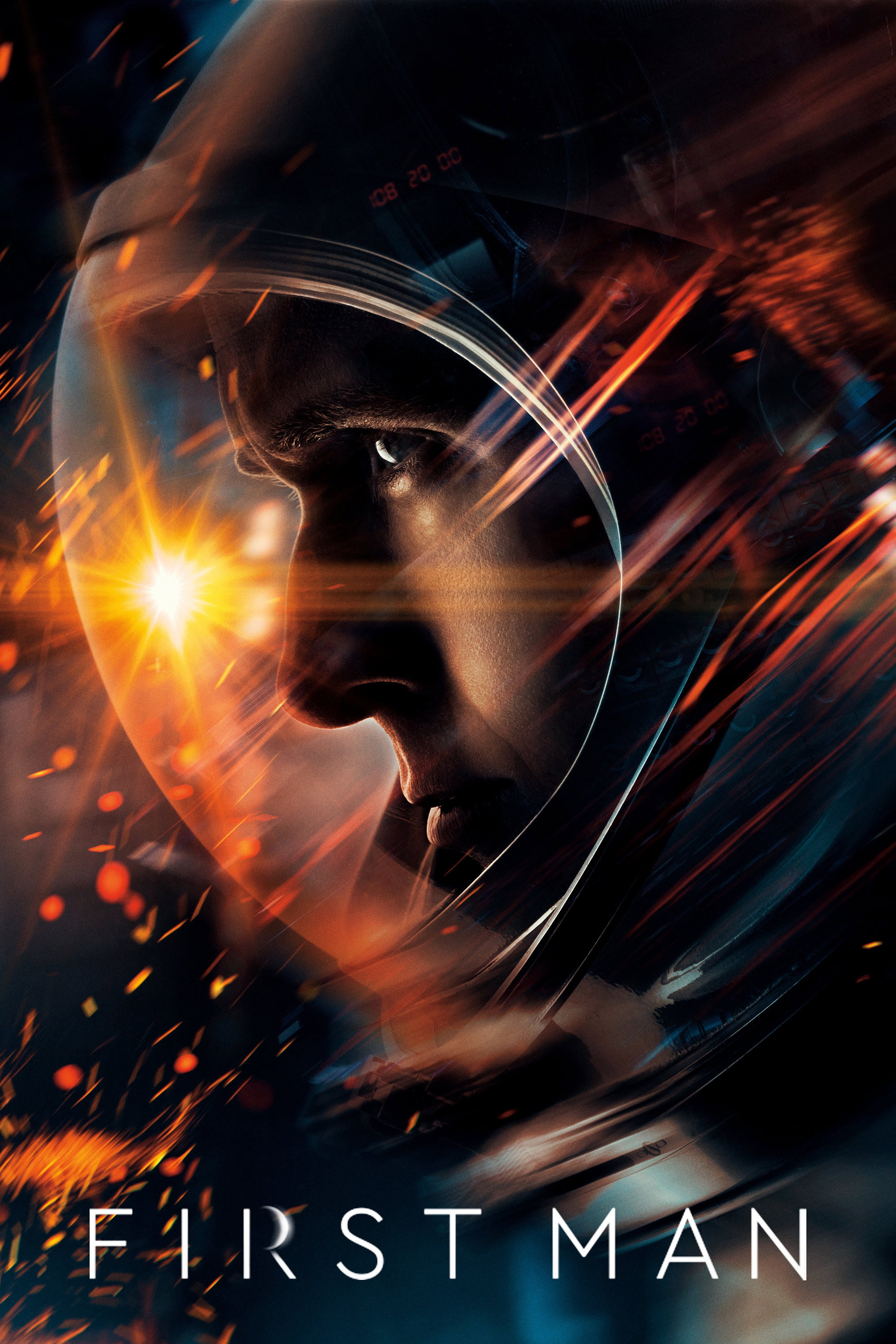

- UK release: October 2018
- Director: Damien Chazelle · Writer: Josh Singer
- Studio / distributor: Universal Pictures; DreamWorks Pictures; Temple Hill Entertainment
- Genre: Biographical space drama / historical drama · Runtime: 141 minutes (BBFC 12A)
- Main cast: Ryan Gosling (Drive, La La Land) as Neil Armstrong; Claire Foy (The Crown) as Janet Armstrong; Jason Clarke (Zero Dark Thirty) as Ed White; Kyle Chandler (Argo) as Deke Slayton
- IMDb: 7.3 / 10 · Rotten Tomatoes: 86% critics / 67% audience · My rating: 8 / 10
Damien Chazelle has spent two films watching people pour themselves into one obsession until something gives. The young drummer in Whiplash bleeds onto his kit; the couple in La La Land trade love for the careers they cannot stop chasing. First Man takes that same fixation and straps it to the Apollo programme, and the surprise is how little it wants to be a Moon film. Reuniting with Ryan Gosling, his La La Land lead, Chazelle has made the least triumphant space picture imaginable, and done it on purpose. This is the missions told from inside the helmet, where the view is mostly rivets, condensation and noise.
The setup
The film picks up Neil Armstrong as a test pilot in the early sixties, grounded as much by private loss as by gravity, and follows him through Gemini and into Apollo. The structure is a procession of flights, each one a small sealed crisis: an X-15 skipping off the atmosphere, a Gemini capsule spinning out of control, a launchpad that turns lethal. Around the cockpit sequences sits the quieter and harder material, the toll the programme takes on the families left in the Houston suburbs, counting their dead and waiting by the squawk box. The Moon is the destination, but the film treats it as the last in a long line of things that might kill him.
The cast
Gosling plays Armstrong as a closed door, and it is a deliberate, slightly risky choice. He gives you a man who has decided that feeling things out loud is a luxury he cannot afford, and lets the grief leak out only at the edges, in a jaw set too tight or a silence held a beat too long. It will frustrate viewers who want a hero to root for; it is also probably closer to the real engineer’s reticence than a more demonstrative performance would be. Claire Foy is the film’s release valve as Janet Armstrong, and she is excellent, turning the long-suffering astronaut’s wife into someone with a spine, demanding NASA tell her the truth rather than feed her the official calm. Jason Clarke brings warmth as Ed White, and Kyle Chandler does his reliable line in institutional authority as Deke Slayton. The supporting astronauts blur together a little, which is the one place the inwardness costs the film something.
The craft
This is where First Man earns its keep. Linus Sandgren shoots the flight sequences on grainy 16mm, handheld and claustrophobic, so the capsules feel less like spacecraft than like barrels going over a waterfall. You rarely get the clean exterior beauty shot; you get juddering metal, warning lights, and a small window with something terrifying on the other side of it. Justin Hurwitz, fresh from the jazz of La La Land, writes a score built around a theremin, all eerie and weightless, that does a great deal of the film’s emotional work where Gosling withholds. Tom Cross cuts the action tight enough that a docking manoeuvre plays like a thriller. And then the lunar landing arrives in a sudden hush and a shift to large format, the noise dropping away, which is the single most effective thing in the picture.
How it stacks up
The obvious comparison is Apollo 13, and the two could hardly be more different in temperament. Ron Howard’s film is a crowd-pleaser, all problem-solving and ground-control camaraderie; First Man is interested in the cost rather than the rescue. It sits closer to The Right Stuff in its suspicion of the official myth, though where Philip Kaufman found swagger in the early astronaut corps, Chazelle finds mostly attrition and exhaustion. As pure sensation in space it does not match Gravity, and it has none of the cosmic ambition of Interstellar, but neither of those films is trying to do what this one does, which is to make the most famous achievement of the twentieth century feel like a personal act of mourning. On that narrow, difficult brief it succeeds.
Critics versus the rest of us
Critics have responded warmly, around the high eighties, praising the immersion and the restraint. Audiences are notably cooler, in the sixties, and the split is easy to read. Anyone arriving for the patriotic Moon-landing spectacular finds a chilly grief drama that holds the catharsis at arm’s length and never once lets you punch the air. I have some sympathy with both camps. The film is austere to a fault, and there are stretches in the domestic scenes where its self-control tips into remoteness. But the coldness is the design, not a failure of it, and the technique carrying it is exceptional.
Verdict
I admire this more than I love it, which is the honest position with a film this disciplined. The flight sequences are some of the best I have seen, the sound design alone is worth the ticket, and Foy and Gosling give it a real emotional centre once you accept the terms. What keeps it just short of the top tier, for me, is rewatchability: this is a film I am glad to have seen and not one I will reach for on a wet Sunday, because its rewards are bought with two hours of held breath. As a piece of craft and a corrective to the usual triumphalism it is close to first rate. 8⁄10.
Availability: On general release in UK cinemas now. Worth seeing on the largest screen you can, where the launch sequences and the switch to large format on the lunar surface land hardest.
Update
Added since this review first appeared: First Man has settled in as the quiet, respected outlier among modern space films, more admired than rewatched, and the consensus that it was mis-marketed as a flag-waver has hardened. Chazelle went on to the maximalist Babylon (2022), about as far from this film’s restraint as he could travel. It is now widely available on disc and digital, and streams on the major platforms depending on region.
BBFC content advice
Rated 12A by the BBFC for infrequent strong language, moderate threat. The notes below may contain spoilers.
Threat and horror: There are a number of intense test flight sequences in which malfunctioning equipment results in threat to astronauts’ lives.
Language: There is infrequent strong language (‘f**k’). Other uses are ‘shit’, ‘hell’, ‘screw’, ‘damn’, ‘Jesus’, ‘Christ’.
Additional issues: There is mild injury detail when an astronaut has blood on the side of his face following a crash landing. There are also scenes of emotional upset when a family lose a young child to Leukaemia.
Source: British Board of Film Classification (bbfc.co.uk).