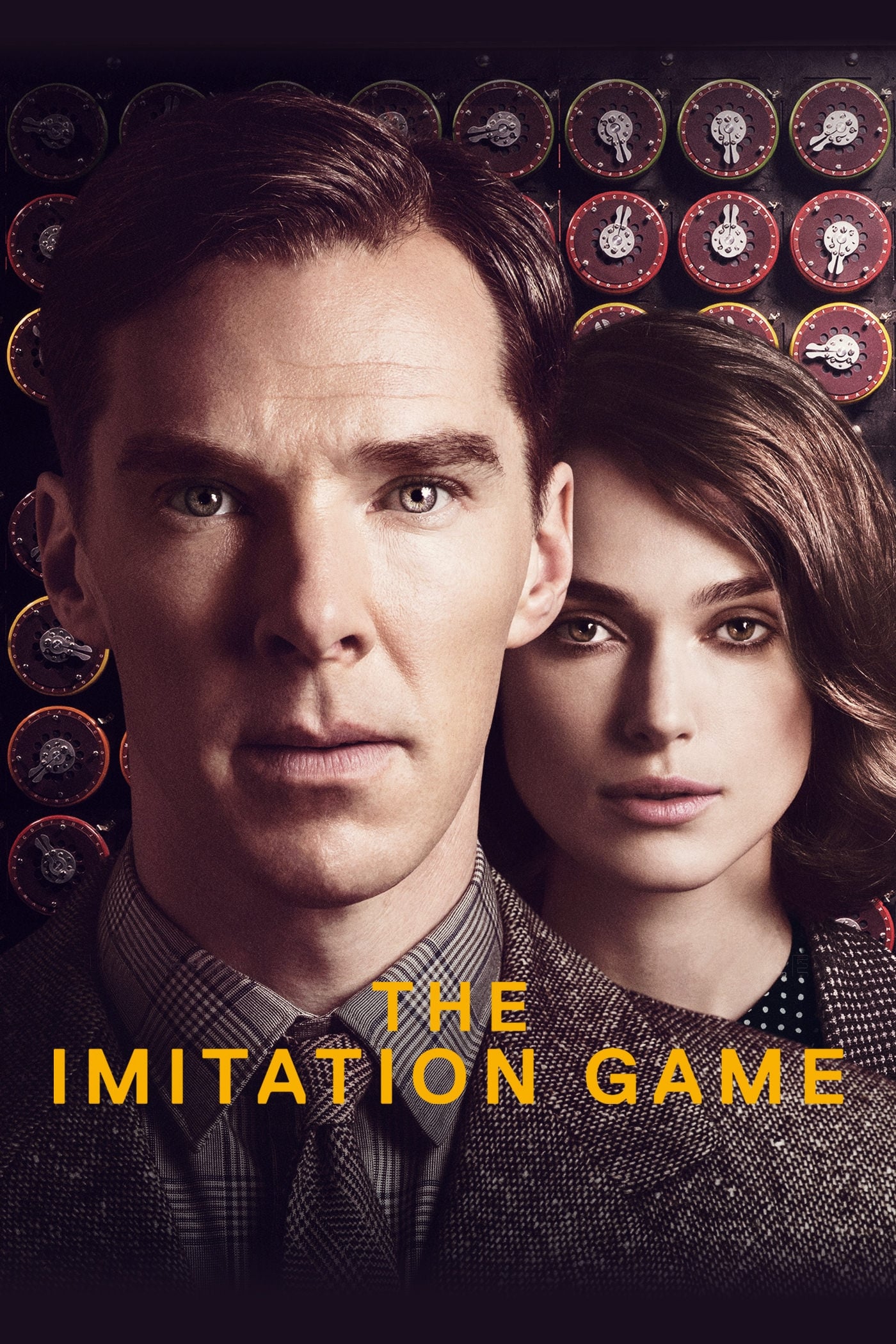

- UK release: November 2014
- Director: Morten Tyldum · Writer: Graham Moore
- Studio / distributor: Black Bear Pictures; StudioCanal
- Genre: Wartime biographical drama / codebreaking thriller · Runtime: 114 minutes (BBFC 15)
- Main cast: Benedict Cumberbatch (Sherlock, Tinker Tailor Soldier Spy) as Alan Turing; Keira Knightley (Atonement, Pride and Prejudice) as Joan Clarke; Matthew Goode (A Single Man, Watchmen) as Hugh Alexander; Mark Strong (Tinker Tailor Soldier Spy, Kick-Ass) as Stewart Menzies
- Rotten Tomatoes: 89% critics / 91% audience · My rating: 8.5 / 10
The Second World War codebreaking story has been told before, most recently by Michael Apted’s Enigma in 2001, which fictionalised the people while keeping the machines. The Imitation Game does roughly the opposite. It keeps the real name, Alan Turing, the man whose work at Bletchley Park helped shorten the war and who was then prosecuted by the country he served, and it bends the events around him into the shape of a more conventional film. Whether that trade is worth it is the question I kept turning over, and the answer is mostly yes, because the film is so well made that you forgive a good deal of the smoothing.
The setup
In 1939 Turing arrives at Bletchley Park, the country house where Britain’s brightest are quietly trying to read German military traffic. The Enigma cipher resets every midnight, leaving a few hours to crack a code with more settings than there are atoms in the observable universe. Turing’s answer is not to break each message by hand but to build a machine to do it, an idea his colleagues resist and his superiors barely tolerate. Around this runs a second thread, set years later, in which a routine police investigation pulls at the secret Turing has spent his life keeping. The film moves between the war room, a schoolboy past, and that bleaker afterward, and it trusts you to hold all three.
The cast
This is Benedict Cumberbatch’s film, and he is very good in it. He has played brilliant and difficult before, on television as Sherlock and on film in Tinker Tailor Soldier Spy, and there is some overlap here in the clipped, socially blind genius. What he adds is hurt: a man who has learned that being right is no protection, who flinches under ordinary cruelty he cannot decode. Keira Knightley’s Joan Clarke is the warmth the script needs, sharp enough to match him and generous enough to see what he is, and the scenes between them are the film’s most human. Matthew Goode brings an easy charm to the rivalrous Hugh Alexander, and Mark Strong, doing the watchful spymaster he does so well, lends Stewart Menzies a quiet menace. Charles Dance turns up as the commander who wants the project shut down, and enjoys himself doing it.
The craft
Morten Tyldum, whose Norwegian thriller Headhunters showed he can keep a plot moving, directs with real discipline. Óscar Faura’s cinematography gives Bletchley a handsome wartime glow, all wood panelling and lamplight, and the machine itself, a wall of spinning drums and clattering relays, is shot with the reverence other films give a cathedral. Alexandre Desplat’s score is the kind I will happily listen to away from the picture: insistent, ticking, threaded with a sense of time running out. William Goldenberg’s editing keeps the three timelines legible without ever stalling. It is a film engineered for momentum, and at 114 minutes it does not waste a scene.
How it stacks up
The obvious comparison is A Beautiful Mind, another handsome biopic that turned a difficult mathematician into a more film-friendly hero and won prizes for it. The Imitation Game shares its strengths and its instincts, the warm gloss, the lone genius against the doubters, the late emotional swell. Enigma is the closer subject match and the more honest about the grind of cryptanalysis, but it is the duller watch. Where this film really sits, though, is alongside Tinker Tailor Soldier Spy: the same muted English palette, several of the same faces, the same sense that the real war is fought in rooms by tired clever people. It is less rigorous than that film and more eager to please, and it lands its punches more obviously.
Critics versus the rest of us
Critics are largely won over, sitting around 89%, with audiences a touch warmer at 91%, and the praise lands on Cumberbatch and on the film’s accessibility. The reservation, voiced by historians as much as reviewers, is that it takes liberties: it invents tensions, compresses a team into a single antagonised genius, and reshapes Turing’s character to fit the underdog mould. Those objections are fair. The film tidies a messy true story into a clean dramatic one, and someone who knows the history will wince once or twice. I wince and keep watching, because the thing it gets right, the cost paid by a man for being who he was, it gets right with feeling.
Verdict
This is a polished, gripping, intelligent piece of mainstream film-making that knows exactly what it is doing and does it with confidence. It simplifies, and the simplifications are worth being honest about, but the performances are excellent, Desplat’s score is a keeper, and the codebreaking thread satisfies the part of me that likes machines and institutional problem-solving. The closing stretch, where the film stops being a wartime caper and reckons with what was done to Turing afterwards, gives it a weight the lighter biopics never reach. I will watch it again, and I suspect the score is doing it well. 8.5⁄10.
Availability: On general release in UK cinemas now, with a DVD and Blu-ray release to follow in the new year.
Update
Added since this review first appeared: Graham Moore went on to win the Academy Award for Best Adapted Screenplay, and the film became one of the year’s most-decorated awards-season titles. It now reads as the front of a small run of clever-people biopics that followed it, alongside The Theory of Everything and, a couple of years later, Hidden Figures, all of them mining the same vein of historical brilliance against the odds. The historical-accuracy debate has only grown louder with time, and it remains the standard reference point when people argue about how much a biopic owes the record. It is widely available on disc and digital and turns up regularly on streaming services in the UK.
BBFC content advice
Rated 15 by the BBFC for moderate sex references. The notes below may contain spoilers.
Sex: A man tells a joke, suggesting oral sex, in which he refers to a woman putting something in her mouth while she’s humming a tune. A man also says that he’s being held in a police station before he’s accused of ‘entreating a man to touch my penis’, with further undetailed references to his homosexuality. There are also comments about a man undergoing chemical castration through hormone treatment.
Additional issues: Other issues include mild bad language, with uses of ‘sod’, ‘bleeding’, ‘bloody’, ‘Christ’, ‘hell’, ‘bastards’ and ‘arse’. There are also uses of discriminatory language, including ‘poofter’ and ‘kyke’. There are scenes of mild violence, including a man being punched and left with a bloody lip, and a man being slapped around the face. There is archive footage of war, including ships and planes being blown up, and burning cityscapes and rubble-strewn streets after the Blitz. A young boy is bullied at school, including being nailed in under some floorboards before he is rescued by a friend. Several characters are seen to smoke, reflecting the wartime era.
Source: British Board of Film Classification (bbfc.co.uk).