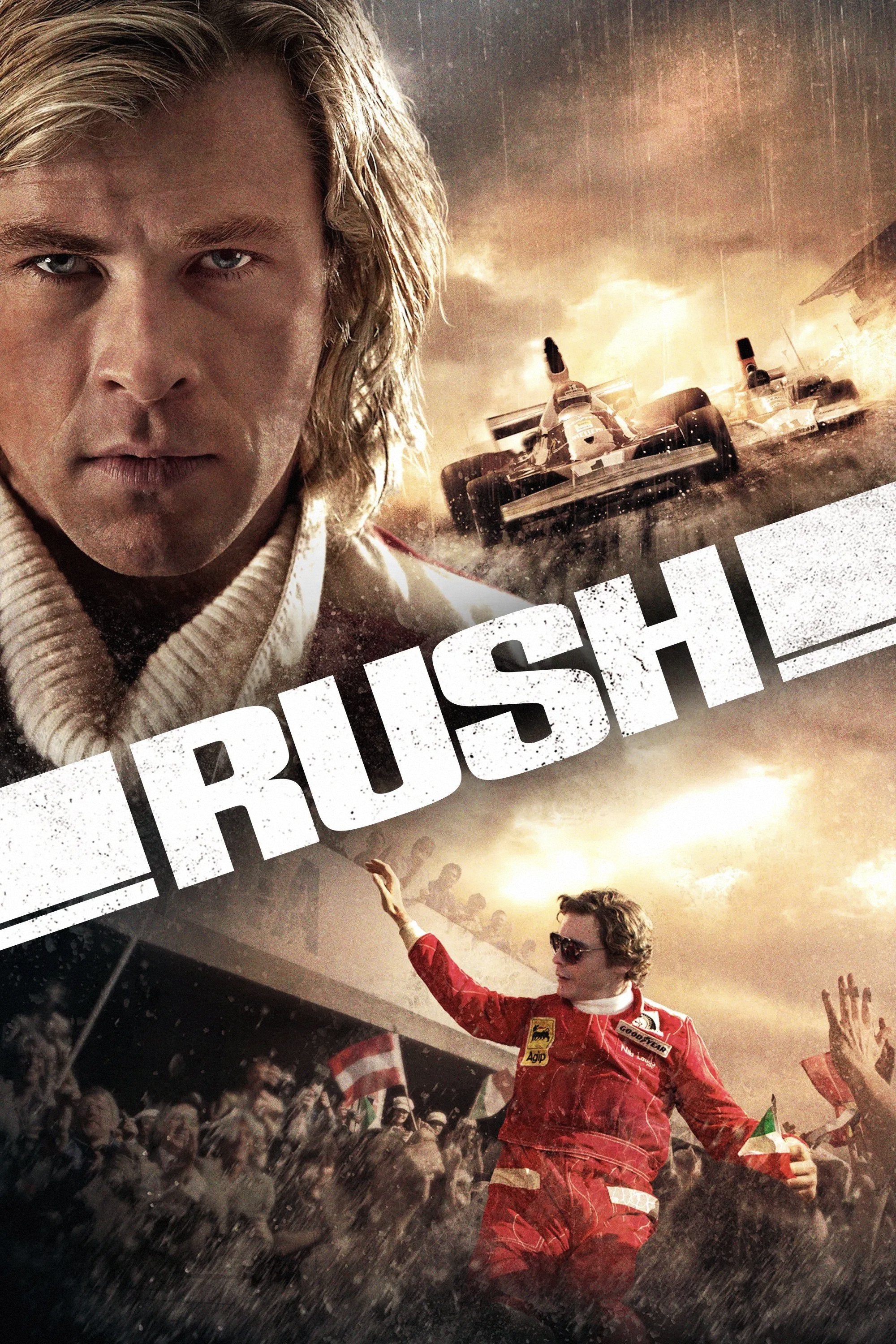

- UK release: September 2013
- Director: Ron Howard · Writer: Peter Morgan
- Studio / distributor: Working Title; StudioCanal
- Genre: Biographical sports drama / racing rivalry · Runtime: 123 minutes (BBFC 15)
- Main cast: Chris Hemsworth (Thor) as James Hunt; Daniel Brühl (Good Bye, Lenin!, Inglourious Basterds) as Niki Lauda; Olivia Wilde (Tron: Legacy) as Suzy Miller; Alexandra Maria Lara (Downfall) as Marlene Lauda
- IMDb: 8.1 / 10 · Rotten Tomatoes: 88% critics / 88% audience · My rating: 8.5 / 10
Ron Howard has spent a career making the kind of polished, grown-up crowd-pleaser that wins prizes without frightening anyone, from Apollo 13 to A Beautiful Mind to Frost/Nixon. Rush is a slightly different animal. It still has the gloss and the careful structure, but it has a meanness and a speed his films usually lack, and the reason is the second time he has worked with the writer Peter Morgan. Morgan builds his stories out of two people who cannot stand each other circling the same prize, and the 1976 Formula One season gives him the best pairing he has had since Frost/Nixon: two drivers who agreed on almost nothing except that the other man was the obstacle.
The setup
The year is 1976, and the championship comes down to two men who could not be less alike. James Hunt (Chris Hemsworth) is an English playboy who drives on instinct and appetite, drinks, beds, and risks his way through a season as though the points table were a side effect of having fun. Niki Lauda (Daniel Brühl) is an Austrian who treats the sport as an engineering problem, calculates every risk to the percentage, and has decided that Hunt is sloppy, lucky, and beatable. The film follows their rivalry from the lower formulae up to the title fight, through a near-fatal crash at the Nürburgring that should have ended one career and somehow does not. It keeps the historical shape of that season intact, so the stakes are real even if you already know roughly how it ends.
The cast
This is a two-hander, and it works because the two halves are properly matched. Hemsworth, still mostly known for swinging a hammer in Thor, turns out to have exactly the easy, dangerous charm Hunt needs; he makes recklessness look like a philosophy rather than a flaw, and he is smart enough never to ask you to admire it. The film belongs to Daniel Brühl, though. His Lauda is prickly, rude, and physically unglamorous, a man who tells people the truth they do not want and is usually right, and Brühl finds the wounded intelligence under the arrogance without ever softening him into a teddy bear. Olivia Wilde and Alexandra Maria Lara are given less, the wife and the girlfriend orbiting two men who are mostly married to their cars, but Lara in particular lands the quieter scenes around Lauda’s recovery.
The craft
Howard and his cinematographer Anthony Dod Mantle shoot the racing close and loud, all heat haze, vibrating bodywork, and rain coming off the tyres in sheets, rather than the clean helicopter sweeps you might expect. You feel the cars as machinery driven by frightened men, not as toys. Hans Zimmer’s score keeps the engine note throbbing under the drama without drowning it. The film is also unsentimental about the cost: the crash and its aftermath are filmed with a frankness that earns the 15 certificate and never lets you forget these men were one mistake from death every Sunday. At 123 minutes it never stalls, which is more than you can say for a lot of two-hour true stories.
How it stacks up
The obvious comparison is Senna, the documentary that proved a couple of years ago how gripping Formula One could be on a screen, and Rush is the dramatised cousin to it: less raw, more shaped, but covering the same emotional territory of obsession and mortality. Against Howard’s own back catalogue it sits closest to Frost/Nixon, another Morgan script about two men using a public contest to settle a private argument. And it belongs to the small, reliable club of sports films that work for people who do not follow the sport, because the racing is the setting and the rivalry is the story. You do not need to know a chicane from a chicken to feel the pull of it.
Critics versus the rest of us
Critics have come out warmly, sitting around 88%, with most of the praise going to Brühl and to Howard’s pacing, and audiences are matching them at 88%, which is a rarer alignment than it sounds for a film about a sport with a niche following in much of the world. The mild reservation in some reviews is that it tidies the history and flatters the rivalry into a cleaner duel than it really was. That is true, and I do not much mind. The film is honest about what it is doing, and the shaping serves a real point about temperament and risk rather than just smoothing the edges for the multiplex.
Verdict
I had a very good time with this. It hits most of what I want from a film of this kind: it is fast, it is funny in the right places, it has two performances worth the ticket, and it is the sort of thing I would happily put on again on a wet afternoon. It loses a fraction for the supporting characters being thinner than the leads and for occasionally telling you what to feel about Hunt and Lauda when the actors have already shown you. But it is a sharper, leaner film than Howard’s reputation would lead you to expect, and one of the most entertaining true stories to reach the screen in a while. 8.5⁄10.
Availability: On general release in UK cinemas now, and worth the big screen for the racing and the sound.
Update
Added since this review first appeared: Daniel Brühl’s performance went on to a BAFTA nomination and helped launch him into wider Hollywood work, and Rush has settled in as one of the most respected racing films of its era, the obvious reference point whenever a new one comes along. For the genre, the bar moved again a few years later with Ford v Ferrari (2019), another handsome, star-led true story built on a rivalry, which makes a natural double bill with this. Rush is now widely available on disc and digital and turns up regularly on streaming services depending on region.
BBFC content advice
Rated 15 by the BBFC for strong language, sex and bloody injury detail. The notes below may contain spoilers.
Language: The film contains frequent strong language (‘fk’), as well as a single non-aggressive and disguised use of very strong language (‘ct’).
Sex: There are two sex scenes, one of which takes place in the toilet of a plane. Although neither scene contains graphic detail, they do provide an impression of sexual mechanics and show some brief nudity, which gives them a strong tone.
Injury detail: The film contains images of bloody injuries in the context of motor racing accidents, some of which resulted in the deaths of drivers. These include sight of a driver’s shattered leg and the severe burn injuries suffered by Lauda in a crash during the 1976 German Grand Prix.
Additional issues: References to drug use, alcohol consumption, smoking, and tobacco company logos appear as contextual elements of the historical period depicted.
Source: British Board of Film Classification (bbfc.co.uk).